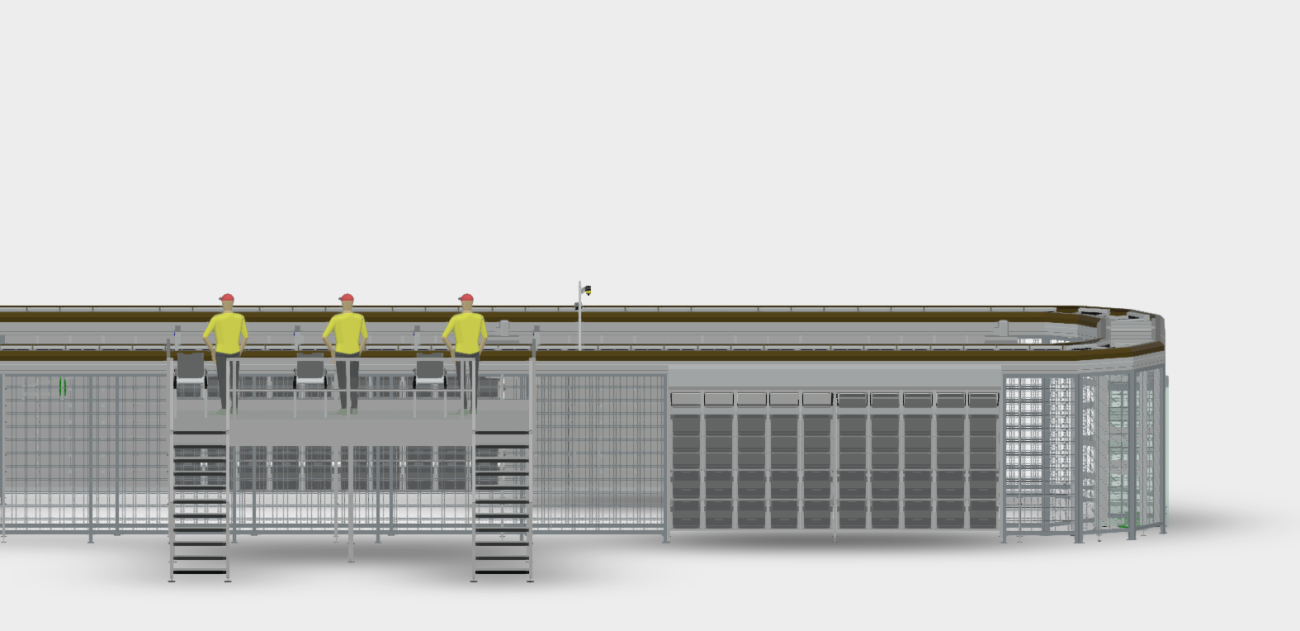
High-throughput sortation on a small footprint has never been possible – until now. Paul Hamblin spoke to EuroSort’s Gerbrand van Schooneveld about the company’s game-changing E-Sort, which will launch at LogiMAT in March.
Like most automation, sortation technology has always been about speed, efficiency and accuracy, enabling larger volumes to be processed cost-effectively to meet demanding customer needs.
Amsterdam-based EuroSort will this year celebrate 25 years of achievement in the arena. Its portfolio of Push Tray, Split Tray, Cross Tray and Push Bar sorters is established at over 500 global sites, and the company boasts a large North American presence and an office in Spain to add to its Dutch core, staffed by over 200 employees. Meanwhile, EuroSort’s in-house integrator DistriSort supplies solutions to end customers while EuroSort itself supplies many of the big European integrators.
EuroSort Technical Strategic Sales Manager Gerbrand van Schooneveld has a dual role, overseeing the Poland and Baltics region in addition to supporting the company’s other sales managers with technical aspects of the sales process. The duality assists the customer in making the right choices for their business and ensuring that the best EuroSort concepts to meet their needs are selected.
Quarter-century of delivery
“Our focus has always been consistent over 25 years,” he reflects. “It’s about high-throughput replenishment and sorting solutions to meet the customer’s needs as closely as possible.”
The dazzling growth of e-commerce has re-modelled the needs of logistics providers, motivating EuroSort engineers to seek innovative solutions to meet those needs.
“E-commerce sortation requires special handling because you are dealing with relatively small orders,” he explains. “To do this effectively, that means you need a large sorter with a high number of exits to enable cost-efficient wave picking – and in traditional sorting, if you have a lot of exits, you need a large footprint to accommodate those exits. So, our customers asked us to find ways to reduce that large and expensive footprint.”
To meet this need, EuroSort ingenuity first created the Chute Pitch Reducer, a simple yet effective idea which enabled narrower chutes thanks to the addition of doors which helped to control items at exit routes and ensure they were not mis-sorted. It reduced the width of the chute for push trays and cross tray sorters by 30%.
“But we wanted to create more exits on a smaller footprint, and still provide that vital increased throughput,” Gerbrand (pictured, below) continues.
LogiMAT launch
The result will be unveiled at LogiMAT at the end of March 2026. Called E-Sort, the company says it can increase the number of exits in a system by 70%, with the double wins of increasing throughput and a much-reduced footprint.
It achieves these aims by combining a put wall with a loop sorter.
“What we have now done is to connect a high-throughput loop sorter to a Smart Wall concept,” he explains. “And the number of exits can be multiplied within a small footprint – for example, on a 3m space we can create almost 100 exits.”
Crucially, the E-Sort concept is modular, which makes it both scalable and cost-effective. Versatility is built in, with the number of exits configurable to the customer. It’s for this reason that the product is squarely aimed at entry-level and medium-sized e-commerce customers as well as the traditional larger players. “We see a lot of growth for E-Sort with customers using semi-automated or fully manual put walls,” he reveals.
The modularity enables each system to be assimilated appropriately with the sortation process preferred by the customer.
“The customer might have a wide range of SKUs, from very small to much larger, and those bigger items would need correspondingly bigger pockets in the put wall,” he points out. “We therefore create the put wall based on those demands. For instance, a half-metre wall might accommodate eight exits, but one requiring larger parcels or items might reduce to four or five larger pockets.”
Another key deliverable for E-Sort is omnichannel suitability.
“The great thing is that we can combine the E-Sort with a conventional sorter for bricks-and-mortar store replenishment so that you can execute both e-commerce, shop replenishment and returns on the same machine. This is the first solution on the market that allows e‑commerce, store replenishment and returns to run on the same machine.”
Retail and e-commerce differences
As a sortation expert how would he describe the differences between e-commerce and ‘standard’ retail sorting procedures?
“There are two main areas to consider,” he replies. “The first is order size. With shop replenishment, you might be looking at 40 to 50 items per order, a big picking wave in a single order, and a fairly efficient process. With e-commerce you are likely to be looking at much smaller orders, perhaps one to five items for a single customer, all needing to be packaged and labelled.
“Then you will have different packaging and labelling needs to suit each order. So the sortation solution needs to provide for that. The E-Sort provides two ways of doing this: the first by packing directly at the sorter exit, with a packing table and packing materials adjacent to it. The second is via a mobile put wall, mounted on a trolley or a cart, kept away from the packing area and moved there when it is full. Different customers have different preferences – it’s their call on how they want to do it and we’re ready for both.”
The specifications of the E-Sort make it appropriate for both established large-scale needs as well as those of entry-level customers. Weight limit is 5kg, dimensions are 400mm x 600mm x 250mm.
Given the versatility, how does he work with a new customer to determine the right concept for them?
“I’d say to you, give me current figures, what’s your throughput, how many orders are you looking to process per day, how many operators do you need for your picking? If I know your annual volumes and the number of operators you have, I can explore ways for you to save costs on your picking, and move many more items, all in a small footprint.”
As well as the modularity and component standardisation of the technology, he also highlights its ease of use. “It is simple technology, made for easy and quick maintenance. Reliability and maintenance costs are very low, and almost everything can be done on site by the customer.”
To provide the best experiences, we use technologies like cookies to store and/or access device information. Consenting to these technologies will allow us to process data such as browsing behavior or unique IDs on this site. Not consenting or withdrawing consent, may adversely affect certain features and functions.
Functional
Always active
The technical storage or access is strictly necessary for the legitimate purpose of enabling the use of a specific service explicitly requested by the subscriber or user, or for the sole purpose of carrying out the transmission of a communication over an electronic communications network.
Preferences
The technical storage or access is necessary for the legitimate purpose of storing preferences that are not requested by the subscriber or user.
Statistics
The technical storage or access that is used exclusively for statistical purposes.The technical storage or access that is used exclusively for anonymous statistical purposes. Without a subpoena, voluntary compliance on the part of your Internet Service Provider, or additional records from a third party, information stored or retrieved for this purpose alone cannot usually be used to identify you.
Marketing
The technical storage or access is required to create user profiles to send advertising, or to track the user on a website or across several websites for similar marketing purposes.