Peter MacLeod attended Jungheinrich’s launch event in Hamburg last week to witness not just five new electric forklift truck developments, but to hear of a clear articulation in the company’s long-term portfolio strategy, which spans from simpler entry-level products to high-voltage heavy-duty alternatives in areas traditionally dominated by ICE trucks.
At one end sits the newly introduced purple-coloured ‘AntOn by Jungheinrich’ brand, designed to address a segment Jungheinrich had not previously targeted with its traditional yellow trucks.
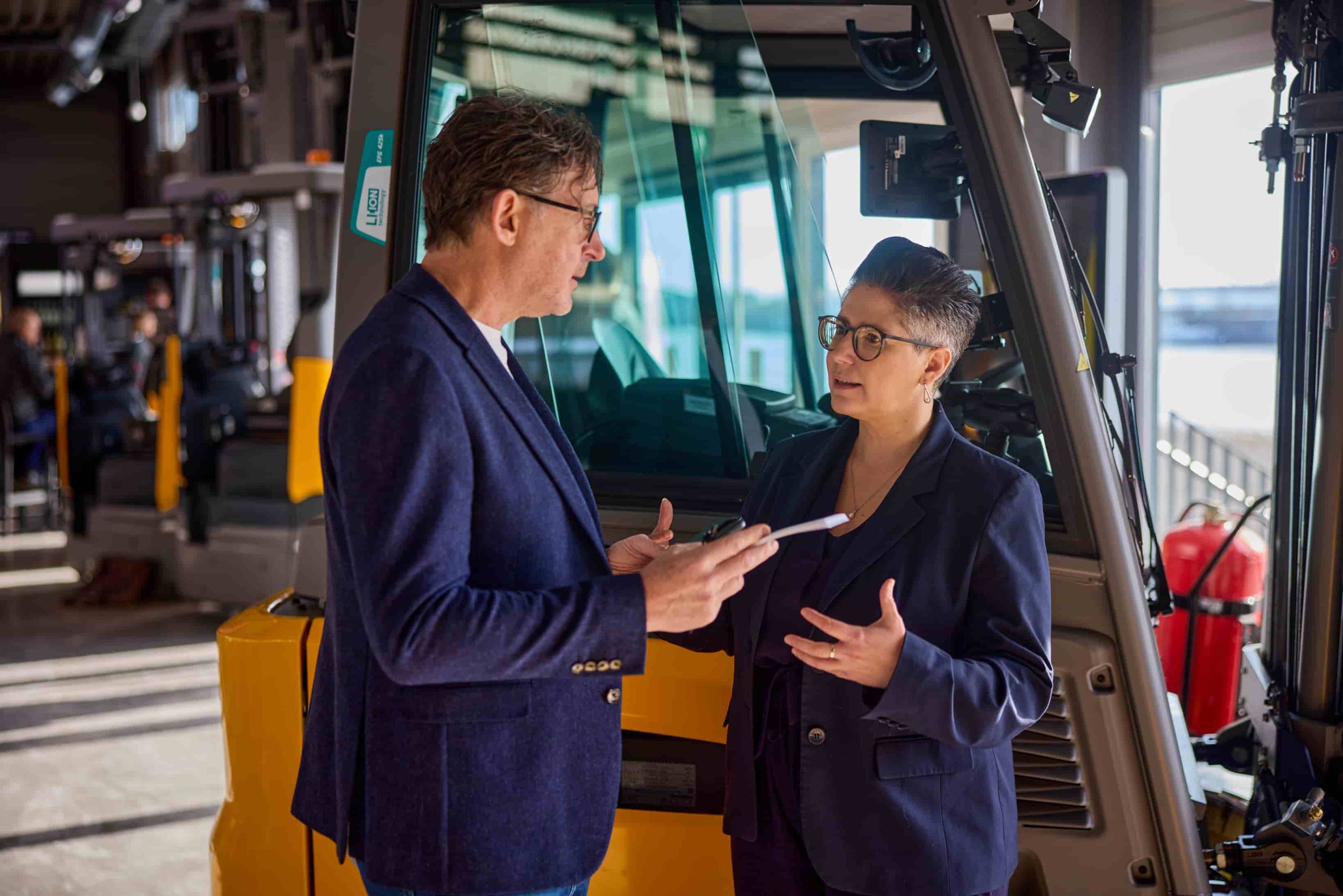
“Typically, these are small to mid-sized customers,” explained Nadine Despineux (pictured with Peter, above), Member of the Board of Management at Jungheinrich, speaking exclusively to Logistics Business at the event. “They buy two, three, four, five units. They don’t have 24/7 high-performance applications. It’s important for them to have a truck available when they need it, but they don’t use it all the time.”
AntOn’s trucks are manufactured in China by electric specialists EP Equipment. Unlike Jungheinrich’s highly configurable core range, AntOn trucks are standardised and built to stock, making them well suited to distribution partners and e-commerce channels. “When you need consultancy and tailored configuration, you typically go through direct sales,” Despineux said. “Jungheinrich is predominantly direct. AntOn is predominantly partner and distribution business.”

Quality control, she stressed, remains non-negotiable. An OEM centre in Shanghai oversees supplier management and compliance, while vehicles are tested again in Germany. “Trust is super relevant. Safety is super relevant,” she said. “If customers cannot build on that trust, there is no reason they would ever move from AntOn to a yellow truck.”
That yellow portfolio is now undergoing one of its most comprehensive electric renewals in years. The redesigned 1i pallet and double-deck truck series focuses on compactness, lithium-ion scalability and integrated safety features, with vehicle fronts shortened by up to 152 mm for improved manoeuvrability in tight warehouse environments.
In the 48-volt counterbalance segment up to 2.0 tonnes, the fully redesigned EFG 2/2i and 3/3i models deliver up to 15% improved space efficiency through reduced turning radii and compact design, alongside enhanced ergonomics and AI-supported assistance systems.
For heavier applications, the new EFG 5 series provides up to 15% higher handling performance via a two-motor drive system and SRM+ lift motor, positioning it as a fully electric alternative to diesel trucks in the 4.0–5.0 tonne class.
High-bay productivity is addressed with the ET
V 4i reach truck, offering what Jungheinrich describes as market-leading lifting and lowering speeds and fully integrated lithium-ion technology to minimise downtime in multi-shift operations.
Looking further ahead, the dramatic (and currently unpainted) new FalcOn prototype showcases high-voltage architecture in a 5-tonne counterbalance truck capable of ultra-fast DC charging up to 150kW, underlining Jungheinrich’s ambition to electrify even the most demanding heavy-duty segments. This truck has been introduced to offer the performance of a diesel equivalent, but with a much cleaner environmental profile.

Despineux positioned the combined portfolio as a strategic continuum rather than separate product silos. Customers today, she noted, sit at different stages of operational maturity. “They are on this tipping point: when does it make sense to invest into automation? What is the right solution? They are searching for partners who can help them on that journey.”
That journey increasingly includes rental and refurbishment models designed to enhance flexibility and reduce carbon impact. “Many customers prefer OPEX over CAPEX,” she said. “Optimising a complete fleet is a huge leverage.” Refurbishment and reintroduction into the market “closes the cycle of sustainability”.
From entry-level purple to high-voltage yellow, Jungheinrich’s message is clear: whatever stage customers are at, be it manual, mid-tech or fully automated, the company intends to offer a solution.
“As a company, if you have the opportunity to say yes, there is a solution that is powerful,” Despineux concluded. “Having somebody you can trust is super relevant.”
