
Among the most followed faces of the Milan-Cortina 2026 Winter Olympics is undoubtedly Jutta Leerdam. Dutch speed skating champion and pure talent on short and medium-short distances, Leerdam has already wongold in the 1,000 meters and a silver medal in the 500 meters, an explosive race where every penny can make a difference.
What sets her apart, in addition to her athletic achievements, is her public image: very strong presence on social media, modern visual language, and a narrative that goes far beyond the ice. Her career perfectly represents the new generation of female athletes capable of combining top-level competitive performance and global personal branding.
His media profile is also intertwined with that of his partner, Jake Paul, a youtuber entrepreneur and boxer known for turning personal communication into a viral phenomenon of spectacular events, provocations, and high-impact storytelling.
When Jutta Leerdam landed in Venice to participate in the Milan – Cortina 2026 Olympics aboard a private jet, the news quickly overtook the sports plane. The trip – along the Amsterdam-Schiphol route – Venice Marco Polo – has been transformed from a simple logistical move to a topic of debate and a ground for confrontation between sports, public image and social values.
Jutta: to the Olympics by private jet
In itself, transferring by private jet is as good a logistical solution as any. In the Olympic context, however, it inevitably takes on symbolic value. The moment images of the flight and arrival are shared on a profile followed by millions, such as Jutta ‘s, the journey is no longer just a displacement: it becomes an integral part of the athlete’s public narrative.
Moving by private jet is not just a matter of luxury. For an elite athlete like Jutta Leerdam, it is a strategic and professional choice to reduce travel stress and optimize time. However, in Jutta‘s case, the strength of the media persona-amplified in part by her relationship with Jake Paul-has meant that the focus is on travel rather than challenges on the track.
Where the controversy involving the Olympic skating champion stems from.
Reactions focused mainly on a few points:
- Perception of poor adherence to team spirit
- environmental impact of private flight
- social exposure of the experience
- Association with a public image perceived as provocative
Interestingly, the discussion quickly shifted from sports performance, to lifestyle narrative.

Jutta’s private jet: luxury or super professionalism?
In the modern sports world, performance and energy management are central.
A private flight allows:
- total control of departure time
- Simplify complex airport procedures
- configure the aircraft cabin To minimize travel fatigue and stress
- greater privacy confidentiality
- ideal environment for recovery and mental preparation
Of course, private jet travel is not a solution designed for mass tourism, nor could it be. Private aviation is a niche service designed for specific business, safety, and even sports performance needs.
Sports, branding and public perception
The case of Olympic champion Jutta Leerdam highlights a broader phenomenon: in contemporary sports, the athlete is no longer just a performer, but a brand.
Every choice-from the business partner to the means of transportation-contributes to the construction of public identity.
In this context, the private jet becomes part of an interweaving narrative:
- sporting excellence
- personal branding
- lifestyle
- digital communication
Whether it is a conscious strategy or simply a consequence of one’s status, the story shows how today even a move to a competition can turn into a global debate.
But while the Web discusses lifestyle, a medal is being decided on the ice against some of the fastest athletes on the planet. And that’s where, in the end, it’s all measured.
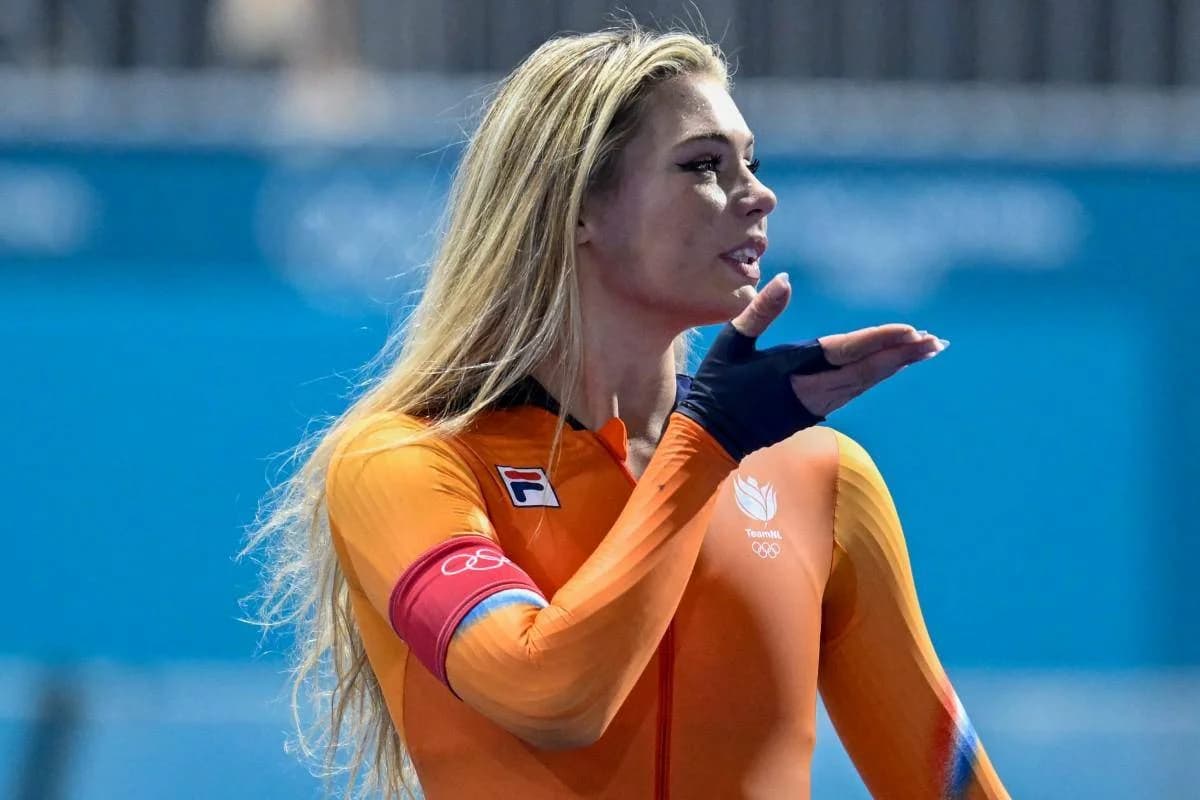
The sporty side of Jutta Leerdam: gold medals in the 1,000 meters and silver in the 500
Beyond the media controversy, Jutta Leerdam remains first and foremost one of the most solid and spectacular performers in modern speed skating.
A specialist in short and medium-short distances, he has built his career mainly in the 1,000 meters, a race in which he has shown his ability to handle power and progression to the fullest. At the Milan-Cortina Games he confirmed his status in his preferred distance, establishing himself as a technical and athletic reference.
She did not disappoint in the 500 meters either, where she won the silver medal after an even more explosive and unpredictable event, where margins and times are decided by hundredths of a second. And it is there, on the ice, that the media narrative gives way to the reality of the sport: Chronometer, technique, power. Everything else stays off the track.
