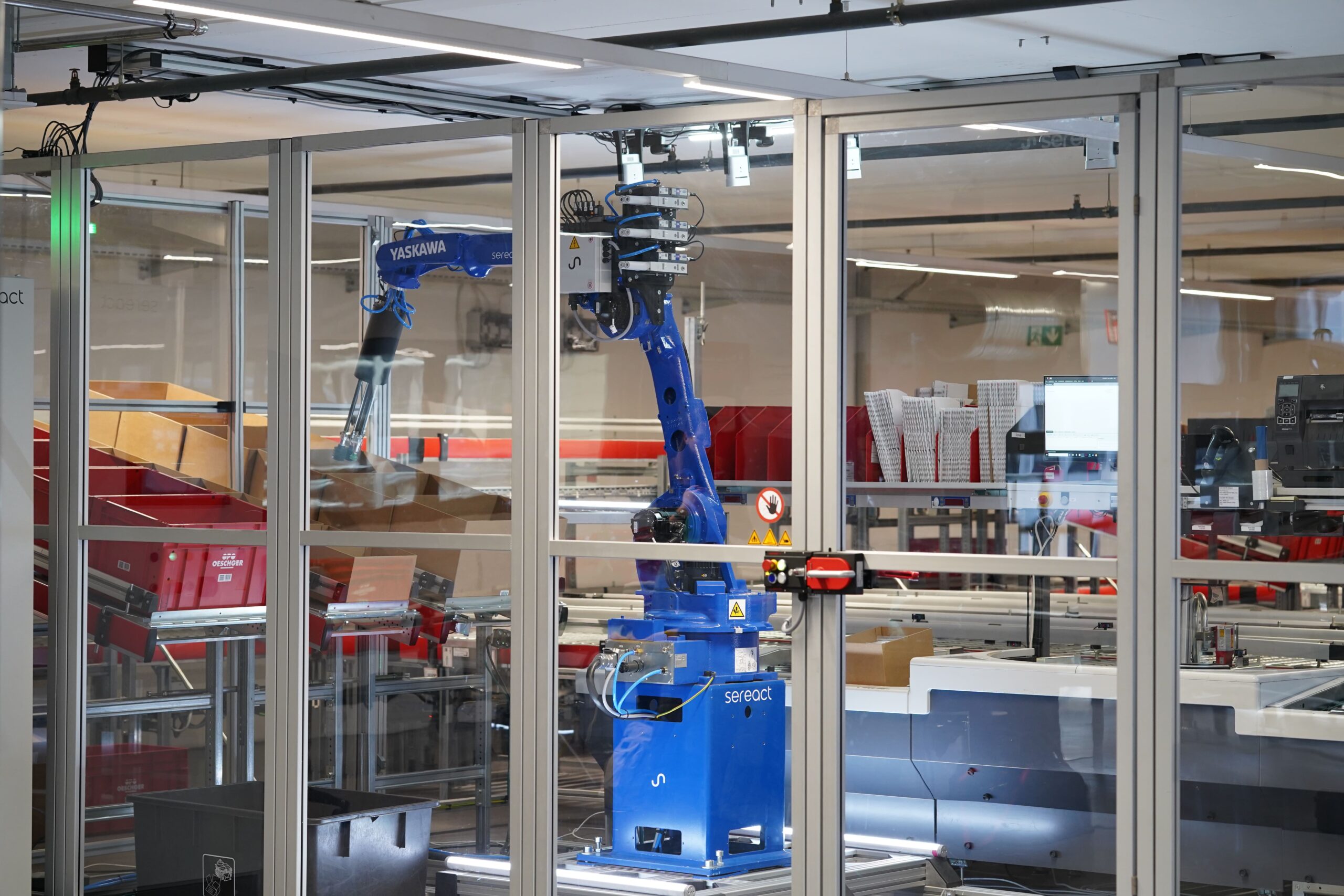
A tightly scheduled picking process, an automated shuttle warehouse, and in the middle of it all, a manual step that slows everything down. OPO Oeschger was looking for a solution that would fit into existing structures without changing them. Sereact impressed with a robot-based solution that uses artificial intelligence and works immediately. The robotics integrate seamlessly into existing processes and ensure a noticeable increase in efficiency.
OPO Oeschger is a Swiss family-owned company headquartered in Kloten, founded in 1926 and now employing around 300 people. With a range of more than 70,000 items, OPO Oeschger is one of the leading suppliers of fittings and components for carpenters, wood, glass, and metal construction, as well as for schools and resellers. In addition to furniture and kitchen fittings, the range also includes door and building fittings, machines, and tools. In its logistics, OPO Oeschger consistently relies on highly automated processes to deliver not only quickly but also reliably. Order picking is also being specifically developed with new technologies to meet increasing demands.
When standard solutions don’t help
Many processes in logistics at OPO Oeschger are already automated. Nevertheless, the goal was to identify new potential. There was a particular need for action in the area of order picking. Although an automated small parts warehouse was in place, items were still being picked manually. Since the warehouse building offers only limited space and the processes are precisely coordinated with the conveyor technology, the new solution had to be implementable without major interventions.
Adjustments to the conveyor technology or upstream control processes were out of the question. The solution had to integrate seamlessly into an existing workplace without imposing new processes. This is precisely where other providers who offered only standardized systems failed. OPO Oeschger, on the other hand, was specifically looking for a solution that would fit into the existing system and could realistically replicate the behavior of a human picker.

The robot picks what fits
Sereact impressed OPO Oeschger with its willingness to consistently adapt to the existing framework conditions. “The Sereact team came to our site, took a close look at our processes, and very quickly understood how they work,” explains Daniel Schütz, Operations Manager Logistics at OPO Oeschger.
“While other providers proposed standard solutions, we were able to implement individual requirements together with Sereact.”
The picking robot was integrated into an existing picking workstation. Instead of adapting the environment, the robot was designed to perform the tasks of a human employee as realistically as possible: it picks up target cartons and places them in two target locations. If requested to pick up a destination container, the robot first removes the anti-slip mat from the container. The robot then removes items from a source container and places them in the prepared destination carton or container. These are then sent on to the conveyor system for further processing.
A prerequisite for commissioning was a targeted adaptation of the interface in the warehouse management system, which was implemented without any problems in cooperation with TGW Logistics. This meant that only orders suitable for automated picking could be forwarded to the robot. The selection of suitable items is carried out directly by OPO in the item master. The actual picking and placement logic — i.e., the decision on how to place and stack items in the box—is entirely controlled by Sereact’s AI-supported control system. No product training was necessary. The AI solution takes care of product recognition, selection, and picking independently. The precision of the solution is particularly evident with items for which the cardboard packaging has been calculated exactly. Targeted preselection is crucial for the stability of the process.
An employee who doesn’t need a break
With the use of the picking robot, OPO Oeschger has taken an important step toward future-oriented logistics processes. The robot reliably performs standardized picking tasks that were previously covered by manual labour, thus creating a noticeable reduction in the daily workload. It works stably and reliably, especially with items that meet clearly defined criteria. Technically, the robot would be capable of significantly higher performance. At OPO, however, the speed was deliberately throttled in order not to overload the existing structural structure. In its current configuration, its performance is roughly equivalent to that of half a full-time employee. This deliberate limitation is part of a strategic approach.
OPO is using the project to learn specifically how AI-based robotics can be integrated into existing processes and what conditions need to be created for later scaling. At the same time, the expertise of the employees remains central: they now focus more on complex picking processes that involve handling flexible or sensitive products, for example. The combination of robot-assisted automation and human experience increases overall efficiency and process quality. Items that are not suitable for the robot are specifically excluded in the warehouse management system. For OPO Oeschger, the use of this technology was not a measure to reduce staff. Rather, the focus is on gaining knowledge. The aim is to further develop the system in a targeted manner and make it scalable.

What works today will continue to grow tomorrow
The experience gained from the project forms the basis for future automation projects at OPO Oeschger. The company is already working with Sereact and TGW Logistics to further develop the interface logic. The aim is to control even more precisely which items the robot can handle in the future, even for more complex orders with mixed items. In the medium term, the picking robot will interact intelligently with manual workstations and automate where it makes economic and procedural sense.
“We deliberately viewed the project as an investment in know-how,” explains Schütz. “We also wanted to learn at an early stage how picking robots can be meaningfully integrated into our processes, with a view to today’s operations and future logistics strategies.”
The aim is also to increase the utilization of the existing robot. The use of additional units is also planned for the future. Based on the knowledge gained, a scalable solution is to be developed that fits seamlessly into future infrastructures and consistently exploits the potential for automation. With the knowledge gained, OPO Oeschger and Sereact are working together to further optimize logistics processes in order to reap the full benefits of automation in the long term.
