Peter MacLeod spoke to Ocado’s Andy Ingram-Tedd to hear how cutting-edge live digital twins remove the guesswork from warehouse operations.
Ocado Intelligent Automation (OIA) has never been shy about scale. But in my conversation with Andy Ingram-Tedd, VP of Advanced Technology, he makes the point that scale is not the story. The story is what you do with it. After nearly 25 years at Ocado, he has watched the company grow from a tight early team to a global organisation with thousands of people, and he is still struck by the same internal energy that drove the first deliveries.
“It just never slows down,” he says. “There’s always something happening, there’s always some new adventure, there’s always some new mission.”
That tempo matters because it shapes how OIA, the Ocado Group division that takes its technology to customers worldwide, thinks about automation deployment. Ingram-Tedd is candid about a familiar misconception: that robotics is simply the substitution of people with machines. His view is that a more accurate way to see it is as systems design, and the interplay between humans, software and hardware.
“A lot of people always ask me, you’re developing robots, you’re putting people out of business,” he says. “But we’ve got more people that we employ today than we ever had. We are doing more, and we’re becoming more efficient.”
Simulation, he adds, is the discipline that forces you to treat that interaction seriously.
Simulation vs. Digital Twins
If there is one thread Ingram-Tedd wants readers to take away, it is the distinction between simulation and digital twins, and why the two are often muddled. Simulation, in his definition, is a predictive model used before something exists in the physical world. A digital twin only becomes a digital twin once the warehouse is built and operating, because it is continuously aligned to reality using actual operational data.

Simulation is what you reach for when spreadsheets fail. Basic processes can be approximated with time and motion assumptions. But once you seek high throughput and high utilisation across many moving parts, you need discrete event simulation, modelling countless activities with start points, end points, process times and rules.
“We really do mean a discrete event simulation,” he says. “There are lots of things happening. They have a start point, they have an end point. You can’t just calculate that on a spreadsheet.”
Ocado’s own definitions are straightforward. Simulation is used before a system is built. You load assumptions, including orders, stock, layout, speeds and rules, then you run what-if scenarios to see outcomes and risks. The questions are practical: will this design work, what size should it be, where are the weak points. A digital twin, by contrast, is a digital representation of a real physical system that stays aligned to the live operation using operational data. Its value is decision support during operation, including testing changes safely and understanding what happens if you change something today or tomorrow.
Removing Guess-Work
Ingram-Tedd emphasises that simulation should not be about your best day. It should be about your worst day. That might mean modelling downtime, late inbound vehicles, or labour gaps, either individually or in combination. “We are operators of our own equipment,” he tells me. “We are not guessing. We know what the bad things can happen. They’ve happened to us in the last 25 years!”
Once a site is live, the inputs are no longer assumptions. They are measurements. You can take data from the real warehouse, feed it into the model, and test configuration changes, from item placement strategies to outload timing, pick speeds and resource utilisation. The goal is continuous improvement, driven by evidence rather than instinct.

I ask why does OIA build its own simulation tools. Ingram-Tedd argues that third-party packages are useful, but insufficient for modelling the complexity of Ocado’s grid-based system, where software determines where and when to store, retrieve and sequence stock, while bots navigate above dense storage. “We don’t use a third party and there’s a really important reason for that,” he says. “There isn’t an off-the-shelf simulation package that can do that.”
Ocado has developed its own simulation capability in-house since 2008. A key point, in his telling, is that the software powering simulation is identical to the software that powers the production site. That tighter link between model and reality, he says, supports better design decisions and more confidence before capital is committed.
Just as importantly, simulation is end to end. It does not stop at bot movement. It extends to conveyors, pallets, vehicles, people and robotic pick, because optimisation only makes sense at the level of the whole ecosystem.
“True optimisation only happens when you put all the subsystems and you model them all together,” he says. “Integration brings complexity, and simulation helps you understand the knock-on effect of every design choice.”
Infrastructural Optimisation
The practical value is that simulation turns design questions into testable scenarios. One slide example is the relationship between bot numbers and achievable throughput. Run a range of cases in parallel and you can plot where diminishing returns begin, identifying a sweet spot beyond which additional investment yields little benefit.
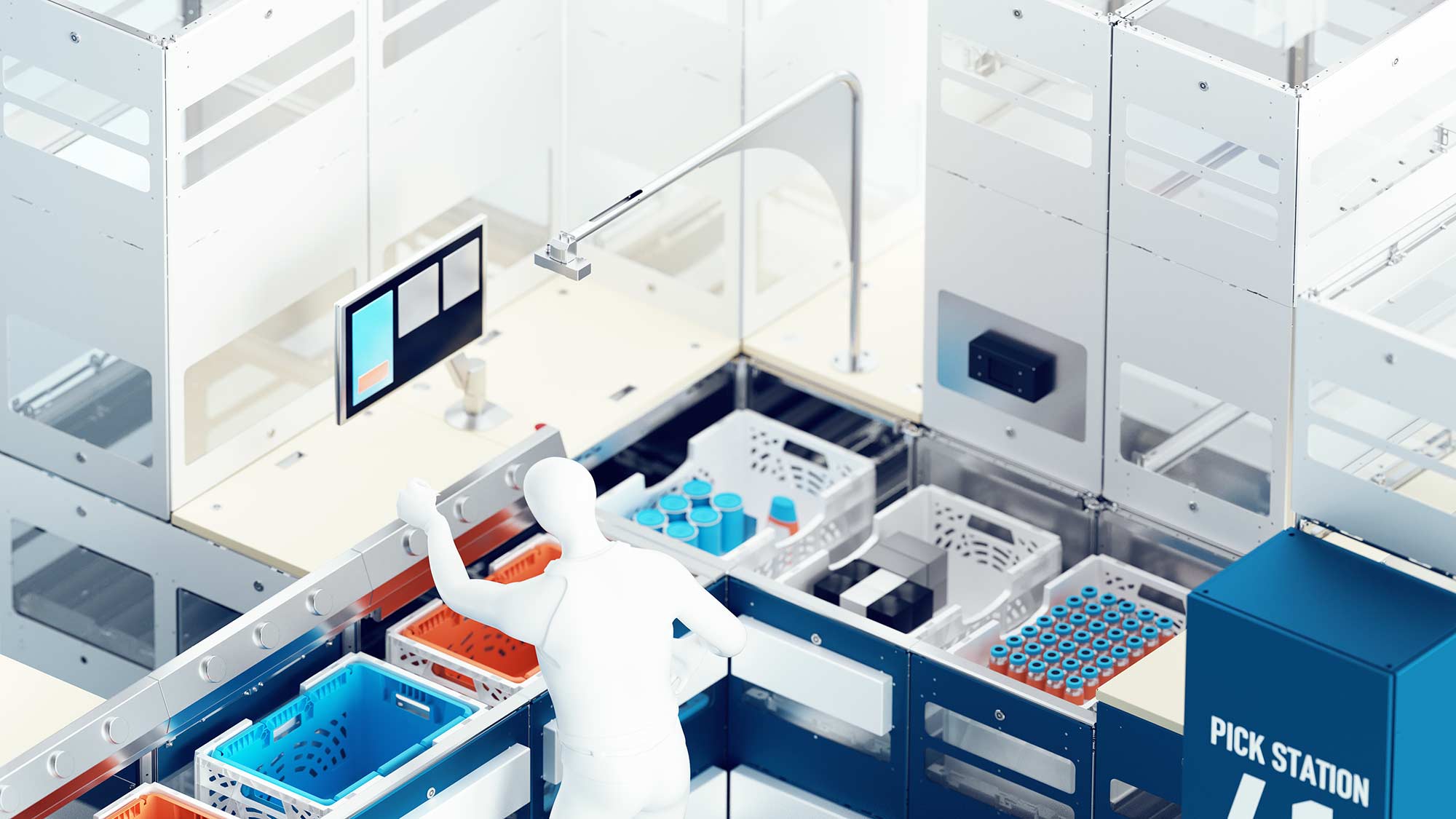
That same approach applies to pick stations. OIA’s stations are modular, and simulation can explore how layout changes affect both throughput and the way an operator performs. The aim is to avoid paying for human time while allowing the station to underfeed the operator with work.
In one demonstration clip discussed in the interview, Ingram-Tedd references a picking performance figure that he knows will sound implausible to many readers: 1,072 units per hour on a station. He is quick to caveat that it is not a sustained operating promise. Building a system around peak human performance risks waste if people cannot maintain it, and drives unnecessary investment in upstream resources. A more sensible operating target might be 600 to 700 units per hour, he suggests, still well beyond common industry expectations.
What often breaks automation is not the average case, but the exception: odd products, awkward presentations, or rare failure modes that still occur frequently at high volume. In robotics and automation engineering these are known as corner cases, unusual or extreme situations outside normal operating conditions that must still be handled safely and reliably. “You can’t have robots like this in a live site unless they can do corner cases,” believes Ingram-Tedd.
Future Looks Bright
Beyond grocery, OIA is applying its platform to other verticals. Ingram-Tedd highlights a major project with McKesson in Canada – not yet live at the time of the interview, but not far off – which he describes as a large system in Montreal designed to raise productivity while improving traceability, accountability and security. He argues that pharma distribution shares many traits with grocery, but with stricter compliance requirements, particularly around batch and lot traceability. He hints at significant productivity gains, while noting there are customer-specific adaptations that remain confidential.
He also brought to my attention that mutual exclusivity has ended in the majority of markets where Ocado operates its grocery technology with partners, opening the door for Ocado to bring its evolved product back to some of the world’s most developed e-commerce markets after a period of exclusivity agreements.
Towards the end of the interview, Ingram-Tedd briefly referenced a new picking technology planned for introduction in 2026, which he characterises as a significant step-change. Logistics Business was given an early look at the concept, but details remain under wraps ahead of public launch at MODEX in the Spring. We hope to return to this in a future edition, once OIA is ready to speak about it in full.
For now, his message is consistent. Whether the question is how many bots to deploy, how to design a pick station, or how to integrate the next wave of automation, the differentiator is not a single robot. It is the capability to model complex systems accurately, learn from real operations, and keep improving.
