Sierraline Cargo Services
  • HOME
  • Services
    • Trade With Us
  • About Us
  • Contact Us
  • private jet
    • BOOK YOUR JOURNEY
  • Track Packages
  • Insurance
  • safekeeping
Services

Hydrogen for HGV Heavies

by
written by


Heavy Goods Vehicles are well-suited to the use of hydrogen for carbon-free transport fleets and good progress is being made. Richard Shepherd-Barron reports for Logistics Business.

In recent years the emphasis on clean power has been very much concentrated on electric vehicles – especially in the light van and medium vehicle sectors. However, there are drawbacks, such as the reduction in load capacity with an increase in the unladen weight from the batteries and the reduction in operating mileage with the need to recharge. Truck makers across the world have been working on the development of hydrogen-powered vehicles and with a particular emphasis on larger trucks although it has been interesting to see that four makers of light commercial vehicles introduced new hydrogen-powered models at the recent IAA Transportation show in Hannover. This has provided a clear indication of the appeal of this technology.

All this activity has not gone unnoticed in EU circles and an additional €1.2 billion fund has just been announced by the European Commission to support the production of renewable fuels of non-biological origin (RFNBO). At the same time, MAN Energy Solutions subsidiary company, electrolysis specialist Quest One, has opened a new ‘giga hub’ for the serial and automated production of electrolysis stacks in Hamburg. At full capacity this new factory is expected to produce stacks with a potential total electrolysis capacity of over five gigawatts per year. The UK is not lagging behind, with the Government announcing in October an £88 million finding boost for zero emission tech firms.

There are two ways to produce hydrogen. Firstly, by cracking fossil fuels – this is called ‘grey’ hydrogen because CO2 is always released when fossil fuels are processed. A second, and much cleaner way to create hydrogen is through electrolysis – when electricity generated from renewable sources is passed through water to create oxygen and hydrogen for a 100% carbon-free product. Used in vehicle engines, this produces only water as its emission.

There are two types of hydrogen-powered vehicle – one using hydrogen fuel-cells to generate electricity to drive electric propulsion and the other where hydrogen replaces diesel fuel in a conventional engine. Both systems require tanks for the hydrogen. The fuel-cell units are, of course, totally silent but the combustion engines have an advantage in hot climates and where power is needed over long periods.

Alternative Zero Emissions

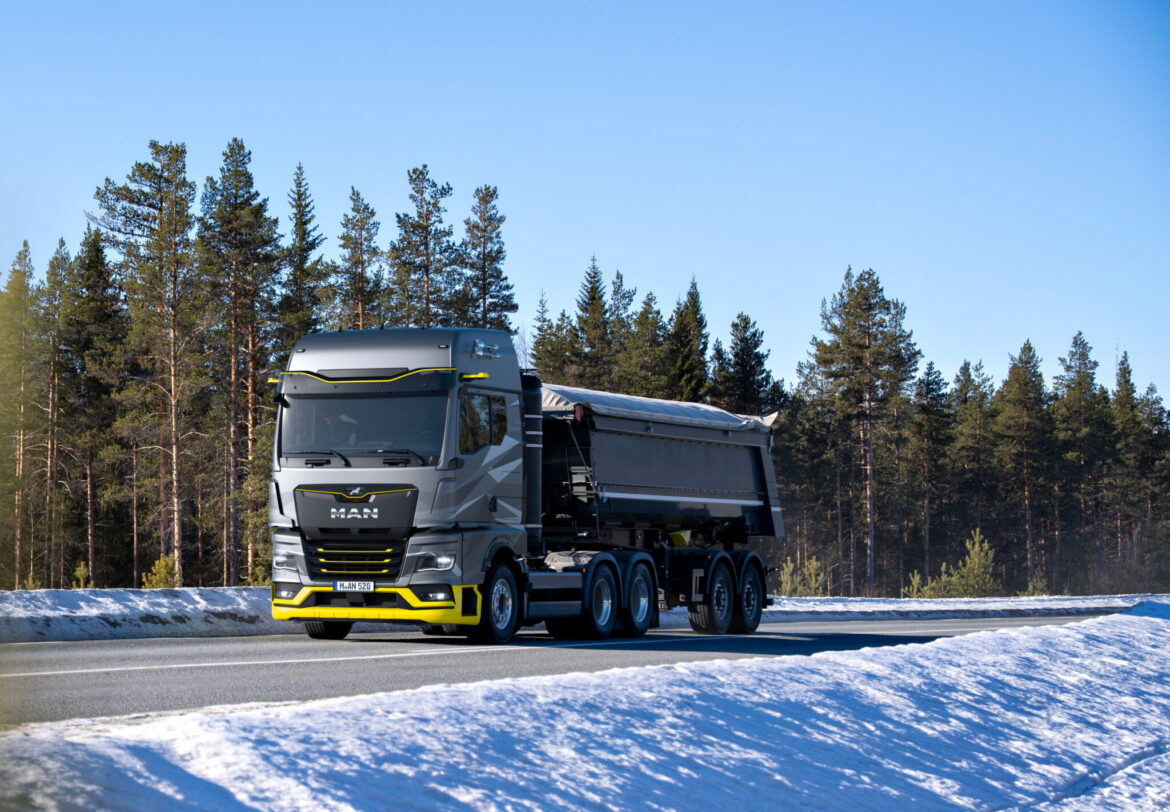
MAN have won the Truck Innovation Award 2025 for their hTGX hydrogen combustion truck (pictured) offering an alternative zero-emission solution. Delivery of the first 200 units starts next year to customers in Germany, the Netherlands, Norway, Iceland and selected non-European countries providing an alternative zero-emission solution. Using the proven H45 engine, it is available in 6×2 and 6×4 axle configurations, enabling a high payload and with maximum ranges of up to 600 kms.

Volvo are also working on hydrogen fuelled trucks, but Toyota have gone further by carrying out trials in Belgium with a new hydrogen fuel-cell powered delivery truck for Coca Cola. This trial is in conjunction with the i gases company, Air Liquide. This collaboration is designed to highlight the potential development of both vehicles and infrastructure to provide operators with zero-emission vehicles. Toyota are also testing this system in trucks used by their logistics providers on their daily routes in Belgium, France and the Netherlands. Mercedes-Benz have their GenH2 truck which has a range of more than 1,000 km, carrying the same payload as a conventional diesel vehicle.

In the UK, Hydrogen Vehicle systems (HVS) has signed a deal to deliver 30 of its hydrogen fuel cell electric tractor units to Worksop-based Explore Plant and Transport Solutions. The trucks will be supported by a service and maintenance plan, full training on the safe use of hydrogen and refuelling, along with hydrogen refuelling infrastructure that fully meets Explore’s operational needs. Vauxhall is beginning customer trials of hydrogen fuel cell vans, based on their current Vivaro Electric range.

Providing an alternative to battery-electric vehicles, particularly at the heavy end of operations, the future looks strong for hydrogen power.

similar news
First Hydrogen vans receive certification


Source link

0 comments
0 FacebookTwitterPinterestEmail
Services

Integrating Service Logistics to Meet Operational Demands

by
written by


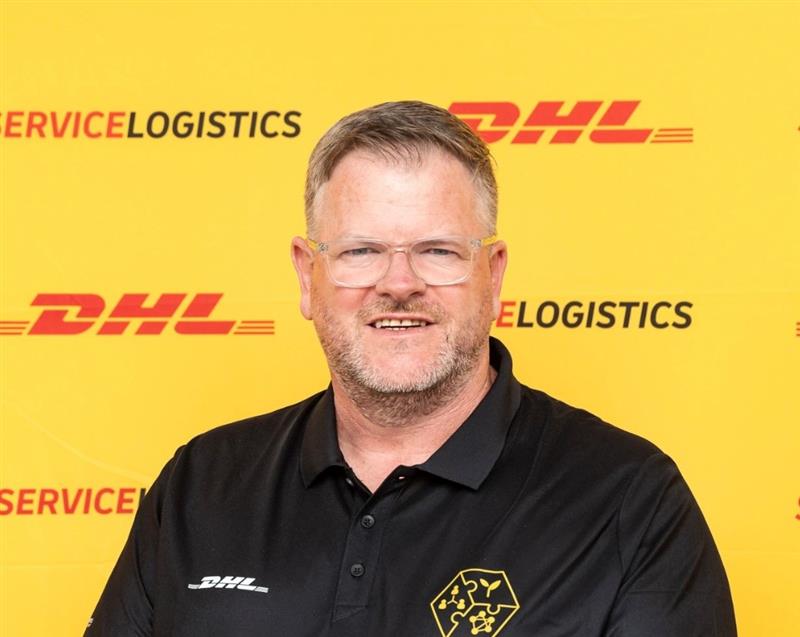
Operational demands can be better met by integrating service logistics, writes Scott Allison (pictured below), Chief Customer Officer, DHL Supply Chain.

Manufacturers have spent the last decade trying to find the balance between cost-effective inventory management and security of supply to ensure product availability and avoid downtime, poor customer service, or outages. But by integrating service logistics into a supply chain strategy, businesses can find the balance between the two, achieving a more cost-effective route to getting the right product, in the right place, at the right time.

The swinging pendulum

Maintaining optimum inventory levels has been one of the biggest challenges for almost every industry for the last four years, no one can afford the downtime or damage that can result from the absence of a critical component.

But in today’s economy, ‘availability at any cost’ isn’t a viable option. Holding inventory for every eventuality has become prohibitively expensive as real estate and labor costs escalate. An audit of one semiconductor company’s supply chain infrastructure revealed that 54% of its inventory, housed in high-cost markets Singapore and Silicon Valley, hadn’t moved in a year. Beyond the cost barrier, companies that hold too much inventory can also become less responsive to shifts in market demand or changing customer needs. Their ability to adjust their offerings becomes constrained by the large amounts of stock they need to sell or manage.

Scott Spain

Despite the need for surety of supply, when times are tough there’s a risk that businesses will revert back to ‘just in time’ supply chains that come with high risk. Service logistics sits at the centre of this challenge – an agile service part network ensures the right goods are close to where they need to be without the expensive overheads thanks to technology, access to a wide network, fulfillment expertise, and effective supply chain planning.

Going back to network design

To increase supply chain flexibility and meet critical operational demands, businesses will benefit from analyzing network flows and processes to create strategic and tailored supply chain designs.

As businesses grow, it’s common for supply chains to expand in a fragmented way, rather than as one ecosystem. By centralizing data and creating cross-functional processes, teams will be able to ensure they can work in alignment, improving operational efficiency and reducing bottlenecks. Improved access to data and digital tools will help to optimize the organizational structure, as well as improve a company’s understanding of its products and operational performance. This will allow organizations to map stock volumes and locations closer to the point of demand, improving fulfillment, repairs, and returns needs. In the wake of global disruption, network design is central to maintaining reliance and ensuring businesses can continue to deliver, even in times of supply chain strain.

Maintaining consistency with technology

In the semiconductor industry example, a company holding excess stock, we approached their issue with advanced industry visibility tools, providing understanding into why certain parts remained in stock. As a solution to better manage stock and inventory, we supported in setting up a new operation in a cheaper real estate market, which resulted in over £3.5M per year in savings.
In another example in the PC & Laptop industry, we were able to improve the turnaround time of returned stock by 40% using AI-recommended disposition logic, which had a 99.7% first time right assessment.

In today’s unpredictable environment, service logistics can give businesses the assurance and stability they need to keep operating and serving customers, while maintaining operating costs.

similar news

Growing Reporting Burden For Transport Offices, Says Survey


Source link

0 comments
0 FacebookTwitterPinterestEmail
Services

Private Jet Ski Week: How to Handle Luggage and Ski Equipment

by
written by


When planning a ski trip, convenience and efficiency are essential, especially if you decide to travel by private jet. Renting private jets to get to a ski resort not only saves you time by avoiding long waits at the airport, but also offers a number of advantages in terms of handling luggage and ski equipment, which can be a tricky aspect during traditional travel.

Transportation of Luggage and Ski Equipment aboard Private Jets

One of the main advantages of flying on private jets is that you can carry more luggage and ski equipment than on commercial flights. Unlike scheduled flights, where there are very strict limits on luggage weight and size, private jets offer more flexibility.

  • Ski Equipment. On board private jets you can bring skis, snowboards, ski boots, poles, snowshoes and all ancillary equipment in addition to your luggage. Most private jets have enough space for this equipment, which can be stowed in the plane’s cargo hold. If there is not enough space, you can bring the equipment on board in the cabin, if the type of jet and itinerary allow.
  • Luggage. Private jets generally do not have strict luggage restrictions, allowing passengers to carry more generously sized suitcases. Depending on the jet model and the number of passengers, space can be arranged to store clothing, hiking shoes, accessories, and even extra sports equipment, such as tennis rackets or bicycles, if necessary.

Private Jets Suitable for a White Week

When planning a ski trip, it is important to choose the type of private jet that best suits your needs. The most common models for this type of trip are light jets and mid-size jets, which offer enough space for ski equipment and comfortable cabins for flying.

  • Light Jet. Ideal for short distances and small group travel. Can carry a good amount of luggage and equipment, but may need to ask in advance to make sure there is enough room for skis and snowboards.
  • Mid-Size Jet. More spacious and comfortable, suitable for longer trips. This type of jet can easily accommodate several pieces of ski equipment and a variety of luggage, and is especially convenient for trips with family or friends.
  • Large Jet. If you are traveling in a large group or with a large amount of equipment (such as for a corporate outing), a large jet might be the best choice. These planes offer ample space for all luggage and ski equipment.

Tips for Managing Ski Equipment to Carry on Board

private jet luggage skiBeware of the amount of luggage! Although private jets are more flexible about carrying luggage, it is still important to check in advance with the jet operator qu leaf ski equipment and how many luggage you can take on private jets, especially if you are traveling with a large group. Here are some tips for optimizing the transport of your luggage and ski equipment:

  • Pack efficiently. Use specific ski bags to protect skis and snowboards. These bags are designed to be lightweight yet durable, best protecting your equipment during travel. Also, make sure they are tightly closed to prevent damage.
  • Customize your trip. Many private jet operators offer the ability to customize the trip to your specific needs, such as reserving extra space to carry sports equipment. You can also request to have space on board to heat or store your equipment so that it is ready for use when you arrive.

Benefits of Chartering a Private Jet for a White Week

Renting a private jet for your ski trip offers many benefits that make the journey more comfortable, faster and more personalized, allowing you to focus only on the pleasure of the snow. The first major benefit is time savings: by avoiding long waits at check-in and security checkpoints, you can arrive directly at the airport closest to your destination. This allows you to greatly reduce your travel time, optimizing every moment of your vacation.

In addition, flight customization is another significant advantage. Unlike commercial flights, with a private jet you can choose the departure and arrival times that best suit your needs, without having to adhere to rigid schedules. This allows you to plan your entire itinerary flexibly, according to your preferences.

Comfort and privacy are other aspects that make chartering a private jet ideal for a ski trip. You can enjoy a spacious and comfortable cabin where you can relax, away from the hustle and bustle of other passengers. In addition, you will have ample space to stow your luggage and ski equipment aboard private jets in an organized manner and without having to worry about the restrictions typical of commercial flights.

Finally, another important benefit is the ability to access the airports closest to the ski resorts. Private jets allow you to land at small airports located a short distance from the ski resorts, minimizing the time needed to transfer and making your trip even more comfortable and quick. This way, you can start your ski week stress-free and devoting your time only to snow and fun.

Destinations for White Week with Private Jet

Here are asome ofhe major destinations in Europe that can be easily reached by private jet for an unforgettable ski week:

private jet luggage ski1) Courchevel (France)
One of the most exclusive ski resorts in the world, Courchevel is renowned for its impeccable slopes and luxurious atmosphere. Courchevel Airport (CVF) welcomes private jets, allowing a direct arrival to this ski paradise. The ski resort is only a 3-minute drive from the airport. Active helicopter transport service to reach the ski slopes directly.

2) Zermatt (Switzerland)
Zermatt, famous for its splendidide slopes and the breathtaking panorama of Mount Matterhorn, is easily accessible by private flights. Sion Airport (SIR ) is the closest airport, about 1 hour and 15 minutes’ drive from the ski resort. If you want an even faster option, you can opt for a helicopter transfer, which will take you to Zermatt in just 15 minutes, of spectacular flight over the snow-capped peaks..

3) St. Anton (Austria)
Another luxury destination for ski enthusiasts is St. Anton, Austria. Known for its world-class slopes and lively atmosphere, St. Anton is easily accessible via Innsbruck Airport (INN), located about 1 hour and 15 minutes’ drive from the ski resort. For those who prefer a quicker and more scenic arrival, a helicopter flight is ideal to reduce transfer time and give yourself a unique experience above the Alps.

4) Cortina d’Ampezzo (Italy)
Cortina d’Ampezzo, one of the most glamorous destinations for a ski week in Italy, is famous for its slopes and chic atmosphere. The resort can be easily reached from Venice Marco Polo (VCE) or from Treviso Airport (TSF), about 2 hours away by car. However, if you prefer to save time and enjoy the scenery, you can opt for a helicopter, which will take you to Cortina in about 45 minutes, allowing you to admire the Dolomites from above before landing directly near the ski resort.

Contact Privatjetfinder to Rent the Perfect Private Jet for your Luxury Ski Week

Chartering a private jet for your ski trip is the perfect way to travel in style, comfort and without stress. Forget long waits at the airport and enjoy the flexibility of choosing the times that best suit your plans. Plus, with the ability to easily transport luggage and ski equipment aboard private jets, you can focus only on having fun on the slopes!

If you’re ready to make your ski trip even more special, visit PrivateJetFinder! We’ll guide you step-by-step to arrange your private flight and provide you with all the information on how to take everything you need with you, from luggage to skis. Contact us today to find out how we can help you plan the perfect trip!

The post Private Jet Ski Week: How to Handle Luggage and Ski Equipment first appeared on Private Jet Finder BLOG.


Source link

0 comments
0 FacebookTwitterPinterestEmail
Services

Warehouse Automation in 2025: Key trends to Watch

by
written by


There are six key trends in warehouse automation to look out for in 2025, writes Theresa Macdonald (pictured below), Business Development Manager at Element Logic.

As automation continues to reshape industries, warehouses are emerging as prime beneficiaries of this rapid technological evolution. By 2025, businesses that embrace a forward-thinking approach to warehouse operations will see significant gains in efficiency, sustainability, and overall competitiveness. But what trends will define these changes? Below, I’ll explore the critical innovations expected to reshape warehousing in the years to come.

Collaborative robotics: Collaborating with humans

Robotic systems are already transforming how warehouses operate, and by 2025, collaborative robots, or co-working robots that perform side-by-side with human workers, will become more widespread. Unlike early fears of full workforce replacement, modern robots don’t take jobs but complement human abilities by managing repetitive and physical tasks, like retrieving items or piece-picking. These collaborative robots are making workspaces safer and more efficient. For example, robotic arms powered by machine learning can continually refine their ability to pick and place products of varying sizes and weights-allowing for faster, error-free sorting. This collaboration between humans and robots optimises workflows and maximises productivity, all while reducing the physical strain on human workers.

Theresa Macdonald

The power of data: turning insights into action

In 2025, data analytics will become a central driver of decision-making in warehouses. Whether it’s predicting demand fluctuations, identifying potential bottlenecks, or conducting predictive maintenance, the insights generated by data are becoming invaluable for operational efficiency. Real-time data, fed through AI-enabled systems, will give businesses a competitive edge by optimising everything from capacity planning to inventory control. Ultimately, it’s not just about gathering data, but turning insights into precise, effective actions that keep operations running smoothly while minimising waste and inefficiencies.

Sustainability: A mandate, not an option

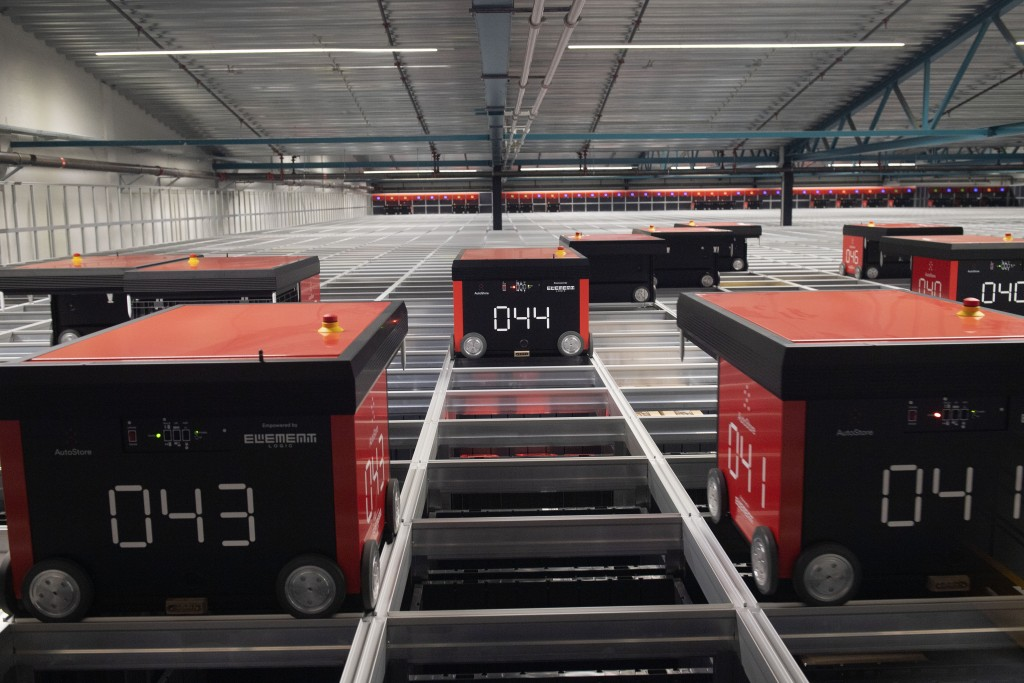
Sustainability has long since moved from ‘nice-to-have’ to ‘must-have’, and warehouses are no exception. With over 40% of global CO2 emissions attributed to buildings, warehouses are under pressure to lower their environmental impact. As we approach 2025, businesses will be prioritising eco-friendly operations, from the materials used in construction to energy-efficient lighting and climate controls. Technology has a crucial role to play in reaching sustainability goals. Automation systems like AutoStore are helping operators reduce their energy consumption-ten AutoStore robots, for example, use about the same amount of energy as a household vacuum cleaner per hour. Implementing such technology can lead to lower carbon footprints and operational efficiencies, both of which offer long-term savings alongside environmental benefits.

AI: Improving intelligence in the warehouse

Artificial Intelligence (AI) will become an increasingly important part of warehouse management by 2025. Already, AI powers predictive analytics for inventory management, helping businesses anticipate demand spikes and avoid stockouts. More advanced applications see AI driving automated systems to manage everything from picking errors to maintenance schedules. AI’s sophistication has reached a point where it can “learn” warehouse patterns and continuously adapt to optimise processes. This makes for a smarter, more flexible warehouse that can adjust to evolving customer demands and operational complexities-whether that’s managing peak busy periods like Black Friday or keeping everyday operations running smoothly.

Rising customer expectations: Speed and accuracy

E-commerce growth and just-in-time delivery models have changed what customers expect from warehouse operations. By 2025, fast delivery will no longer be a competitive advantage but a customer expectation. Warehouses must respond with better agility, accuracy, and scalability. Automated Storage and Retrieval Systems (ASRS), like AutoStore, will help businesses efficiently manage surges in demand while maintaining operational flexibility. Automation allows companies to reduce picking errors, streamline returns, and ensure that even during peak seasons, customers receive their orders quickly and accurately.

Preparing for the future of logistics

Warehousing in 2025 isn’t just about embracing automation-it’s about building smarter, more sustainable operations that can adapt to changing customer needs while minimising environmental impact. By investing in AI, robots, and data-driven tools, businesses can future-proof their operations and ensure they stay ahead of the competition in an increasingly demanding market.

similar news

Industry View: Automation and the Future of Warehouse Racking


Source link

0 comments
0 FacebookTwitterPinterestEmail
Services

New Fork Positioner Boosts Handling Precision

by
written by


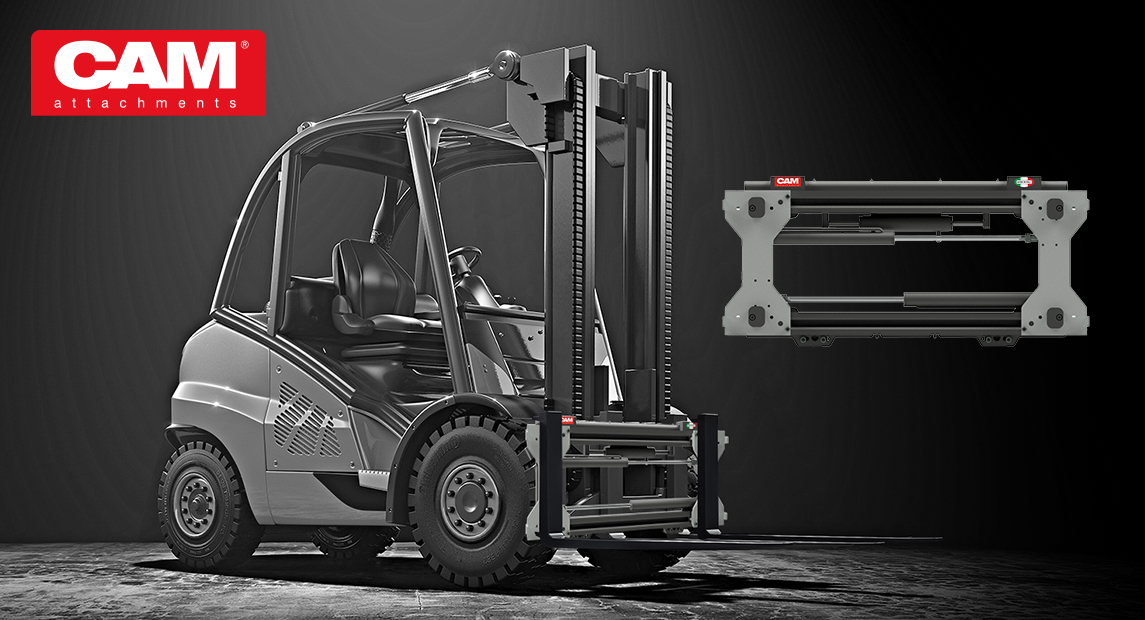
TVH, a leading specialist in parts for material handling, agricultural, construction and industrial offroad machines, announces today the launch of the PK-TS Fork Positioner, the latest addition to its CAM attachments range. Designed for precision and safety in material handling, the PK-TS offers features tailored for operators of material handling machines like forklift trucks and telehandlers.

CAM attachments, subsidiary of TVH, specializes in manufacturing attachments for off-road equipment. Today they introduce the PK-TS Fork Positioner. This new attachment allows drivers to adjust fork spacing hydraulically from the cabin, eliminating the need for manual adjustments. This reduces the risk of injuries and operator fatigue, leading to a safer and more efficient work environment. Additionally, the sideshift function enables precise lateral movement of loads, cutting down on cycle times and enhancing productivity.

Kobe Naert, Chief Product & Procurement at TVH, states: “Thanks to their numerous benefits fork positioners are increasingly becoming a standard upgrade feature on material handling equipment. By enabling precise adjustments of fork spacing, they enhance safety and efficiency in various operations. Operators can handle a wider range of loads with greater comfort, reducing strain and the risk of accidents. Additionally, the robust design of these positioners ensures durability, making them a reliable choice for diverse industrial applications.”

PK-TS Fork Positioner Technical Details

The body is designed from 2 C-Profiles for precise guiding of the fork carriers. Equal arm movement is guaranteed by choosing cylinders according to the hydraulic principle of communicating vessels, instead of applying flow divider valves or throttles on the cylinders.

The PK-TS also features a reinforced frame and a scratch-resistant powder coating, the connections between piston rods and fork carriers are made of stainless steel extensions which feature ball eye rod ends. This helps absorb deflections between cylinder, body and carrier which happen in dynamic load-handling processes, especially when moving loads over uneven grounds or under other tough conditions.

Its compact design and low over-height improve visibility and manoeuvrability in confined spaces, making it deployable for a variety of applications. This model comes as a hook-on version with carriers to install standard forks (ISO 2328:2011). Other models of PK-Series can include fork arms and come either integrated, with or without a sideshift function, or in various combinations of these features.


Source link

0 comments
0 FacebookTwitterPinterestEmail
Services

High Throughput; Tried & Tested

by
written by


David Priestman visited Ocado’s Luton customer fulfilment centre (CFC) in Bedfordshire, England, to experience one of the most sophisticated hive storage and retrieval systems in global logistics.

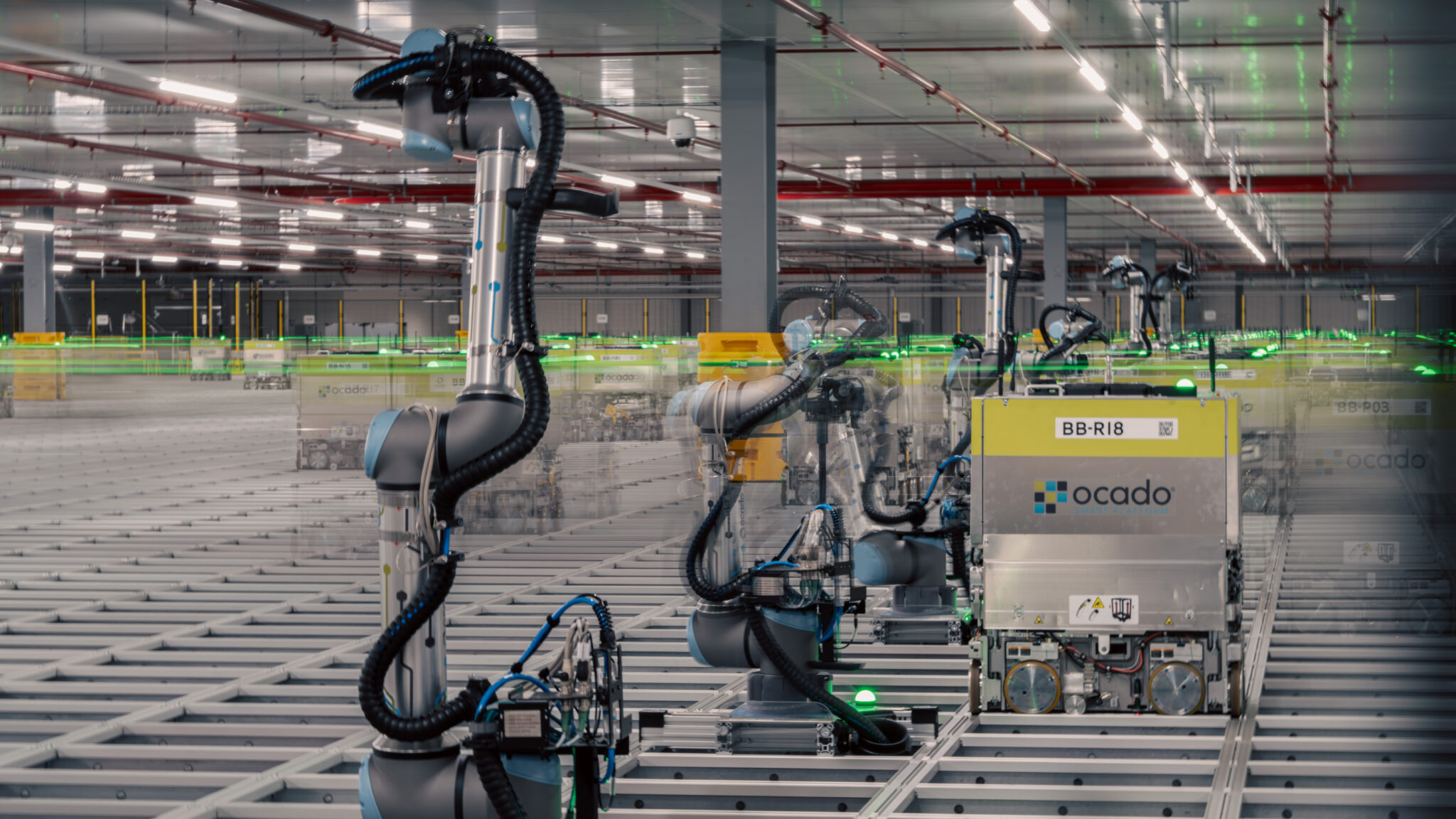
CEO of Ocado Intelligent Automation (OIA) is Mark Richardson, who spoke to us for our May issue (p 30-31) about the company’s OSRS system and ambitions to become a major force in non-grocery warehouse automation systems. He provided an extensive tour of the Luton CFC, which opened last year. The CFC has rapidly scaled its operations to approximately 55,000 orders per week since its go-live in September 2023, relative to a planned design capacity of approximately 65,000 orders per week. With its more than 500 restless bots this facility ships 250 units per labour hour, with a target of increasing that to over 300 per hour when all the automated picking robots have been installed.

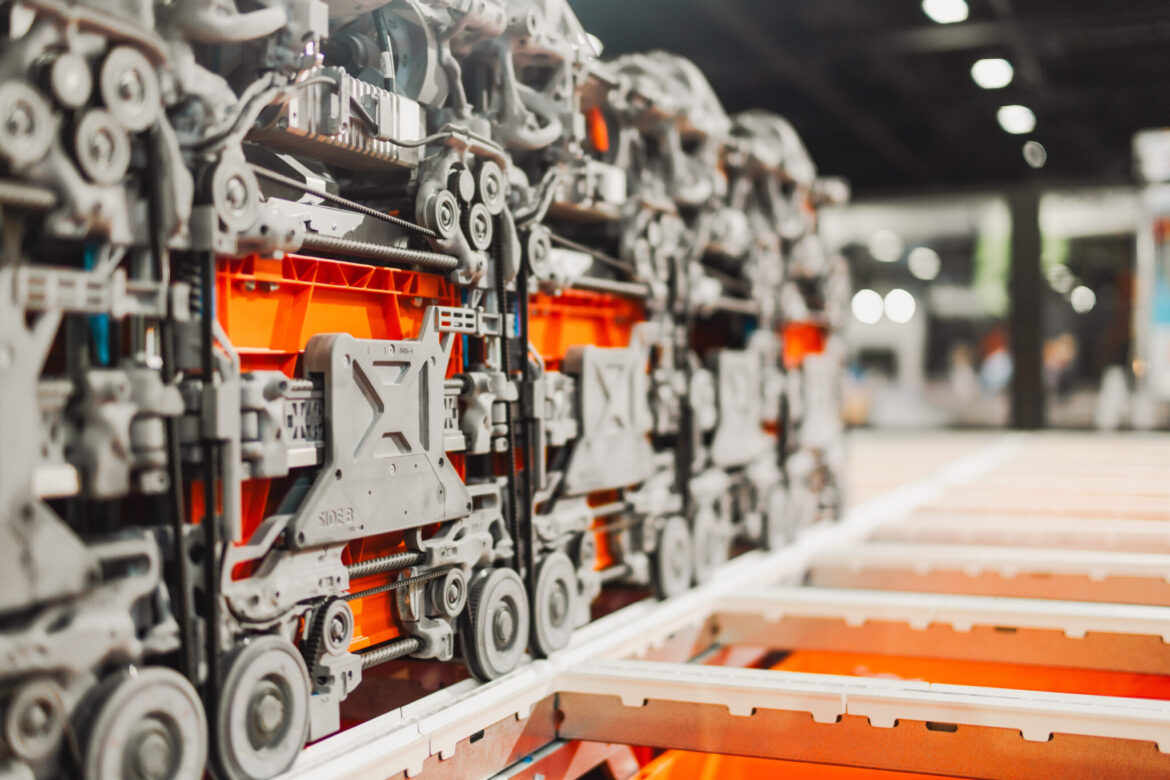
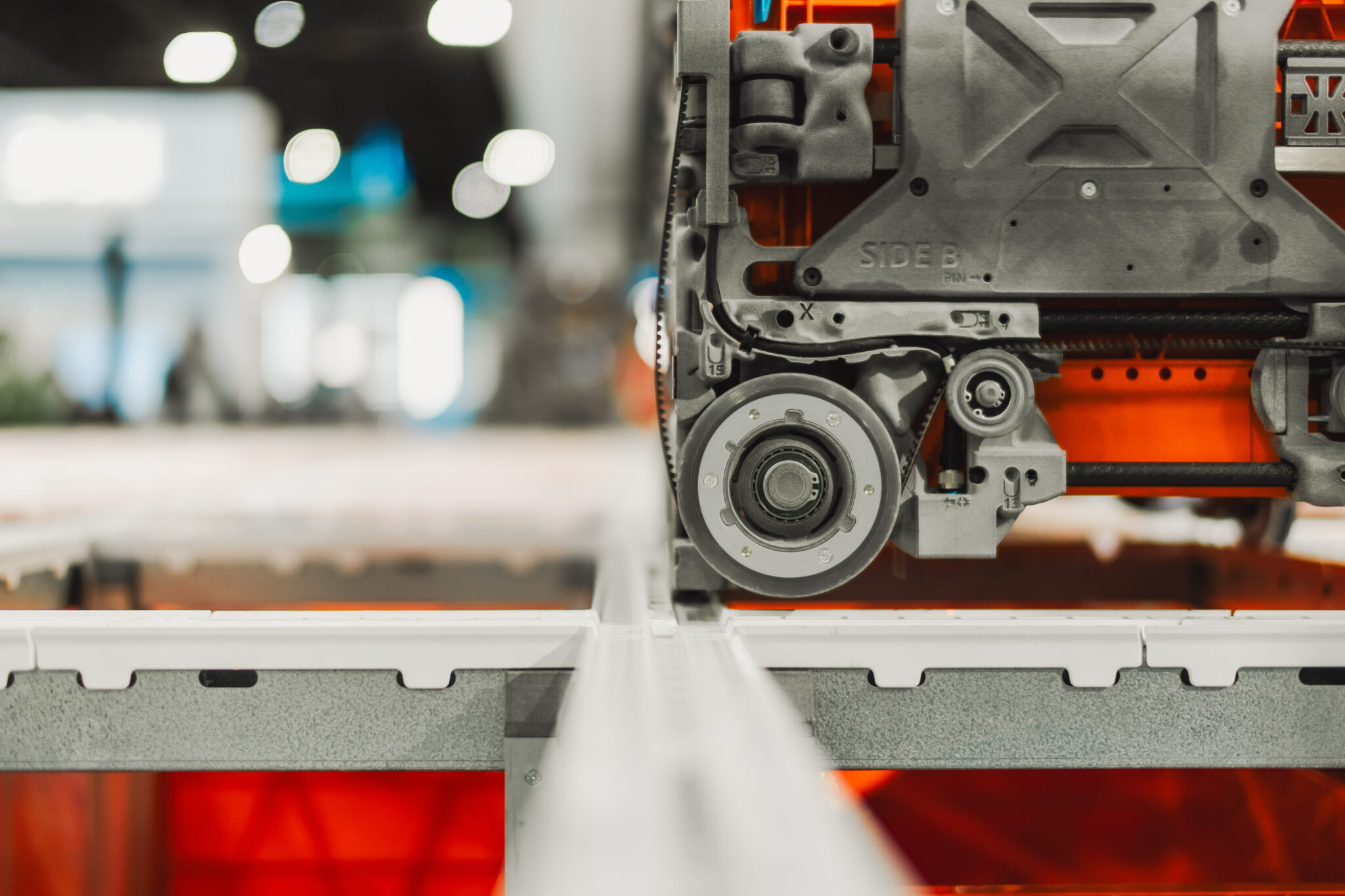
OIA’s bots are deliberately unclad and without skirting. This makes them lighter, shows the inner workings, makes maintenance easier and perhaps feeds greater acceptance by users – the warehouse engineer staff programming and monitoring them. They have luminous green lights visible to the engineers, which turn red should a bot be in error mode, which happens very rarely, Richardson assures me. The new 600 series bot is now being manufactured, featuring more plastic components and smaller motors to make it lighter and even faster, whilst using less power.

Action all induct stations

Most of the products in the OSRS grid are newly arrived items. They are brought on pallets to the induct station, adjacent to the metal grid, where items are manually unloaded and unpacked before being fed into the 200,000 white, injection-moulded plastic storage bins that are used inside the grid. In the future OIA may switch to auto-depalletization technology for this. The company is also now introducing metal bins, with a similar weight, that are fire-resistant to protect assets. Customers can choose between all plastic bins with firewalls in the grid, a combination of materials, or all metal for very cautious environments.

The manned pick stations, situated in a ‘tunnel’ underneath the centre of the grid to keep products closest to the pickers, are designed by Ocado and manufactured by a contractor. Pickers use a visual system featuring a large screen that shows images of each product to be taken from a storage bin and placed into a delivery tote. The screen shows the picker exactly where items are to be placed as there are 3 plastic carrier bags inside each delivery tote. “No voice picking is used,” Richardson explains, “as we’re visually presenting the exact product to be picked.” It’s intended to provide a ‘gamification’ experience for staff.

The ambient part of the Luton OSRS grid is 21 totes high, with the chilled zone being just 8 high (well above ground level). The delivery bins sit inside the storage totes that always remain in the grid. Between two and four hours’ worth of delivery items are kept inside the grid at any time, waiting for their delivery departure slot. This means the OSRS acts as a despatch buffer, which is very effective as, whilst customer delivery times are from morning to late evening, picking inside the grid should be a 24/7 operation. For reference, the average Ocado grocery order consists of 46 items.

Typically, there are around 20 customer deliveries per individual van route. Items for each van are fetched quickly from the grid to be loading manually in roll cages, as well as via some automatic loading systems.

Choreographed picking robots

The Luton OSRS currently has 45 on-grid robotic picking arms fixed in position on top of the grid, above the picking tunnel. They are spread all over the top of the grid; 22 are in the ambient zones, 23 in chilled. Each one can reach to and pick from the 8 storage bins surrounding it. The system brings bins into any of these 8 locations, some are storage bins, some are delivery totes. The robots then do the necessary picking and placing, quickly but precisely. They will be added instead of installing more manual pick stations, which there is space for in the tunnel. The robotic pick solution at Luton is currently picking around one-third of the volumes at the CFC. At target, OIA expect approximately 70% of the range will be picked robotically, with a high proportion of the chilled goods, so as to keep temperature-controlled products inside the grid.

“We tried ground-level robotic picking,” Richardson informs me, “but we decided that on-top was better. We’re slowly teaching the robots and driving productivity up. This will be our most productive warehouse. We can use any robotic arm on it as the magic is in the software. The robot mustn’t just drop an item but place it in the best spot in the delivery bin.” The picking robots are being rapidly deployed for large-scale use across other Ocado and grocery customer sites internationally, and they can be used for non-grocery items too, of course.

The Luton CFC is the most advanced Ocado site in the world and it represents a complete step change in the productivity that can be achieved. Not only does it use Ocado Group’s bot and grid technology (as opposed to the 10 miles of conveyor at the company’s first-generation CFC in Hatfield, Hertfordshire), but it also houses OIA’s latest automation.

Large scale use

The use case for installing an OSRS is based on leading-edge efficiency and the proven expertise that Ocado has gained over 20 years using it as sites like Luton for up to 50,000 sku items. “If you have a demanding use case then we can really help,” says Richardson. “We’re not new to materials handling, it’s tried and tested. We’re more interested in the productivity of the whole site than the speed of individual machines. General merchandise warehouses are ideal, as is pharma, apparel and fashion, plus small consumer electronics.”

OIA can also configure the set-up to include picking some items outside the grid for warehouse staff to do value-add things like packaging and personalised messages before despatch. With the picking robots in operation the company is now gaining more large-scale use-case experience. “Whether our system is superior to competitors or not,” Richardson tells me, “the expertise we’ve gained is the key. We’re fully ready to deploy OSRS with picking robots. We’re not bolting it on, it comes with the grid and is well thought-out.”

Simply the densest

OSRS is scalable, with no limit or maximum breadth. Richardson claims that OSRS is the densest ASRS system available, thereby maximising footprint and ideal for new greenfield site distribution centres, as well as retrofitting an existing DC. It can be used for ambient goods and with a cold store. Above all, it is seriously fast, due to the advanced communications with all the bots. McKesson, the large Canadian pharmaceutical distributor, is going live next summer with an OSRS for retail store replenishment.
Next year’s LogiMAT (where Ocado are in the same hall as us, Hall 8), ProMAT and IMHX shows should see a good deal of interest in OIA’s booths, from both customers and competitors.

similar news

ASRS to OSRS Automation


Source link

0 comments
0 FacebookTwitterPinterestEmail
Services

Ferag and Sparck Collaborate for Automated efulfilment

by
written by


In an ecommerce industry first, systems integrator, Ferag, and auto-boxing specialist, Sparck Technologies, have collaborated to develop a continuous ‘one touch’ process from order-picking to individual ‘fit-to-size’ boxes ready for despatch. The technological leap closes the gap between order-picking and packing, enabling ecommerce businesses to offer its customers secure and compact boxed orders prepared with complete accuracy, and without manual intervention, from pick right through to despatch. A ‘one touch’ operation.

Single system solution

The innovative step, considered a ‘game-changer’, came about soon after Ferag installed its Skyfall automated pouch sortation system at a leading retail brand’s ecommerce centre in the UK. Equipped with 24,000 overhead pouches the Ferag system carries, directs and sorts a wide variety of picked goods from pick-stations, served by ASRS and Autostore systems, to over 70 manual packing benches and one automated ‘fit-to-size’ boxing system – a CVP Everest from Sparck Technologies.

Ferag’s Skyfall pouch system is located on a mezzanine level above the Autostore, maximising the use of available overhead space. Here ordered items are picked from totes into open pouches and carried away, sorted and accumulated within dynamic storage buffers, before being called off to order and delivered at speed to packing benches. The system is designed for a throughput of 16,000 pouches per hour, with a buffer capacity of an hour, where pouches can be held for single or multiple item orders. A key advantage of the system is that each pouch is designed to carry multiple items together – hanging garments, as well as flat-packed and boxed items, such as shoes.

Auto-unloading pouch

The Skyfall overhead pouch sorter was originally sourced to deliver single and multi-item orders to mainly manual packing desks. However, Ferag had recently developed an automated unloading capability for its pouches. This prompted the idea of closing the gap between picking and auto-packing, creating a direct infeed to Sparck’s CVP Everest to automate the whole process.

The CVP Everest is capable of producing 1100 boxes per hour with two operators. So, the question was, could Ferag’s pouch sorter and the new Everest boxing system be integrated to produce a continuous process from pick to despatch, with no manual intervention? If so, it would be a game changer.

The challenge

It was a great idea, but it wasn’t without its complications. The highly versatile Ferag pouch sorter is designed to carry a diverse range of goods, making it well suited for varied product profiles, such as garments, accessories, and shoes.

Chris More, Ferag UK’s Head of Sales, explains how the pouch design was critical: “When it came to tendering and specifying the type of pouch needed, we put forward a couple of technologies for consideration, one being our soft pouch and the other being a hard pouch. The hard pouch has a wire frame which allows it to be opened automatically by our newly developed auto-unloading technology. We had various options for unloading, and a gentle unloader was ultimately selected. This would prove critical.”

But the challenge was, how to present a wide variety of products with different profiles in the right order and orientation to Sparck’s CVP Everest? It was a complex issue.

As it happens, Sparck Technologies’ development team was in the process of looking at ways of auto-infeeding items, as singles and possibly multiple units, into their automated boxing machines to remove the need for manual intervention. The CVP machines had always required manual induction of order-items for an otherwise completely automated process of 3D scan, cut-to-size, fold, seal and label, and then on to despatch.

“We immediately knew we could provide a solution as we were already working on a more holistic approach to the problem, with agnostic, scaleable and modular solutions,” said Jo Bradley, Business Development Manager for Sparck Technologies in the UK.

Chris More said: “We understood exactly what was needed, so we entered into close collaboration with Sparck to set out how the two systems would exchange information, creating a tight integration between upstream and downstream processes, with reliable hand-over and acknowledgement of product and order information.”

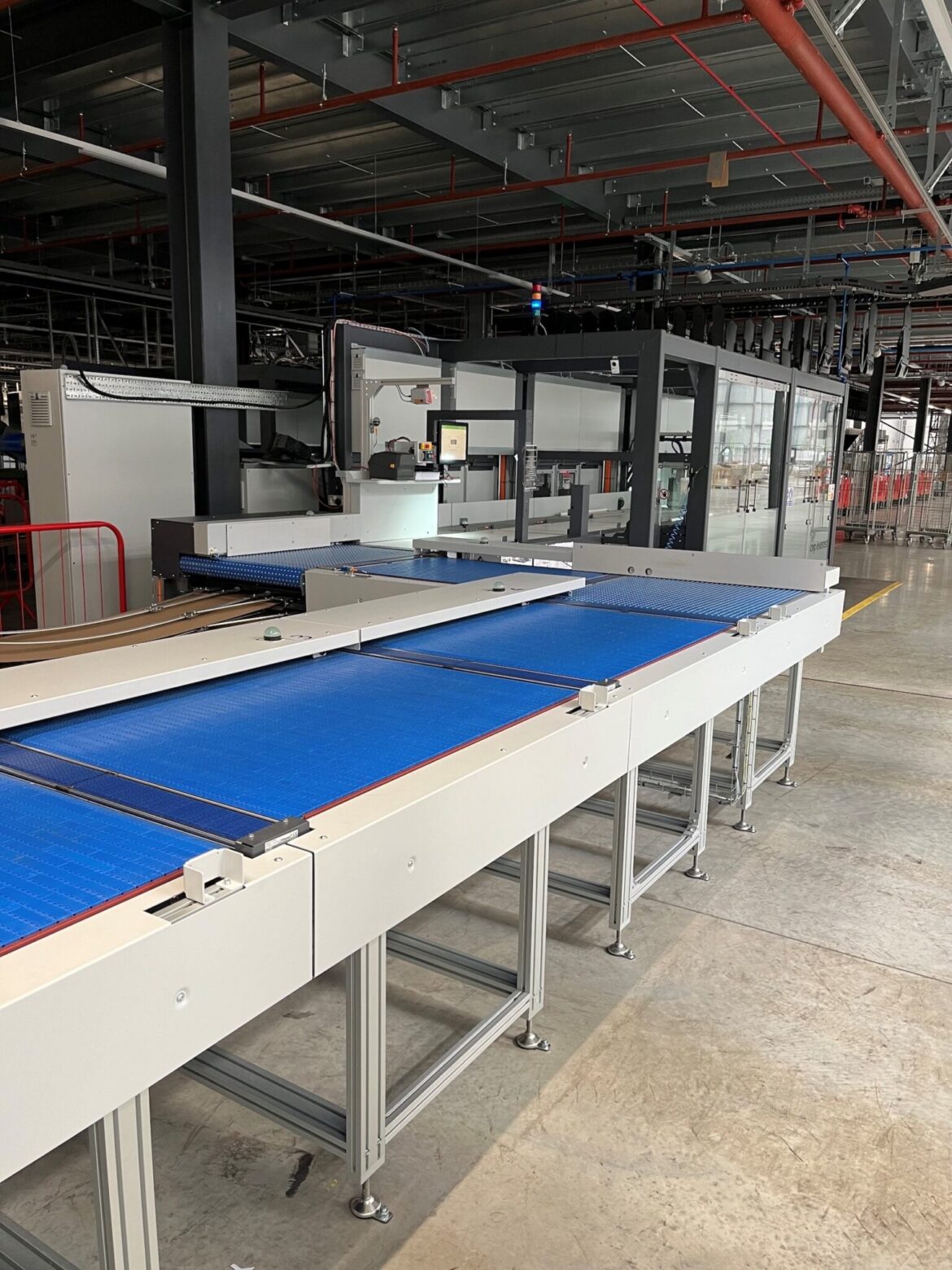
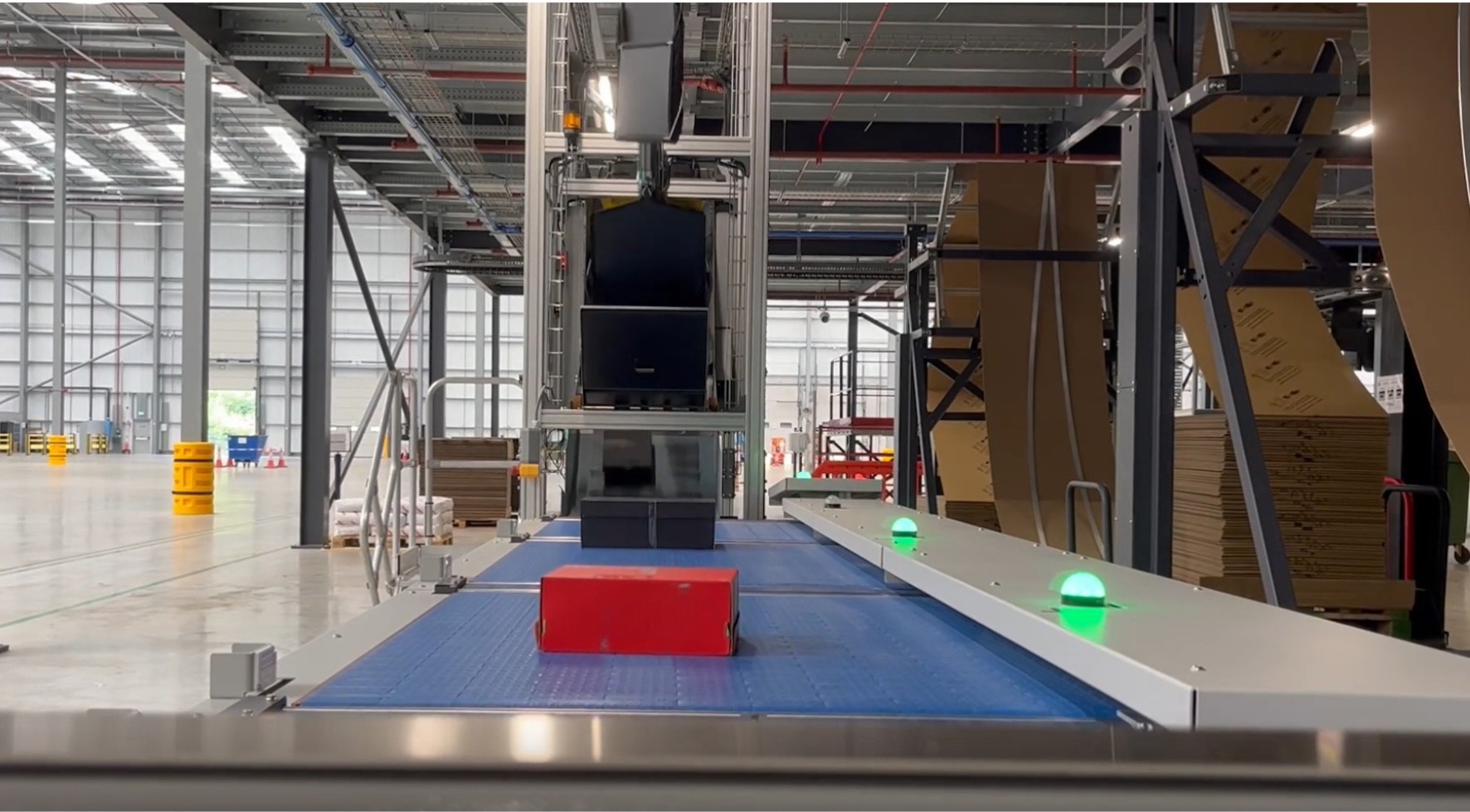
Meanwhile, Sparck carried out further work related to ensuring a smooth and consistent induction of a variety of sized items to the CVP Everest. A clever ‘Z’ shaped conveyor section efficiently aligns and positions each item ready for 3D scanning and processing, providing a well matched, consistent pace sequenced with the upstream Ferag sorter.

Counting the benefits

After thorough testing in late summer 2023, the ‘one touch’ solution went live. The performance of the system has exceeded the retailer’s expectations, with accurate, consistent and reliable delivery of ‘right-sized’ boxes to despatch, maximising the full potential throughput of the system and standing as testament to the successful collaboration between Ferag and Sparck.

Jo Bradley, says: “Automating the interface between order-picking and ‘fit-to-size’ boxing has been a ‘Holy Grail’ for the sector for a number of years. Creating a smooth, seamless process free from human intervention has not been easy, given the complexity of the task, but now we have developed technology that aligns and positions individual items for induction into our CVP machines with great speed and accuracy. We are delighted to have worked with Ferag on achieving an industry first.”

With no need for direct human intervention between upstream order-picking processes and the fast, automatic production of ‘right-size’ ecommerce boxes – cut, formed sealed and labelled, ready for dispatch – exposure to risks, such as labour shortages and sickness, are significantly reduced. Flexibility to ramp up easily for peaks is an added bonus. This innovative step takes out cost, increases throughput and offers the retail client the reassurances they need to perform efficiently at peak.

similar news

Sparck Celebrates 100 years of Innovation


Source link

0 comments
0 FacebookTwitterPinterestEmail
Services

FIFA Appoints Official Logistics Provider for World Cup

by
written by


FIFA has selected Rock-it Cargo, a Global Critical Logistics (GCL) company, as the Official Logistics Provider of the FIFA World Cup 26™ – the game-changing edition of the tournament set to take place across 16 Host Cities in Canada, Mexico and the USA from 11 June to 19 July 2026.

Rock-it Cargo will help FIFA create history, providing multi-year planning, management and event-logistics services as the FIFA World Cup™ expands to 48 teams and 104 matches across three countries and 16 Host Cities in 2026.

Appointed following a highly competitive request-for-proposal process, Rock-it Cargo demonstrated exceptional experience in planning and delivering event logistics to the world’s most complex and high-profile sporting and entertainment events.

FIFA Secretary General Mattias Grafström said: “In Rock-it Cargo we have found the perfect partner to entrust with the critical logistics services for the biggest FIFA World Cup ever. We’ve been impressed by Rock-it Cargo’s experience and attention to detail, teamwork and passion to deliver operational excellence. Their global model fits perfectly with our extensive ambitions for the tournament.”

As the Official Logistics Provider of the FIFA World Cup 26, Rock-it Cargo will provide planning, management and event-logistics services, including with regard to customs and international freight forwarding, warehouse and distribution operations, on-site venue operations at the International Broadcast Centre and team equipment operations.

The multi-year partnership will begin in 2025, with Rock-it Cargo providing selected services for the new FIFA Club World Cup™ to be hosted across 12 stadiums in 11 different cities in June and July next year. The partnership will expand in scope to include a broader range of services for the FIFA World Cup a year later, with Rock-it Cargo also taking up a position as a Tournament Supporter for the game-changing global event.

President and CEO of GCL, the parent company of Rock-it Cargo, Daniel Rosenthal said: “We are deeply honoured to have been selected by FIFA to support the planning and delivery of the biggest FIFA World Cup ever. For nearly 50 years our team has been trusted by the world’s biggest artists and North American sports leagues to deliver extraordinary experiences through extensive planning, contingency management and outstanding event coordination. We look forward to drawing on our experience in the FIFA World Cup 26 stadiums and Host Cities to help successfully execute the 39-day tournament.”

Beyond its direct relationship with FIFA, Rock-it Cargo’s status as FIFA’s Official Logistics Provider – combined with its deep North American operational and customs experience, centralised warehouse infrastructure and last-mile ownership – will enable a more efficient and sustainable logistics service to be provided to FIFA’s partners, vendors, broadcasters and other stakeholders.

similar news

Liverpool FC and UPS Deliver Partnership


Source link

0 comments
0 FacebookTwitterPinterestEmail
Services

Industrial Doors to Play Their Role at Innovation Site

by
written by


A state-of-the-art 29,700 sq. ft. research and manufacturing facility is set to transform Sheffield with its innovative design and commitment to sustainability. The new development will feature a large open-plan factory space, individual workshop areas, and adaptable ancillary spaces, all underpinned by a robust, sustainable design addressing environmental, social, and economic responsibilities.

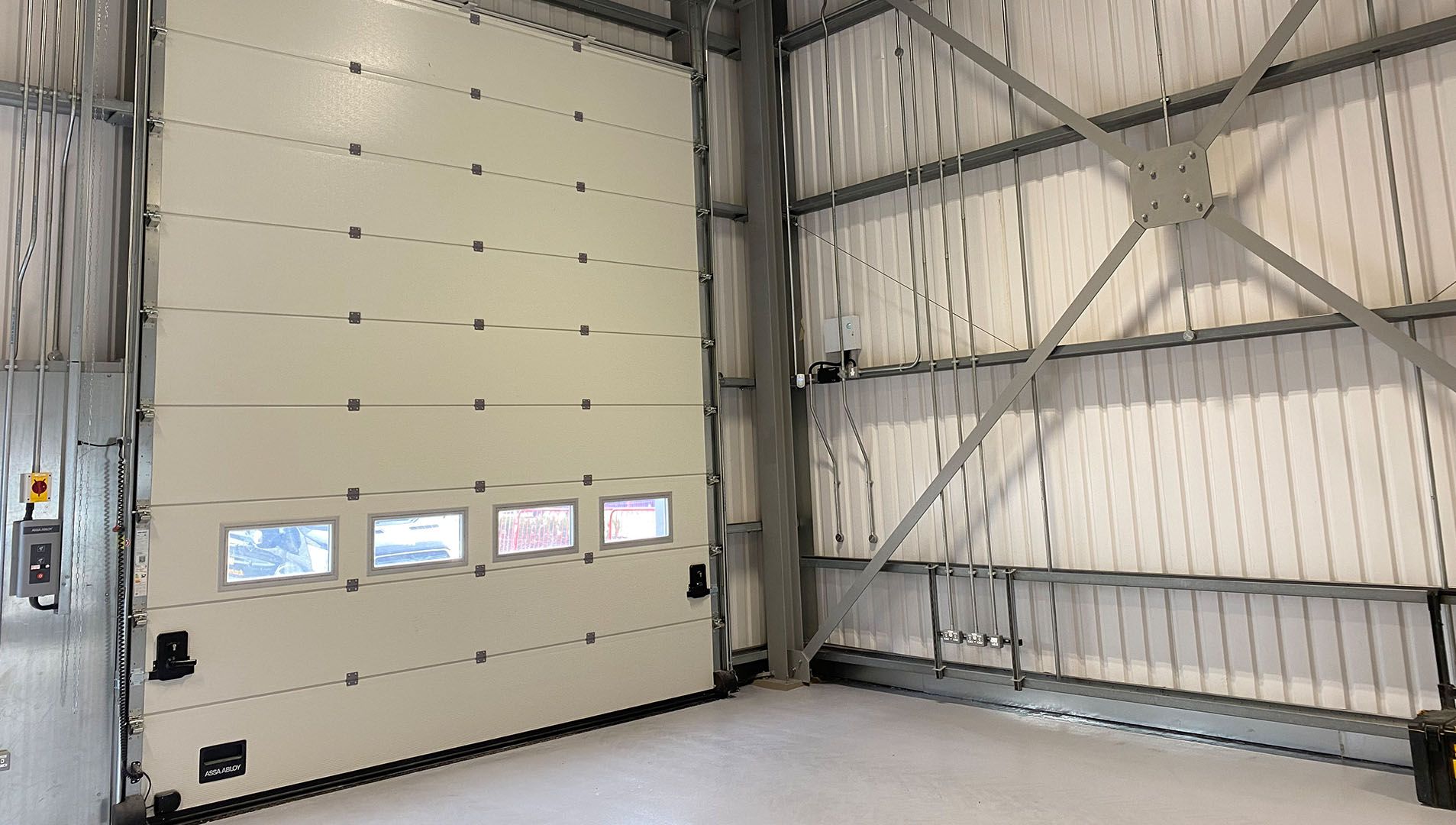
To meet the advanced needs of this cutting-edge facility, ASSA ABLOY Entrance Systems supplied an array of industrial doors, ensuring both functionality and security. Among the installations are two OH1042P Secure by Design sectional doors, two electrically operated tube motor fire shutters, and one HS9110P internal high speed door. Each door system has been carefully selected to enhance operational efficiency, safety, and environmental performance.

One standout feature of the project is the electrically operated tube motor fire shutter, measuring 3000mm wide by 2400mm high. This fire-rated roller shutter, certified to BS EN 1634-1:2014 standards, boasts a one-hour fire resistance rating. Designed to house recycling waste securely, the shutter operates via a 240V tubular motor with a key switch. Its uninterruptible power supply ensures reliable operation during power outages. The robust construction includes a galvanised steel curtain, a T-section bottom rail, and a durable powder-coated finish, ensuring both resilience and longevity.

Equally impressive are the two OH1042P sectional doors, certified to Resistance Class 2 (RC2) and part of the Secured by Design initiative. These overhead sectional doors prioritize security, thermal efficiency, and durability. With wind-resistant reinforced panels and advanced anti-lift features, the doors provide unparalleled protection against unauthorized access. The inclusion of burglar-proof window panels allows for increased natural light while maintaining high security. The largest of these doors, measuring 6000mm by 6000mm, operates with vertical lift tracks and wind bracing, making it ideal for the facility’s industrial environment.

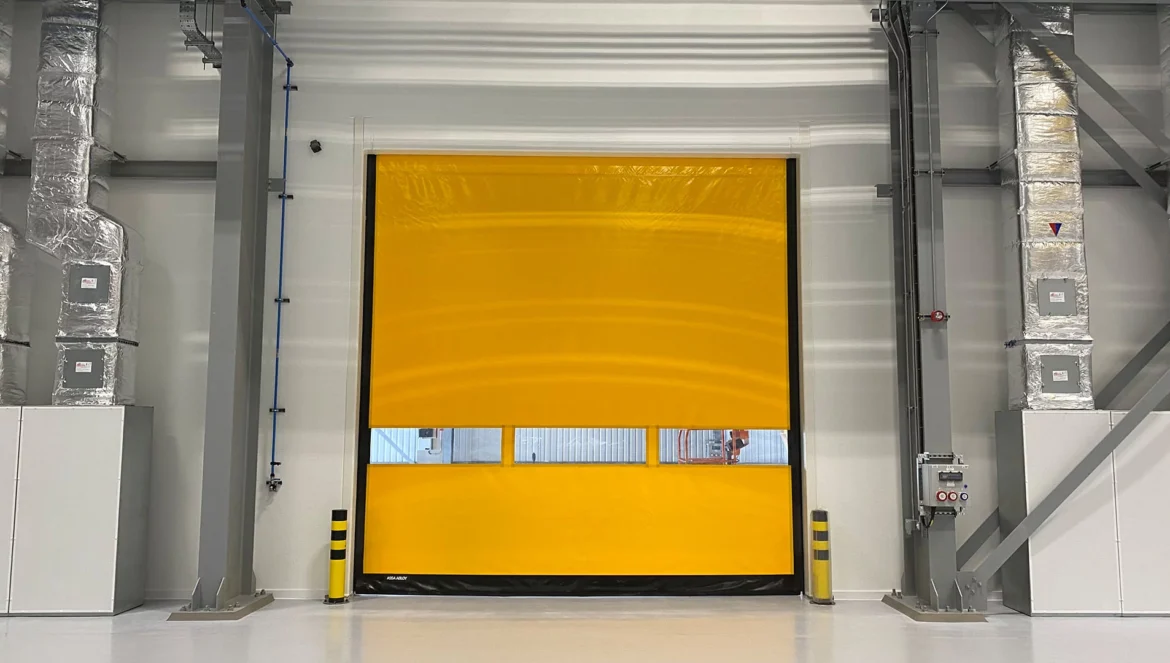
Inside the factory, the HS9110P high speed door plays a vital role in enhancing traffic flow and maintaining energy efficiency. This door, with a bright yellow curtain measuring 5000mm by 5000mm and equipped with vision panels, operates at speeds of up to 2.4 m/s. Designed for heavy-duty use, it features a break-away and automatic reset system, reducing downtime in the event of impacts. Its advanced dual-barrel power drive and retention belt technology create an excellent draft seal and pressure resistance, ensuring reliable performance under demanding conditions. The automation of the door features a radar motion detector with an integrated active infrared presence detector, enabling seamless automatic door opening while ensuring the safety of both people and vehicles.

This Sheffield facility embodies a vision for sustainable and innovative industrial development, with ASSA ABLOY’s advanced door systems playing a crucial role in achieving its goals. By integrating cutting-edge security, energy efficiency, and operational reliability, these solutions exemplify the future of industrial design and functionality.

similar news

24/7 Endurance Doors


Source link

0 comments
0 FacebookTwitterPinterestEmail
Services

FarEye Wins Award for Last Mile Logistics Solutions

by
written by


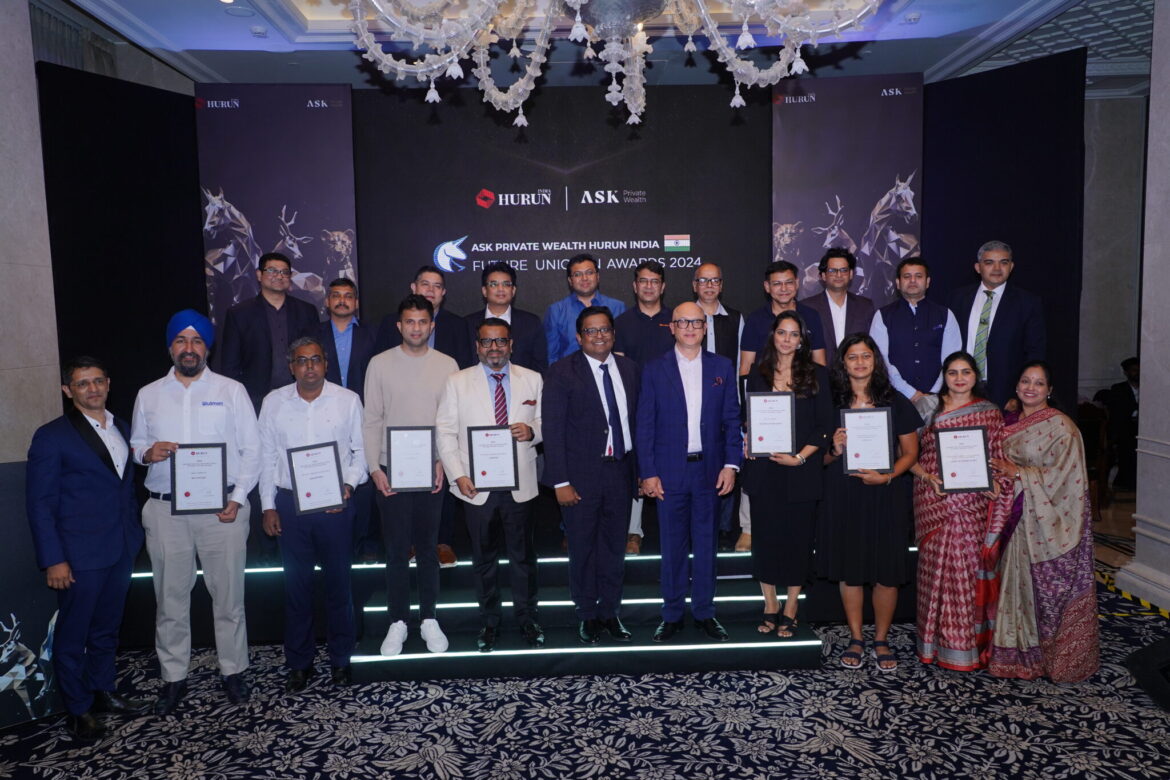
Hurun India, in partnership with ASK Private Wealth, has honoured FarEye with the prestigious 2024 ASK Private Wealth Hurun India Future Unicorn Award in the Last Mile Logistics Solutions category. This recognition highlights FarEye’s innovative approach to transforming global logistics through cutting-edge technology, optimizing last-mile deliveries, and reshaping how goods move across the globe.

The Hurun India Future Unicorn Award identifies high-growth companies on the cusp of becoming unicorns. The awards reflect Hurun India’s deep understanding of global markets, as evidenced by the network of Hurun rankings in China, the Middle East, and now India, as it continues to spotlight companies that are shaping the future of various industries.

Gautam Kumar, Co-founder of FarEye, expressed his gratitude for the recognition, stating: “We are thrilled to be recognized by Hurun India with the Future Unicorn Award. For over a decade, FarEye has been relentlessly focused on transforming the global delivery landscape, empowering businesses to deliver smarter, faster, and more efficiently. This recognition is a testament to the hard work, dedication, and innovation of our team, and we are incredibly grateful to be acknowledged for our contribution to revolutionizing last-mile logistics worldwide.”

Anas Rahman Junaid, Co-founder of Hurun, and Rajesh Saluja, Co-founder and CEO, ASK Private Wealth also shared their perspective, saying: “India has emerged as a breeding ground for some of the most successful unicorns, and we believe FarEye is well on its way to becoming one of the next big success stories.”

FarEye’s commitment to innovation has attracted global attention, with major clients across e-commerce, retail, and logistics sectors relying on FarEye’s solutions to meet the growing demand for faster and more reliable delivery services. With India at the heart of its success story, FarEye is positioned to be a leader in the rapidly expanding logistics sector, with significant investments driving its future trajectory.

similar news

FarEye Platform on SAP for Parcel Visibility


Source link

0 comments
0 FacebookTwitterPinterestEmail
Newer Posts
Older Posts

Recent Posts

  • One eHGV Could Save 1000 Tonnes of Carbon
  • Libiao Robotics Demonstrates AirRob PRO
  • New Sleeve Wrapper for Transport Packaging
  • LogiMAT 2026: Practical automation & AI define first 2 days
  • Pallet Transport Service Added – Logistics News

Recent Comments

No comments to show.

Social Connect

Whatsapp

Recent Posts

  • One eHGV Could Save 1000 Tonnes of Carbon

  • Libiao Robotics Demonstrates AirRob PRO

  • New Sleeve Wrapper for Transport Packaging

  • LogiMAT 2026: Practical automation & AI define first 2 days

  • Pallet Transport Service Added – Logistics News

Newsletter

Categories

  • Services (1,096)
  • Uncategorized (41)

@2024 - All Right Reserved. Designed and Developed by Sierraline Cargo services

Manage Consent
To provide the best experiences, we use technologies like cookies to store and/or access device information. Consenting to these technologies will allow us to process data such as browsing behavior or unique IDs on this site. Not consenting or withdrawing consent, may adversely affect certain features and functions.
Functional Always active
The technical storage or access is strictly necessary for the legitimate purpose of enabling the use of a specific service explicitly requested by the subscriber or user, or for the sole purpose of carrying out the transmission of a communication over an electronic communications network.
Preferences
The technical storage or access is necessary for the legitimate purpose of storing preferences that are not requested by the subscriber or user.
Statistics
The technical storage or access that is used exclusively for statistical purposes. The technical storage or access that is used exclusively for anonymous statistical purposes. Without a subpoena, voluntary compliance on the part of your Internet Service Provider, or additional records from a third party, information stored or retrieved for this purpose alone cannot usually be used to identify you.
Marketing
The technical storage or access is required to create user profiles to send advertising, or to track the user on a website or across several websites for similar marketing purposes.
  • Manage options
  • Manage services
  • Manage {vendor_count} vendors
  • Read more about these purposes
View preferences
  • {title}
  • {title}
  • {title}
Sierraline Cargo Services
  • HOME
  • Services
    • Trade With Us
  • About Us
  • Contact Us
  • private jet
    • BOOK YOUR JOURNEY
  • Track Packages
  • Insurance
  • safekeeping

WhatsApp us