Sierraline Cargo Services
  • HOME
  • Services
    • Trade With Us
  • About Us
  • Contact Us
  • private jet
    • BOOK YOUR JOURNEY
  • Track Packages
  • Insurance
  • safekeeping
Services

DX Acquires HBC Logistics – Logistics News

by
written by


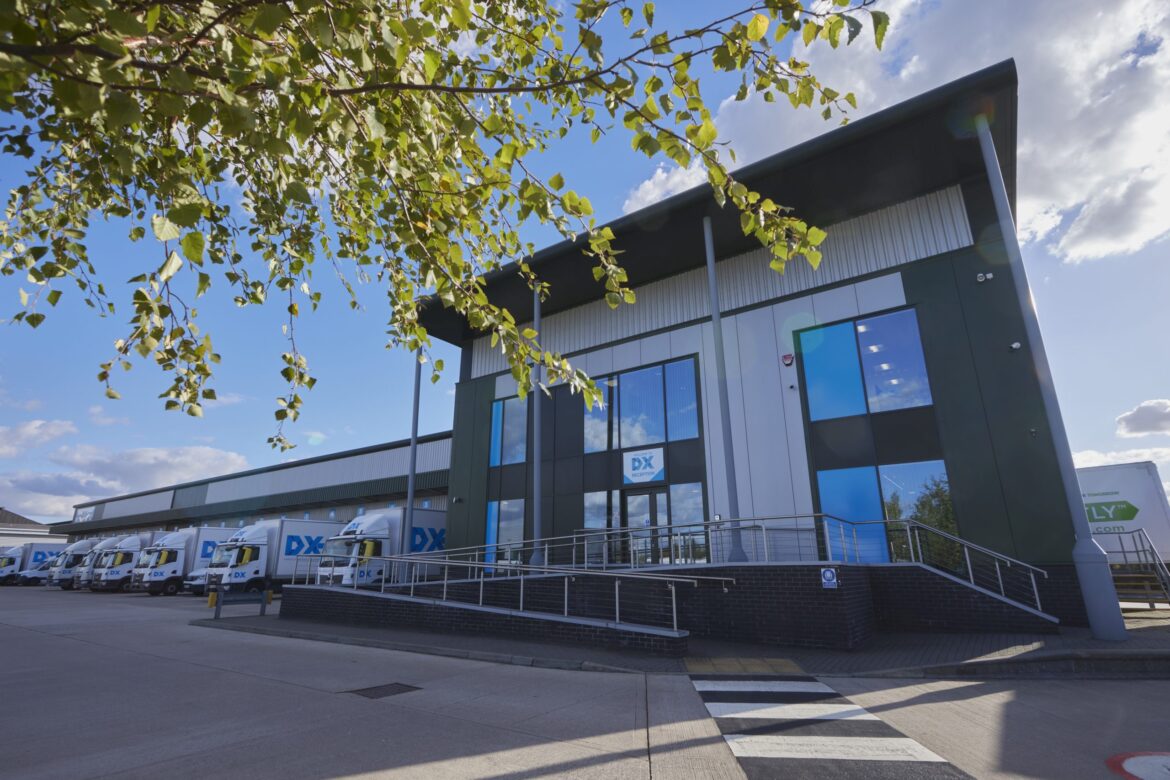
DX, the parcel, freight, document and fulfilment operator, today announces the acquisition of HBC Logistics Ltd, a third party logistics and same day services business based in Bedfordshire, UK.

The acquisition comes just six months after the appointment of Ian Truesdale as CEO last July by DX’s parent company, H.I.G. Capital, a leading global alternative investment firm with $70 billion of assets under management. It marks the first step in the company’s next phase of growth and reflects the leadership’s ambitions to scale and evolve DX.

Founded in 2017, HBC Logistics delivers rapid and scheduled logistics solutions, offering warehousing
and fulfilment, palletised freight, same-day courier services and international shipping. It is headquartered at Stratton Business Park in Biggleswade, where it operates a 62,000 sq ft. facility, and has additional support centres in Hertfordshire, Cambridge and London. Its footprint spans the South East, West Midlands and East Midlands, supported by a diverse fleet ranging from small vans to articulated HGVs. It is a Platinum-rated member of the United Pallet Network and Palletforce, and partners with a number of global carriers. In recent years, the business has also taken steps to strengthen its sustainability credentials, including partnering with Carbon Neutral Britain, the UK’s leading carbon-offseting initiative.

Ian Truesdale, Chief Executive Officer of DX, commenting on the acquisition said: “We’re delighted to welcome the team at HBC Logistics to DX. They bring valuable operational capability and sector experience as we continue to evolve the business, particularly across our DX Fulfilment and DX SameDay propositions. “This acquisition marks the next phase in DX’s expansion and development. It reflects deliberate choices about where we invest and how we grow, both organically and through future acquisitions. DX turned 50 last year, and we are moving forward with intent, investing in our services, developing our people and delivering greater value for our customers. Bringing HBC into the business is an early example of that direction in action.”

Will Wright, Chief Financial Officer of DX, added: “This acquisition is an excellent fit and natural commercial progression for both DX and HBC. HBC has built a disciplined, high-quality operation that complements our services portfolio and will underpin efficient growth in key regions. This is exactly the kind of targeted, strategic investment we are committed to making as we scale the business.”

Ben Weldon (pictured, above), Director of HBC Logistics, said: “DX is passionately committed to serving its customers’ needs and, culturally, we share the same values. This makes for a very good union. We have been impressed by DX’s growth trajectory and are excited by their ambi􀆟ous plans for expansion. We look to the future with confidence.”

Dave Northfield, Director of HBC Logistics, added: “This next step with DX brings many opportunities for our team, our customers and the future of the business. We’re proud of what we’ve built at HBC and joining DX means we can keep building, now with even greater scale and support behind us.”



Source link

0 comments
0 FacebookTwitterPinterestEmail
Services

Why OMS is the Missing Link in Digital Supply Chains

by
written by


Logistics Business is hosting an essential new webinar examining why Order Management Systems (OMS) are fast becoming the missing link in fully connected, digital supply chains.

Hosted by Peter MacLeod, Editor of Logistics Business, this expert session brings together Infios and Deloitte to provide practical, real-world insight into how OMS platforms are helping organisations gain visibility, agility and control across increasingly complex supply chain networks.

📅 Date: 5 February 2026
🕙 Time: 10:00am GMT
💻 Format: Live online webinar – free to attend

Why You Should Attend

If you’re struggling with fragmented systems, limited order visibility or the growing complexity of omnichannel fulfilment, this webinar will show you how a modern OMS can help close the gap between planning and execution.

By registering, you will:

  • Understand why OMS is now a strategic requirement, not just an IT upgrade
  • Learn how leading organisations are using OMS to orchestrate orders across channels and partners
  • Hear how AI and automation are improving fulfilment decisions and customer service
  • Gain expert insight into integrating OMS with ERP, WMS and TMS platforms
  • Take away practical guidance you can apply immediately to your own digital transformation plans

Expert Panel

The session will be hosted by Peter MacLeod, Editor of Logistics Business, with expert contributions from:

  • Fabien Kbaïer, Sales Director OMS – EMEA, Infios
  • Saartje Smolders, Senior Manager – Supply Chain & Network Operations, Deloitte

Whether you’re a supply chain director, logistics manager, IT leader or digital transformation specialist, this webinar will give you the insight needed to make smarter, more connected order management decisions.

Register now to secure your spot and gain access to the live session and on-demand recording.


Source link

0 comments
0 FacebookTwitterPinterestEmail
Services

Beyond Solar – Energy Reality for Warehousing

by
written by


For the warehousing sector, the pressure to decarbonise to meet stricter energy efficiency and sustainability standards has undoubtedly been building over the past 12 months. Heading into a new year offers a chance to take stock and look at the options to make purposeful changes. David Woon (pictured, below), head of net zero engineering and operations at Ennovus Solutions, offers an insightful roundup of the year’s most significant developments and a look ahead into 2026, exploring the next frontiers in achieving net zero for warehousing businesses.

2025 has been a landmark year for renewable energy, with solar and wind surpassing coal as the world’s top source of electricity generation for the first time. In the UK specifically, more impactful plans were put in place by the government to help the country achieve net zero, such as the hotly anticipated Planning and Infrastructure Bill, which became law in December. However, it has also been a year of increased challenges for many sectors.

The convergence of rising operational costs, grid instability and pressure from supply chains on top of new government mandates, are all forcing warehousing and logistics operators to redefine their relationship with energy. In 2026, there is arguably more potential than ever for a smart warehouse to act as its own power plant. Your roof isn’t just a cover; it’s your greatest untapped financial asset.

A look back on the year’s defining moments

2025 has left us with a lasting sense of political uncertainty, which has resulted in an overwhelming feeling that, as a business, we must move away from long-term goals and support more businesses in taking action now.

Perhaps most importantly, this year has proved above all that the move towards sustainable operations and harnessing renewables is fundamental to protecting the bottom line. The 2025 B Lab UK data released in November, shows B Corps saw 20% turnover growth vs. 3% for standard SMEs, proving that sustainability is now a marker of high-performing, resilient companies.

As businesses face the reality of high capital costs and the long-term nature of energy transitions, the emphasis has shifted to data-driven audits that ensure financial viability for the future. This financial wariness is operating against a backdrop of unprecedented grid strain; the explosive growth of AI and data centres has transformed energy demand from a steady climb into a steep surge. This pressure is acting as a catalyst, forcing many organisations to consider on-site renewables, even as they navigate the high initial price tag of energy independence.

Despite political rhetoric, it has been positive to see that the global momentum for sustainability remains resilient. Locally, the publication of government solar and wind roadmaps has provided a much-needed, if imperfect, sense of direction, reinforcing green building mandates that are now standard in many sectors. Ultimately, 2025 has been the year in which climate awareness moved from a global concern to a local risk, pushing partners and supply chains to integrate mandatory renewables as a matter of basic business resilience rather than just corporate social responsibility.

Shifting up a gear for 2026

Looking ahead, we hope to see more decentralised resilience, with the warehousing sector shifting toward energy independence. Large-footprint sites are a perfect scenario for holistic, renewable technology, combining roof-mounted solar and wind turbines. This could likely be supercharged by a massive drop in battery storage prices, making it economically viable for warehouses with low base loads but high physical space to store excess generation for peak use. The strategic value of feasibility studies and audits will therefore be more important, as businesses move away from trial-and-error toward data-backed models that identify the exact mix of technologies needed to avoid price volatility and supply chain fragility.

The regulatory and political landscape does present a complex push-pull dynamic for investors. On the positive side, the National Energy System Operator has finally broken the gridlock by clearing the connections queue and issuing new offers, which will trigger a surge in renewable construction across the country. However, this momentum is shadowed by political instability. The rise of alternative movements with virtually non-existent net-zero policies, or that actively reject the concept of net zero, has created a climate of caution. However, many firms are now framing their energy investments primarily through a cost and resilience lens rather than a purely environmental one – something that will certainly continue into the new year.

The cost of doing nothing

The UK warehousing sector is ripe for the renewable switch, but the window for early-mover advantage is closing fast. As we look toward 2026, the transition has shifted from a sustainability nice-to-have to a fundamental pillar of operational resilience. Businesses that wait to explore renewable opportunities risk facing exponentially higher grid costs, increasingly punitive mandates and a total loss of competitive edge against B-Corp-aligned peers who have already secured their energy independence. In an era of political and infrastructure instability, the choice is simple.


Source link

0 comments
0 FacebookTwitterPinterestEmail
Services

Year of Progress for Shipping Group

by
written by


One of Scotland’s leading shipping and logistics firms, Streamline Shipping Group, reflects on a landmark year shaped by high-profile event partnerships, major steps forward in sustainable logistics, and a deepening commitment to communities across the Highlands and Islands.

For the Streamline Shipping team, the busiest month of the year came in July, as the team supported one of the most memorable weeks in Aberdeen’s history as the Regent and Blaikies Quay Sponsor at the Tall Ships Races 2025. The event was a huge success for all involved, turning the Port of Aberdeen’s North Harbour into a four-day festival with around 50 tall ships, live music, street food and an estimated 400,000 visitors.

A few days later, the team was back in the thick of it, as the Official Logistics Partner for the Orkney Island Games, the largest event ever held on the islands. Marking the 40th anniversary of the International Island Games, the celebration welcomed athletes from 24 island communities around the world.

Will Rodger, Service Manager at Streamline, said: “Being involved in two huge events so close together was a real highlight for us. The Tall Ships brought an incredible atmosphere to Aberdeen, and the Island Games meant so much to everyone in Orkney. Seeing our teams step up for both occasions, often working quietly in the background to keep everything moving, made me really proud.”

However, away from the crowds and celebrations, another side of the business was gathering pace as Streamline worked closely with UK-based autonomous aviation company, Windracers, who design, manufacture and operate heavy-lift, long-range cargo drones. Over nine weeks, the two teams completed one of the most ambitious autonomous delivery trials in the UK, where Drones flew more than 2,000 km between Orkney’s islands to transport medical samples, water tests, shellfish and other everyday parcels, handling up to 90 percent of last-mile deliveries.

Due to the success of the trial, Streamline has now been named a partner in the next phase of Innovate UK’s Sustainable Aviation Test Environment, which will explore the potential for a drone network linking Orkney, Shetland and other remote regions.

Rodger shared: “What we achieved with the drone trials genuinely felt like the future arriving. When you see a parcel taking off from one island and landing on another, completely autonomously, and doing it safely, consistently and with no environmental disruption, it changes what you believe is possible for technology as well as remote, sustainable logistics.”

Elsewhere, Streamline continued to deepen its support for local communities throughout 2025. In Orkney, the business provided free transport of building materials and specialist furnishings for The Peedie Retreat, a fully accessible seaside sanctuary for individuals affected by cancer, MS and MND. The team also assisted NHS partners across Scotland, including delivering a palliative cuddle bed to Gilbert Bain Hospital in Shetland and supporting the installation of a Breathing Space mental health bench at FDAMH.
Internationally, Streamline partnered with Rendall FC and University of Glasgow researchers to transport donated football kits from Orkney to Malawi, supporting rural health outreach programmes through community sport.

“Community work is not something we do on the side, it is part of who we are,” said Rodger. “From local charities to NHS partners to families who need a hand, our approach is always the same. We treat every request with care, respect and the determination to make a difference.”

Now, as the company moves into 2026, the team will be pushing forward with plans to expand its drone logistics, deepen its UK and island networks, and invest further in low-carbon transport solutions, ensuring the business remains resilient, reliable and ready for the challenges ahead.


Source link

0 comments
0 FacebookTwitterPinterestEmail
Services

Embraer S.A.: the best private business jets from South America

by
written by


In the field of private jets andexecutive aviation, the most frequently mentioned names are often North American or European. Yet one of the world’s most solid, innovative and highly regarded manufacturers was born in South America: Embraer S.A., the pride of the Brazilian aviation industry.

In this article, we tell the story of Embraer S.A., where its headquarters are located, the brand’s philosophy, and take a detailed look at the top business jet models, with real usage-oriented reviews.

Embraer’s origins: from state vision to global success

Embraer (Empresa Brasileira de Aeronáutica S.A.) was founded in 1969, at a time in history when Brazil decided to invest seriously in the country’s technological and industrial development. The company is founded as a state-owned enterprise, with the goal of creating a competitive national aeronautics supply chain.

The project has strong ties to theInstituto Tecnológico de Aeronáutica (ITA), one of the most prestigious aerospace engineering schools in South America. From the beginning, Embraer has been distinguished by a pragmatic approach: aircraft that are efficient, reliable, and adapted to real market needs.

In the 1990s, the decisive turning point occurs: privatization. From that time Embraer accelerated its international expansion, becoming one of the world’s leading aircraft manufacturers.

Where Embraer S.A. is located.

Embraer S.A.’s headquarters are located in São José dos Campos, in the state of São Paulo, Brazil.

This city is considered the heart of Brazilian aerospace:

  • hosts advanced research centers

  • technical universities of excellence

  • aviation industrial clusters

From here Embraer coordinates:

  • production

  • research and development

  • design

  • global strategy

The company also has plants and offices in North America, Europe and Asia, confirming its international focus.

Embraer today: a brand of private jet global business

Today Embraer is active in four major areas:

  1. Commercial aviation (regional jets)

  2. Executive aviation (business jet)

  3. Defense and security

  4. Services and support

In the world of private jets, the Embraer Executive Jets division is considered one of the most reliable in the world, especially for:

Embraer has built its reputation by offering concrete luxury, without excess, but with great attention to the passenger experience.

Embraer’s top models: reviews and analysis of the most popular jets

Embraer Phenom 100EV

Category: Very Light Jet

The jet Embraer Phenom 100EV is the compact evolution of the famous Phenom 100, designed for short routes and regional flights with few passengers.

Strengths:

  • Surprisingly spacious cabin for a very light jet

  • Excellent fuel efficiency

  • Advanced and intuitive avionics

Onboard experience: Suitable for single riders and customers who choose speed and comfort for short trips. Ergonomic seats and quietness make the ride enjoyable even for routes of an hour or two.

Overall rating: Excellent. A small jet that makes passengers feel as comfortable as in a larger light jet.

Embraer Phenom 300 / 300E

Category: Light Jet

The Phenom 300 is probably Embraer’s most popular business jet and one of the world’s best-selling in its class.

Strengths:

  • Outstanding performance for a light jet

  • Spacious and bright cabin

  • Very high operational reliability

  • Competitive operating costs

Onboard experience: The cabin is surprisingly comfortable: ergonomic seats, excellent soundproofing and a fully enclosed bathroom, a detail not taken for granted in light jets.

Ideal for:

Overall rating: Excellent. An absolute reference in the segment.

Embraer Legacy 450 / 500

Category: Mid-Size / Super Mid-Size Jet

The Legacy 450 and 500 represent Embraer’s intermediate line, with more spacious cabins and longer range than the Phenoms, but maintaining high efficiency.

Strengths:

In-flight experience: Ideal for corporate clients who require high-level comfort and space for meetings or in-flight work. Perfect for medium-haul business flights.

Overall rating: Excellent ½ Excellent balance of luxury, space and performance.

Embraer Praetor 500 and 600

Category: Midsize / Super Midsize Jet

The Praetor 500 represents Embraer’s technological leap forward in midsize jets, while the Embraer Praetor 600 is one of the best super midsize jets on the market.

Strengths:

  • Elegant and modern cabins

  • Intercontinental Autonomy

  • Advanced avionics and state-of-the-art safety systems

Onboard experience: Praetor cabins offer generous space, comfort and premium materials, ideal for intercontinental business flights.

Overall rating: Excellent/Excellent. Perfect jets for executives and demanding clients.

Embraer Lineage 1000

Category: Ultra Large / VIP Airliner

The Embraer Lineage 1000 jet is derived from a regional aircraft and designed for “ultra-high-net-worth” customers.

Strengths:

  • Immense space and extreme customization possibilities

  • Intercontinental Autonomy

  • Luxury comparable to a residence

On-board experience: It can include bedroom, office, meeting room and shower, turning into a real flying home.

Overall rating: Top of the line. Representative jet more than just a business jet.

Why Embraer S.A. is different from other aircraft manufacturers

Embraer has been able to distinguish itself through:

It is not a private jet manufacturer aiming only at image, but at concrete performance and intelligent comfort.

Private aviation beyond the borders of South America

Embraer S.A. represents extreme South American excellence capable of competing at the highest world level in the private jet industry. From the robustness of the Phenom 100EV (read PrivateJetFinder review ) and 300 to the versatility of the Legacy 450/500 (read PrivateJetFinder review), to the ambition of the Praetor 600 and the exclusivity of the Lineage 1000, the Brazilian brand has built a consistent, reliable and highly regarded range.

An aircraft manufacturer that demonstrates that innovation has no geographic boundaries, only vision, expertise and industrial courage.


Source link

0 comments
0 FacebookTwitterPinterestEmail
Services

Revolutionizing Logistics with Reusable Packaging

by
written by


In the latest episode of Logistics Business Conversations, host Peter MacLeod sits down with Jason Lee, the General Manager of Europe for ALSCO, to delve into the evolving landscape of logistics packaging. The episode centers around ALSCO’s pioneering efforts in promoting sustainable logistics through their innovative reusable packaging solutions. As businesses worldwide strive to reduce their carbon footprint, ALSCO’s shared leasing and pooling service emerges as a game-changer, offering standardized and recyclable packaging options that significantly cut down on waste and emissions.

Jason Lee shares insights into ALSCO’s core business model, which focuses on the lifecycle management of reusable packaging, from design and production to recycling and reuse. This approach not only reduces capital investment for customers but also enhances supply chain efficiency and sustainability. The conversation highlights ALSCO’s strategic focus on key European markets, including automotive, new energy vehicles, chemicals, and retail, where the demand for durable and traceable packaging is paramount.

The episode also explores the role of digitalization in logistics, with ALSCO’s “Find Me” data platform enabling real-time tracking of assets, thereby improving pooling efficiency and reducing loss rates. Jason discusses the integration of IoT and RFID technologies in ALSCO’s packaging solutions, providing customers with advanced monitoring capabilities and supporting efficient warehousing management.

As the logistics industry faces increasing regulatory pressures, ALSCO’s commitment to sustainability and innovation positions them as a leader in the transition towards a circular economy. The episode concludes with a forward-looking discussion on the future of logistics packaging, emphasizing the growing importance of reusable solutions in achieving net-zero goals and driving industry-wide transformation.


Source link

0 comments
0 FacebookTwitterPinterestEmail
Services

Freight Predictions for 2026 – Logistics News

by
written by


SMBs cannot afford ‘blind’ shipping anymore, says Carmit Glik (pictured) of Ship4wd, setting out her forecasts for cargo this year.

As 2026 gets underway, global freight is entering a phase defined less by recovery and more by permanent volatility. What was once viewed as a series of temporary disruptions has evolved into a structurally unstable operating environment. Geopolitical instability, shifting trade routes, and the long tail of tariff uncertainty are continuing to reshape how goods move around the world, forcing businesses to rethink long-established assumptions about cost, reliability, and planning.

One of the most visible changes is the acceleration of cargo diversification away from China toward Southeast Asia, Africa, Central and South America, as companies seek to reduce dependency on any single geography. This redistribution is altering traditional trade lanes and creating new capacity and infrastructure challenges. At the same time, ongoing disruptions in key corridors, such as the Red Sea, highlight how exposed global shipping remains to geopolitical flashpoints. Even as routes reopen or stabilize, these remain a structural risk rather than a short-term anomaly, with ripple effects on transit times, capacity availability, and freight rates.

This environment makes long-term planning increasingly difficult, especially for small and medium sized businesses (SMBs), raising the cost of both mistakes and delays. Unlike large enterprises, SMBs lack the financial buffers and scale needed to absorb sudden cost increases or operational disruptions. A single delay, miscalculation, or unexpected fee can cascade into missed customer commitments, lost sales, or reputational damage. As a result, the cost of uncertainty has risen sharply, making predictability just as valuable as price.

In response, SMBs, and businesses more generally, are fundamentally changing how they approach freight planning and execution. Visibility, cost transparency, and speed of decision-making are no longer ‘nice to have’ but are operational requirements. Smaller shippers are moving away from reactive logistics models toward partners and platforms that provide real-time milestones, predictable end-to-end pricing, allow businesses to anticipate issues, adjust routes or timelines, and make informed trade-offs between speed, cost, and reliability.

At the same time, logistics providers themselves are evolving. In 2026, freight forwarding will no longer be limited to moving cargo from point A to point B. We see a trend in more providers expanding their offerings to include integrated services such as flexible payment terms, financing options, and Delivered Duty Paid (DDP) models. These services help companies manage cash flow, simplify supplier relationships and reduce risk, factors that are especially critical in volatile markets and an increasingly uncertain world.
Technology is a key enabler of this transformation. As platforms, APIs, and data-driven tools become accessible to both large enterprises and SMBs alike, participation in cross-border commerce is no longer the differentiator it once was. Instead, in 2026, competitive advantage will come more from how effectively companies use data to move faster, plan more accurately, and respond in real time to change across an increasingly volatile freight landscape.

Looking ahead, competitiveness in freight will be defined less by scale and more by intelligence and adaptability. Companies that succeed in 2026 will be those that treat logistics as an integrated part of their business strategy, prioritize transparency over guesswork, and partner with providers that can deliver both flexibility and reliability. In an increasingly uncertain world, the ability to move goods predictably and intelligently may prove to be one of the most important advantages a business can have.


Source link

0 comments
0 FacebookTwitterPinterestEmail
Services

Supply Chains in Mining Are at a Turning Point

by
written by


Mining supply chains are at a turning point and there’s no going back, argues Firuz Abdolah (pictured, below).

For decades, supply chain and logistics in the mining sector were judged by a narrow set of metrics: cost per tonne, equipment uptime, and how reliably material moved from pit to port. If the trucks rolled, the barges sailed, and exports cleared on time, the system was considered successful.

That definition no longer holds

Today, mining supply chains sit at the intersection of environmental scrutiny, carbon accountability, community expectations, and regulatory pressure. Sustainability is no longer a side conversation — it is becoming a core operational constraint, much like fuel availability or infrastructure access once was.
What is different this time is permanence. Carbon reporting, emissions reduction, and environmental responsibility are not passing trends. They are structural changes that will shape how mining logistics is planned, funded, and governed for the next generation.

What Mining Companies Must Do — Beyond Compliance

Mining companies and asset owners face a critical choice: treat sustainability as a reporting exercise, or embed it into how logistics decisions are actually made.

The first step is visibility. Many mining supply chains still lack end-to-end emissions data — especially beyond the mine gate. Haulage, river transport, coastal shipping, port congestion, and fuel quality often sit outside a single, accountable view. Without credible data, carbon reduction targets remain aspirational rather than actionable.

The second step is design, not retrofitting. Companies need to reassess logistics flows with emissions in mind:

  • Shorter transport routes where possible
  • Modal shifts from road to rail or water
  • Higher asset utilization to reduce empty runs
  • Cleaner fuels and electrification where infrastructure allows

These decisions are not always cost-neutral in the short term, but they increasingly determine access to capital, insurance, and long-term operating licenses.

Finally, companies must communicate intent clearly. Stakeholders — from regulators to communities to downstream buyers — are no longer satisfied with generic sustainability statements. They want to see pilots, partnerships, and trade-offs openly discussed. Credibility comes from showing progress, not perfection.

The Role of Government: Enabler, Not Just Enforcer

Local, regional, and national authorities play a decisive role in whether mining supply chains can transition responsibly or stall under conflicting mandates.

  • Governments can help by:
  • Aligning carbon policy with operational reality, especially in remote areas where alternatives are limited
  • Investing in shared infrastructure, such as rail, inland waterways, and port efficiency upgrades that lower emissions for all users
  • Providing transitional incentives, allowing companies time and support to adopt cleaner technologies without disrupting employment or output

Carbon taxation and environmental regulation work best when paired with practical pathways, not just penalties. When rules are predictable and infrastructure is planned with industry input, companies are far more willing to invest ahead of compliance deadlines.

The Real Obstacles: Not Technology, but Friction

While technology often gets the spotlight, the biggest obstacles in mining logistics are more human and institutional.

  • Fragmented accountability across contractors, transport providers, and terminals
  • Legacy habits built around lowest upfront cost rather than total lifecycle impact
  • Infrastructure bottlenecks that limit greener alternatives, regardless of intent
  • Uncertainty in policy enforcement, which discourages long-term investment

Overcoming these challenges requires coordination, not just innovation. Shared standards, clearer data ownership, and stronger collaboration between operators and authorities are often more impactful than new hardware alone.

The Mindset Shift That Will Define the Next Decade

Perhaps the most important change is cultural. Sustainability, environmental impact, and carbon footprint are becoming operating conditions, not values statements. Much like safety standards transformed mining decades ago, carbon awareness will shape daily decisions — from route planning to fleet selection to supplier choice.

This shift requires leaders who are comfortable navigating trade-offs, not absolutes. It also demands patience. Habits formed over decades do not change overnight, but they do change when incentives, accountability, and expectations align.

Those who adapt early will find themselves more resilient, more trusted, and better positioned in a world where supply chains are judged not just by what they deliver — but by how they deliver it. And those who wait may discover that relevance, once lost, is far harder to reclaim than it ever was to protect.


Source link

0 comments
0 FacebookTwitterPinterestEmail
Services

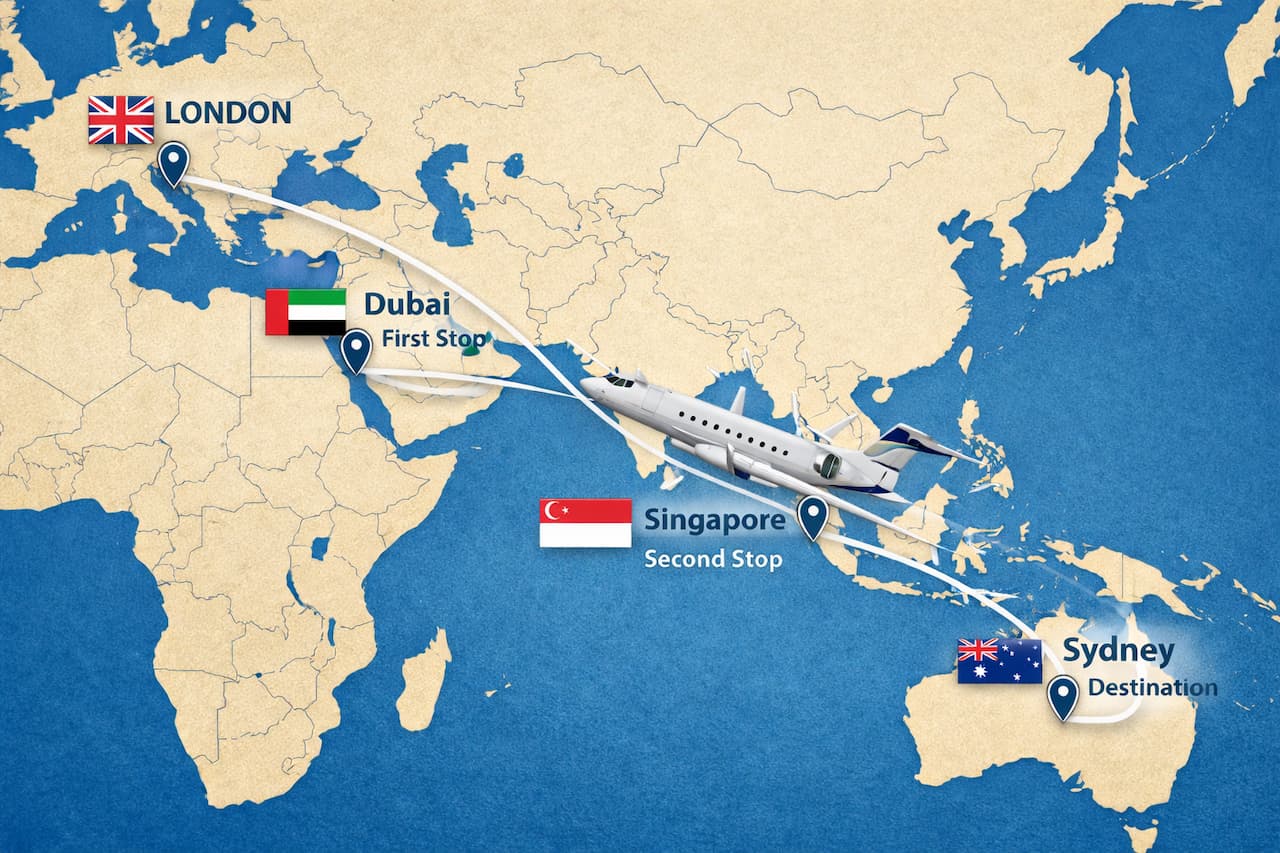
London to Sydney by private jet: which planes succeed in getting to Australia from Europe

by
written by


Flying from London to Sydney represents one of the most challenging routes ever for private aviation. With a distance exceeding 9,000 nautical miles, this route tests the range, performance, and operational capabilities of even the world’s most advanced business jets.

But is it possible to cover such a distance with a private jet? More importantly: which models are able to do this efficiently and safely?

The London-Australia distance and operational limitations.

The London-Sydney route measures about 9,200 nm, while London-Perth is around 7,800 nm. These values are greater than the actual operational range of any currently certified private jet.

As a result, today there are no business jets capable of flying the London-Australia route without at least one technical stopover, maintaining fuel reserves and operating standards that meet international regulations.

Private jets best suited for ultra long-range routes

Bombardier Global 7500

The Bombardier Global 7500 is considered one of the absolute benchmarks for very long-range missions.

  • Maximum range: about 7,700 nm
  • Cruising speed: Mach 0.85-0.90
  • Operating altitude: up to 51,000 feet

This aircraft allows direct connections between London and Southeast Asia, with a single technical stopover to continue to Australia.

Gulfstream G650ER

The G650ER combines high range and one of the highest speeds in the entire business jet category.

  • Autonomy: about 7,500 nm
  • Maximum speed: up to Mach 0.925
  • Altitude: about 50,000 feet

Because of this performance, the Gulfstream G650ER is particularly suitable for intercontinental routes with only one intermediate stop, while maintaining extremely competitive overall flight times.

  • Also read our article on Micheal Jordan’s extra luxurious Gulfstream G650ER

Gulfstream G800

The Gulfstream G800 represents the next generation of ultra long-range private jets.

  • Declared range: over 8,000 nm under optimal conditions
  • Cruising speed: Mach 0.90
  • Maximum altitude: 51,000 feet

It is the business jet that comes closest in theoretical terms to being able to cover extreme distances such as London-Sidney, while operationally requiring a stopover for refueling.

Speed and altitude: key advantages of private aviation in such long flights

Ultra long-range private jets regularly fly at altitudes between 45,000 and 51,000 feet, well above most commercial traffic.

This allows:

  • more stable air
  • lower aerodynamic drag
  • High cruising speeds, often exceeding Mach 0.90

On routes of more than 15 hours flight time, these factors significantly affect the efficiency, regularity and overall comfort of the flight.

Technical layovers on London-Sidney routes.

Stopovers for refueling are planned at strategic airports with dedicated business aviation infrastructure.

Airports commonly used for intermediate stopovers between London and Sydney:

  • Singapore – ideal hub between Europe and Oceania
  • Dubai and Abu Dhabi – natural transit points between Europe and Asia
  • Delhi – efficient solution for more direct routes
  • Perth – Australia’s main gateway from Europe

In most cases, two stopovers are limited to the time needed for refueling and technical checks.

Are there private jets that can fly nonstop from London to Australia?

Currently no. There are no business jets, even in operational prototype stage, capable of covering more than 9,000 nm while maintaining the safety, load and fuel reserve requirements of civil aviation.

Even the most advanced projects currently remain below this threshold.

Estimated flight times

With only one technical stopover, a private flight from London to Australia (Sydney or Perth) takes on average:

  • 18-20 hours of total flight time
  • Variable depending on the chosen route, weather conditions, and prevailing winds

The main advantage of the private jet lies in continuity of travel and operational flexibility, key elements on routes of this length.

Can it be done?

  • Flying from London to Australia by private jet is perfectly possible today, with proper planning
  • Ultra long-range jets such as Global 7500, G650ER, and G800 are the most suitable
  • The route requires at least one technical stopover
  • No business jet is currently able to operate the nonstop route

The London-Sidney route represents one of the most extreme examples of what modern private aviation can offer in terms of performance, range, and operational capabilities.


Source link

0 comments
0 FacebookTwitterPinterestEmail
Services

100,000th Forklift Raises €100,000 for UNICEF

by
written by


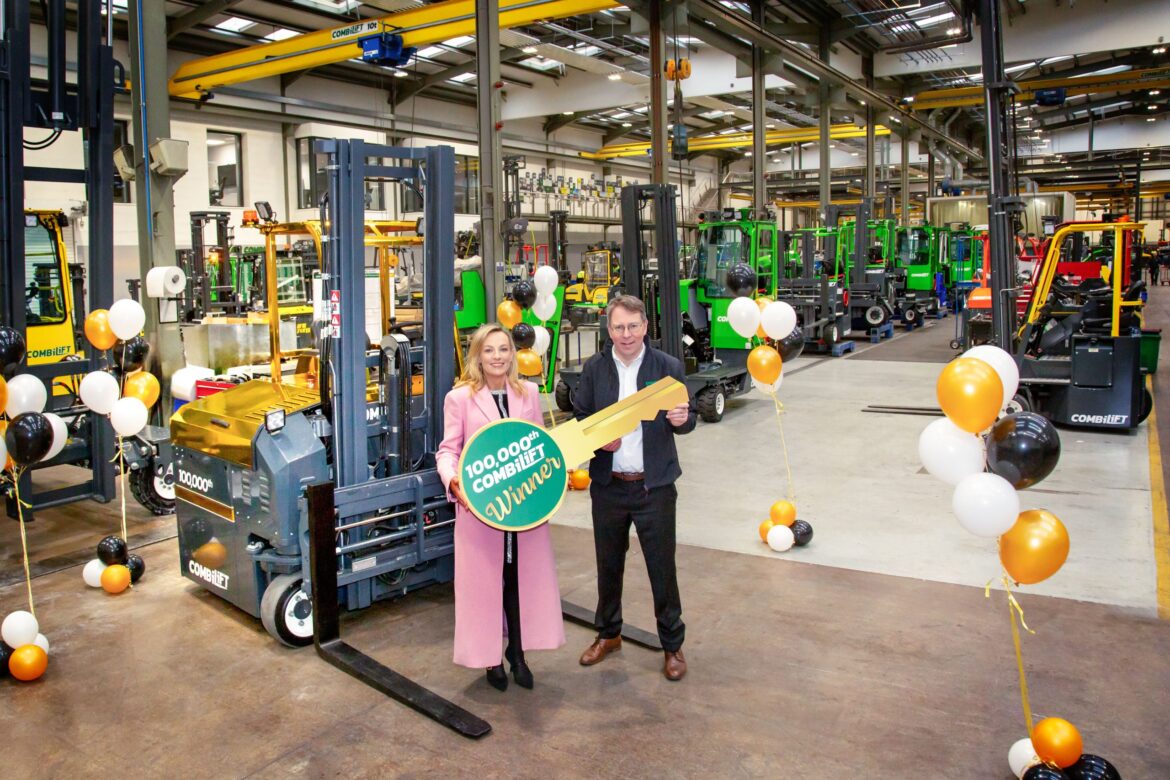
Global materials handling supplier Combilift has celebrated a major manufacturing milestone by transforming its 100,000th forklift into a powerful force for good, raising and donating €100,000 to the United Nations International Children’s Emergency Fund to support children in crisis worldwide.

To mark the production of its 100,000th forklift, Combilift launched its largest-ever worldwide competition, offering the exclusive 100,000th ‘Golden Prize’ multidirectional Combi-CBE. All proceeds raised were donated to UNICEF Ireland’s Emergency Fund.

The campaign generated €56,500 in ticket sales, and at a cheque presentation ceremony, Combilift announced it had topped up the total contribution to an impressive €100,000, underlining the company’s long-standing commitment to corporate social responsibility.

Speaking at the handover, Combilift CEO and Co-Founder Martin McVicar (a recent guest on Logistics Business Conversations Podcast) said:

“This campaign was designed not only to celebrate a major manufacturing achievement for Combilift, but also to make a meaningful difference beyond the factory floor. By supporting UNICEF, we are supporting one of the world’s most effective humanitarian organisations and helping children who need it most.”

The cheque was formally presented by Martin McVicar to Owen Buckley, UNICEF Ireland’s Head of Corporate Partnerships, and Michaela Plunkett, Business Development Manager, in Monaghan.

Owen Buckley welcomed the donation, saying:

“As we enter the winter season, our priority is ensuring children affected by war and natural disasters have access to warm clothing, safe shelter and continued education. This generous contribution from Combilift will help UNICEF respond quickly to urgent needs.”

The winning ticket was purchased by Kareen Farrell, who travelled to Combilift’s headquarters in Monaghan to receive the one-of-a-kind 100,000th Combi-CBE ‘Golden Forklift.’

Reacting to her win, Kareen Farrell said:

“I was absolutely delighted when I heard I had won, as I’m never lucky. My dad shared the competition details and bought a ticket to support UNICEF because it’s a children’s charity that helps children all over the world, so winning the forklift was an incredible bonus.”

The Golden Forklift was first unveiled at the IMHX Exhibition in the UK before embarking on a European trade show tour, attracting strong international interest and reflecting Combilift’s global customer base and shared commitment to positive social impact.


Source link

0 comments
0 FacebookTwitterPinterestEmail
Newer Posts
Older Posts

Recent Posts

  • Driving Efficiency and Innovation in Conveying
  • Milano Linate l’aeroporto ideale per i jet privati
  • Software Migration for Automated Warehouse
  • Yard Management for Smaller Logistics Facilities
  • Order Picking with Intelligent Robotics

Recent Comments

No comments to show.

Social Connect

Whatsapp

Recent Posts

  • Driving Efficiency and Innovation in Conveying

  • Milano Linate l’aeroporto ideale per i jet privati

  • Software Migration for Automated Warehouse

  • Yard Management for Smaller Logistics Facilities

  • Order Picking with Intelligent Robotics

Newsletter

Categories

  • Services (1,086)
  • Uncategorized (41)

@2024 - All Right Reserved. Designed and Developed by Sierraline Cargo services

Manage Consent
To provide the best experiences, we use technologies like cookies to store and/or access device information. Consenting to these technologies will allow us to process data such as browsing behavior or unique IDs on this site. Not consenting or withdrawing consent, may adversely affect certain features and functions.
Functional Always active
The technical storage or access is strictly necessary for the legitimate purpose of enabling the use of a specific service explicitly requested by the subscriber or user, or for the sole purpose of carrying out the transmission of a communication over an electronic communications network.
Preferences
The technical storage or access is necessary for the legitimate purpose of storing preferences that are not requested by the subscriber or user.
Statistics
The technical storage or access that is used exclusively for statistical purposes. The technical storage or access that is used exclusively for anonymous statistical purposes. Without a subpoena, voluntary compliance on the part of your Internet Service Provider, or additional records from a third party, information stored or retrieved for this purpose alone cannot usually be used to identify you.
Marketing
The technical storage or access is required to create user profiles to send advertising, or to track the user on a website or across several websites for similar marketing purposes.
  • Manage options
  • Manage services
  • Manage {vendor_count} vendors
  • Read more about these purposes
View preferences
  • {title}
  • {title}
  • {title}
Sierraline Cargo Services
  • HOME
  • Services
    • Trade With Us
  • About Us
  • Contact Us
  • private jet
    • BOOK YOUR JOURNEY
  • Track Packages
  • Insurance
  • safekeeping

WhatsApp us