Sierraline Cargo Services
  • HOME
  • Services
    • Trade With Us
  • About Us
  • Contact Us
  • private jet
    • BOOK YOUR JOURNEY
  • Track Packages
  • Insurance
  • safekeeping
Services

From Chaos to Clarity in Parcel Logistics

by
written by


Parcels and parcel bags that pile up at transition points on belt conveyors are not inevitable. From March 24 to 26th, Flexco Europe, a specialist in mechanical conveyor belt connection systems, will be presenting its segmented transition plates and belt edge protection at LogiMAT. Other exhibits include transfer plates for roller conveyors. Flexco Europe will be demonstrating how the individual solutions are used and complement each other to achieve maximum effectiveness in Hall 1, Booth A25, using a demonstration model.

With a low coefficient of friction, the company provides reliable transfer points where items can easily slide from belt to belt or to the transfer hopper to transport packages and cartons safely. Conveyed material frequently accumulates at transfer points and falls to the ground, especially at airports. This can damage the contents of packages. With segmented transfer plates the material can glide smoothly from belt to belt. Flexco Europe offers two transfer plate variants, suitable for belts with widths of up to 1,524 millimeters and gaps of 100–250 or 75–150 millimeters. The bright yellow colour of the segments helps maintenance personnel monitor them and replace them quickly if necessary.

Roller conveyor transfer plates (RCTPs), which can be installed in belt-driven, shaft-driven, chain-driven and motorized roller conveyors, ensure that envelopes, polybags, and small parcels do not get lost between the rollers – a common problem in conveyor systems. The RCTP covers the gap between two rollers. With this solution, conveyors are not only more productive, but also safer. Employees no longer have to reach between the rollers to pull out products, reducing the risk of injury. The transfer plates are suitable for large quantities of packaged products that can differ greatly, ranging from soft and flexible to dense and compact.

Open edges along conveyor lines also allow conveyed goods to fall and slide under the conveyor belt. Product loss and damage to goods, belts, and, in the worst case, the system itself, can result in unplanned and costly downtime. To prevent this from happening, Flexco has developed the Belt Edge Protector (BEP). Made from recycled and wear-resistant UHMW, it covers the conveyor belt edge and prevents packages from getting stuck underneath. The simple and quick installation in individually adjustable lengths makes the BEP even more indispensable.

These three components in combination (STP, RCTP, and BEP) offer the solution for any logistics system to make maintenance work and downtime plannable, keep maintenance costs low, and maintain high safety standards.


Source link

0 comments
0 FacebookTwitterPinterestEmail
Services

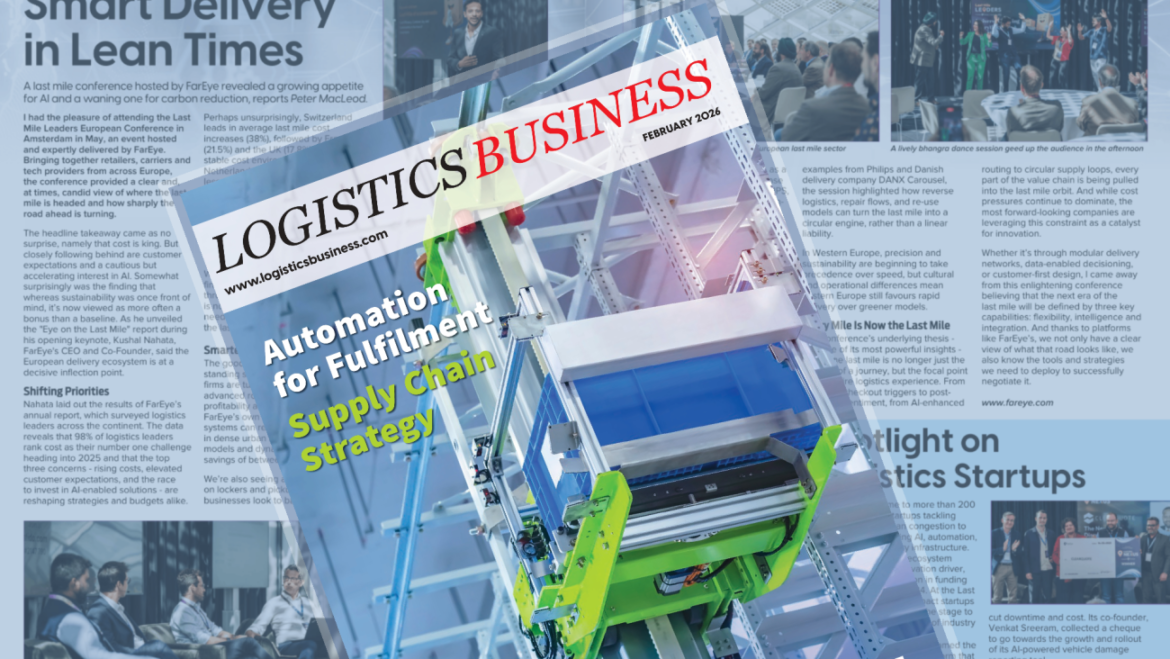
New Logistics Business Magazine Issue Out Now: February 2026

by
written by


The February 2026 issue of Logistics Business is now available, offering in-depth coverage of supply chain resilience, warehouse automation, energy strategy, and next-generation logistics technology. With disruption, cost pressures, and decarbonisation continuing to shape the sector, this edition explores how operators are adapting — and where investment is being directed.

Supply Chain & Transport: Resilience at Scale
We open with an exclusive interview with Etihad Cargo’s Chief Cargo Officer, Stanislas Brun, on a strategy built around disciplined growth, digital control, and strategic partnerships. The feature looks at how Abu Dhabi is positioning itself as a global logistics hub amid geopolitical volatility and extended aircraft delivery timelines.

Amazon’s approach to supply chain resilience is also examined, drawing on insights from the Amazon Business Reshape conference. From AI-led forecasting to same-day fulfilment and supplier redundancy, adaptability is emerging as the defining capability for modern supply chains.

Infrastructure and investment remain key themes, including the 285,000 sq.ft. chilled distribution hub at DIRFT for Arla Foods and XPO Logistics, adaptive planning models for volatile conditions, and ways to turn warehouse energy into a competitive advantage.

Software & IT: From AI Hype to Agentic Execution
Digital transformation continues at pace. This issue features interviews with software providers positioning themselves as AI-first, debates on modular versus monolithic supply chains, and an exploration of “Agentic AI” — the latest concept in decision-driven warehouse execution.

Materials Handling & Intralogistics: Automation for Fulfilment
Warehouse innovation is at the heart of this issue. Highlights include visits to highly automated 3PL centres, Flying Tiger’s AMR-driven distribution hub in Poland, the growing role of digital twins, next-generation conveyor systems, and smarter safety and energy-saving equipment. Humanoid robots and compact, high-throughput sortation systems are also reviewed.

Energy, Sustainability & Post-Peak Strategy
Rising electricity costs and electrification pressures are driving smarter energy management. The issue examines battery storage, onsite renewables, and other strategies to reduce grid dependence. It also looks beyond peak season, outlining five challenges logistics businesses face once demand subsides — and why fundamentals like preventative maintenance remain critical.

The February 2026 issue shows a sector moving beyond growth at any cost. Resilience, scalability, energy intelligence, and disciplined automation are shaping the next phase of supply chain evolution.


Source link

0 comments
0 FacebookTwitterPinterestEmail
Services

Digital Trade Tech Firm Moves HQ to UK

by
written by


LogChain will relocate its global headquarters to the UK and establish a HQ and new base for innovation and scale in the Liverpool City Region, strengthening the UK–Southeast Asia digital trade corridor and scaling trusted, interoperable trade infrastructure across global markets.

The move reflects the company’s ambition to scale the practical infrastructure required for modern trade: multi-party digital workflows, trusted data exchange, and legally robust electronic documentation that reduces friction, strengthens resilience and improves compliance across global supply chains.

Leading Base for Trade Tech

The UK aims to become one of the world’s most credible environments for trade technology companies, combining deep capital markets and world-class professional services with a legal and regulatory direction-of-travel that enables innovation to scale responsibly.

Liverpool: An Engine Room Of Growth

Liverpool City Region was selected for its globally connected trade and logistics footprint, strong innovation credentials, and Freeport development. This positions the region as a practical ‘real economy’ testbed for scaling digital trade. The UK HQ and operational base will support LogChain’s work with governments, ports, financial institutions and industry partners, while strengthening links between UK capabilities and international trade corridors. 45 percent of trans-Atlantic trade goes through the Port of
Liverpool and is home to more than 6,500 digital and tech businesses. Its blend of trade infrastructure and innovation capacity (combined with the world’s greatest football team!) makes it one of the UK’s most important real-world testbeds for scaling next-generation supply chain and logistics solutions.

“I’m really proud that LogChain has chosen the Liverpool City Region as its UK base. We’re a place that ‘gets’ trade, logistics and technology, and we’re serious about backing companies that are shaping the future of global commerce. Moves like this help bring good jobs to the region and strengthen our links with the rest of the world,” said Steve Rotheram, Mayor of the Liverpool City Region, UK.

Proof Point in Trade Digitalisation

LogChain is globally recognised as a leader in the burgeoning field of trade digitalisation, not ‘paper on PDFs’, but the transformation of cross-border trade processes through secure digital documentation, automated workflows and interoperable data. LogChain delivered the world’s first fully digitalised movement of goods, demonstrating that legal, operational and commercial barriers can be
overcome in live trade environments.

In 2026, trade digitalisation is more important than ever: geopolitics, supply chain disruption, compliance pressures and cyber risk have made trade resilience a national capability issue, not just an operational efficiency issue. Digital trade infrastructure underpins faster customs clearance, reduced fraud, better ESG traceability, and improved access for SMEs and emerging markets.

“LogChain was built as infrastructure for digital trade, designed to support innovation while meeting the highest standards of security, trust and compliance. This expansion reflects our confidence in the UK as an environment where regulated innovation can scale responsibly. Liverpool City Region’s role in global trade, logistics and Freeport development closely aligns with how we think about building dependable systems that underpin international commerce. We see this move as a foundation for long-term collaboration,” said Andie McKeown, Co-Founder and CEO of LogChain.


Source link

0 comments
0 FacebookTwitterPinterestEmail
Services

Execution Is the New Competitive Edge

by
written by


Supply chain leaders are betting on real-time action over planning to gain a competitive edge, according to new research, which reveals that competitive advantage comes from connected, intelligent execution, not isolated systems and static planning.

Supply chain execution has emerged as the defining battleground for competitive advantage, according to research released by Infios, a global specialist in intelligent supply chain execution. The ‘Supply Chain Execution Readiness Report’, based on a survey of 100 U.S.-based supply chain leaders, reveals that nearly eight in ten enterprises now view fast, dynamic execution — not planning or visibility alone — as their primary source of competitive differentiation in volatile markets.

This strategic shift is driving unprecedented investment: 59% of organizations plan to increase spending on supply chain solutions over the next 12 months, even as economic headwinds persist. The message is clear: connecting execution across order, warehouse and transportation operations is no longer operational infrastructure — it’s strategic leverage.

Yet the research exposes a troubling paradox. While supply chain leaders recognize execution as their competitive edge, most organizations lack the fundamental capabilities to execute at speed.

Where Supply Chains Break Down

The Infios research documents systematic execution failures: 58% cite manual workflows as their biggest inefficiency, nearly half lack automation for daily tasks (46%) and only 20% have real-time visibility across operations.

Most remain trapped in reactive mode, relying on delayed information and manual firefighting. In fact, when asked to best describe their decision-making approach during a major supply chain disruption, only 6% of respondents say they use analytics and/or AI for automated, prescriptive responses, while the majority primarily react to events as they occur (51%) or use technology for predictive alerts and manual interventions (43%).

“Supply chains aren’t struggling because leaders lack intent or investment,” said Richard Stewart, Executive Vice President of Product and Industry Strategy at Infios. “They’re struggling because execution environments were never designed to sense disruption, coordinate decisions and act in real time. When systems operate in silos, even minor delays quickly cascade into missed commitments and rising costs.”

From Reactive to Autonomous: The Power of Intelligent Execution

Supply chain execution has evolved into a strategic capability that directly impacts resilience, customer experience and growth. Organizations that master execution can respond to disruptions in real time, synchronize decisions automatically across operations and transform volatility into competitive opportunities.

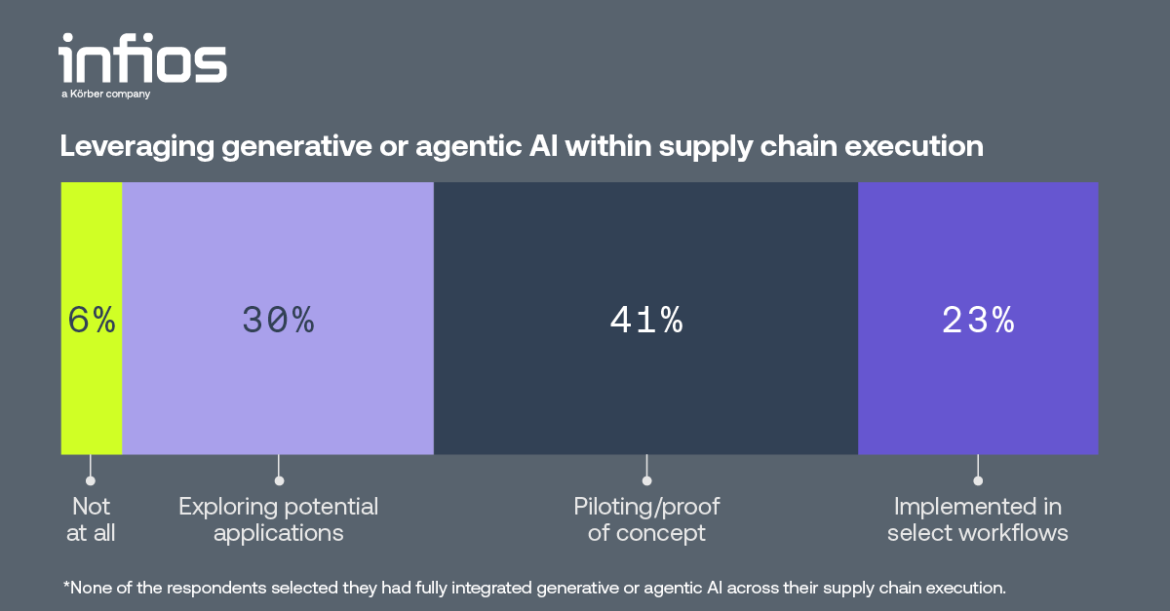
Yet a stark artificial intelligence (AI) execution gap persists: only 23% have implemented AI in select workflows across supply chain execution and 41% remain in pilot stages.

The Next Phase: Systems That Act, Not Just Record

The next wave of supply chain advantage won’t come from more dashboards or visibility tools—it will come from connected execution environments that synchronize decisions and embed intelligence at the point of action.

“AI creates the most value when intelligence is directly connected to action,” Stewart added. “The organizations that pull ahead will be those that move from systems that record activity to systems that act—automatically, intelligently and end to end.”

The Execution Imperative

Execution capability is the new competitive divide. Organizations that fail to modernize — replacing manual workflows with intelligent automation and achieving real-time synchronization — will fall behind competitors who master dynamic execution. As supply chains face mounting pressure from customer expectations, cost volatility and operational complexity, the ability to execute with speed and precision will separate market leaders from followers.

To learn more about how to seize the opportunities revealed in today’s supply chain landscape, download The Supply Chain Execution Readiness Report.


Source link

0 comments
0 FacebookTwitterPinterestEmail
Services

Manchester International, the ideal airport for arriving in England by private jet

by
written by


Landing in the UK by private jet means choosing efficiency, comfort, and premium services. Among all airports in northern England, Manchester International Airport (MAN) stands out as one of the best options for business and leisure flights, thanks to dedicated infrastructure, impeccable ground services.

Manchester International Airport: the benchmark for private jet travel in the UK

The airport in Manchester is not only the third busiest airport in the United Kingdom, but also a strategic hub for private flights. Here, every detail is designed to make the flying experience quick, safe, and comfortable.

FBO and VIP lounge services

FBOs (Fixed Base Operators) at Manchester International Airport offer everything a business or private passenger could want:

  • Fast track check-in and security checks-you skip the lines and are ready to go in minutes.
  • Catering services and private lounges: elegant spaces to relax or work before takeoff.
  • Dedicated pet transport services: with utmost attention, dedicated spaces and guaranteed safety.
  • Extreme weather management: including heated hangars and ground operations such as de-icing (removal of ice from wings) in winter, a critical service to ensure safety and punctuality.

Here, every detail is designed to turn the landing or departure experience into a smooth and stress-free process, setting Manchester apart from many other British airports.

Private jets Manchester airport

Land at other airports near Manchester

While Manchester is ideal for more direct flights and those seeking established infrastructure, there are attractive alternatives for private jets:

  • Biggin Hill Airport (BN2): located south of London, famous for discretion, premium services, and low traffic.
  • Farnborough Airport (FAB): a symbol of British business aviation, ideal for corporate flights and large jets.
  • Liverpool John Lennon Airport (LPL): a quieter option than Manchester, with excellent facilities for private jets.

The choice of airport depends on the travel strategy, but all of these airports should be considered excellent for private jets and dedicated ground services.

Main routes to Manchester

Due to its strategic geographic location and efficient airport, Manchester is a popular destination for discerning travelers who choose to arrive in England and throughout the United Kingdom by private jet. Below are three examples of routes from Italy, Spain, and France.

Rome Ciampino – Manchester

Imagine taking off from Rome’s Ciampino airport aboard a Cessna Citation CJ3, and in less than three hours finding yourself in the heart of the North of England, ready to start a business day or an exclusive weekend. This is not a dream: it is the real experience of those who choose to fly by private jet to Manchester by landing at one of the finest hubs for business aviation in the United Kingdom.

  • A private flight Rome Ciampino – Manchester Internationalduraabout 2h45 minutes by light jets such as Cessna Citation.
  • Departing from Rome Ciampino, the experience is immediately premium thanks to high-end FBOs, VIP lounges. and truly streamlined boarding procedures.

Barcelona – Manchester

  • The private flight from Barcelona to Manchester is equally quick and relaxing, combining efficiency and pleasure: about 2h15-2h30 flight time.
  • Interesting alternative for those who want to leave a nearby secondary airport: Sabadell Airport, dedicated exclusively to private jets ensuring greater discretion without sacrificing luxury.

Paris (Le Bourget) – Manchester

MAN International: perfect for landing in the UK.

Whether it is Rome, Barcelona or Paris, Manchester remains a very important destination for business aviation in the UK,even taking off from alternative airports for those who want to personalize their flying experience to the fullest.

Those flying to the UK by private jet should consider:

  • Security checks and customs: quick procedures with FBOs, but always to be planned.
  • Weather conditions: winter and frequent rains may require extra services such as wing de-icing.
  • Airport alternatives: in addition to Manchester, Farnborough is an excellent choice for corporate flights, while Biggin Hill offers discretion and agility for direct flights to and from London.

Contact privatejetfinder.com if you want to turn your next private flight to Manchester into an exclusive, efficient and completely tailor-made experience. Requesting a personalized quote is quick and easy: you will quickly receive a detailed proposal designed around your actual travel needs.


Source link

0 comments
0 FacebookTwitterPinterestEmail
Services

Free Webinar: How to Stop Fleet Spend Leakage & Regain Cost Control

by
written by


Margins are under pressure across the transport and logistics sector – and fleet spend leakage is increasingly part of the problem. From fuel misuse and unauthorised transactions to delayed visibility and manual reconciliation, small inefficiencies can quickly accumulate into significant cost erosion.

To address this challenge, Logistics Business is hosting a free webinar on 24 February 2026 at 14:00 UTC, exploring practical strategies to stop fleet spend leakage and regain cost control.

Expert panel discussion

The session brings together industry expertise from across fleet operations, compliance and technology:

  • Peter MacLeod, Editor & Podcast Host, Logistics Business
  • Ruth Waring, Transport & Compliance Consultant and Founder, Women in Logistics UK
  • Stuart Campbell, Product Lead, Fleetwallet at Cubic³

Together, the panel will examine how transport and finance teams can move from reactive, month-end reporting to proactive spend management.

What the webinar will cover:

  • Improving real-time visibility of fleet spend
  • Identifying and preventing unauthorised transactions
  • Tracking costs by vehicle, driver and route
  • Simplifying compliance and audit-ready reporting
  • Reducing administrative burden while strengthening control

The discussion is aimed at fleet managers, transport operators, compliance leads and finance professionals seeking practical approaches to tightening cost control without slowing operations.

With cost pressures continuing across fuel, maintenance and operational overheads, gaining better visibility and control over fleet spend has become a strategic priority rather than an administrative task.

Register for the free webinar:


Source link

0 comments
0 FacebookTwitterPinterestEmail
Services

ASRS Goes Live at Dutch DC

by
written by


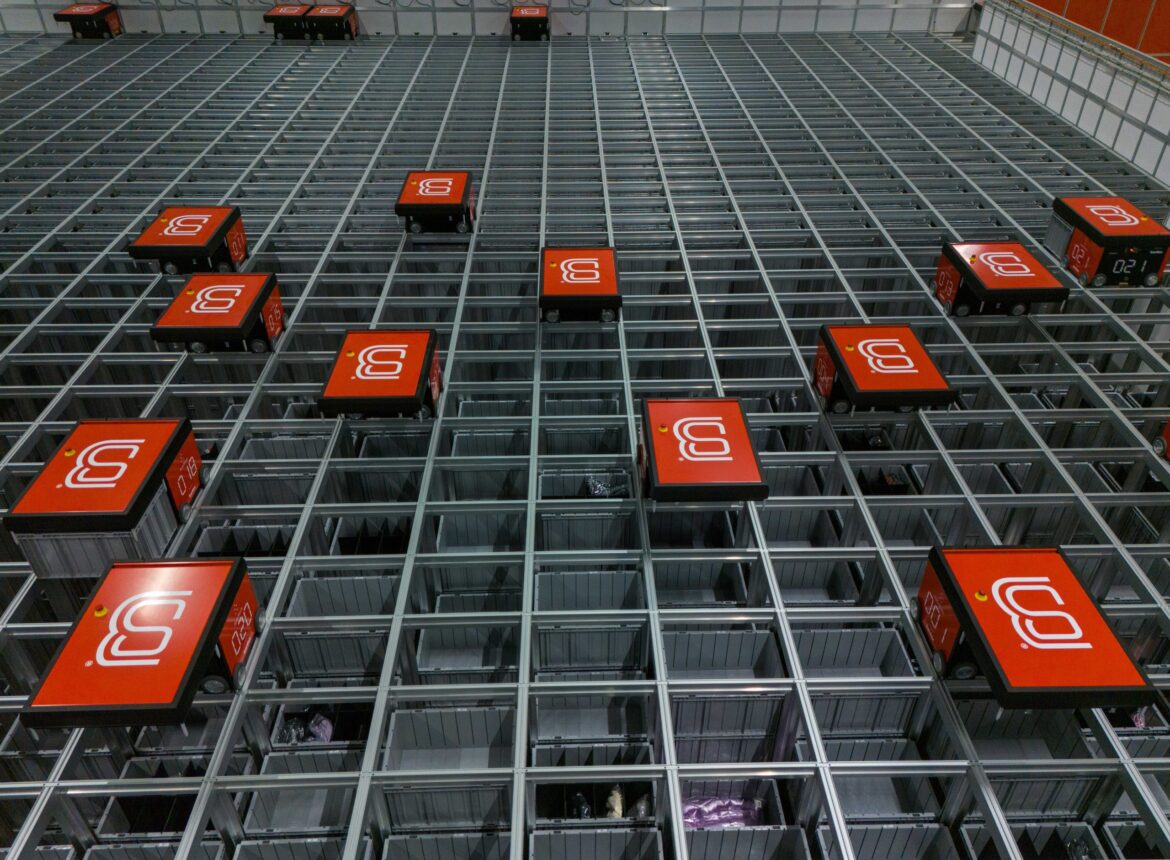
Bleckmann, providers of supply chain management for fashion and lifestyle brands, announces the ‘go-live’ of a new automated storage and retrieval system (ASRS) at its site in Almelo – Newton, Netherlands. The new integrated goods-to-person system is an integrated Kardex AutoStore solution with automated packing line and provides a streamlined alternative to traditional rack storage. It dramatically reduces inventory footprint while speeding up picking and packing operations. The new system is the next step in Bleckmann’s automation strategy, which aims to address labour scarcity and provide a smoother fulfilment process.

Less space, more speed

The new AutoStore uses up to seven times less space than a traditional picking floor to store the same amount of inventory. This increases storage capacity, allowing more SKUs (from multiple customers) to be stored simultaneously and greatly reducing the risk of stock shortages. Items are also retrieved by radio-controlled robots, saving time by eliminating the need to walk towards picking locations.

The AutoStore is part of an integrated solution that requires minimal human intervention. This features an advanced conveyor system from carton erectors and an autonomous packing station with height reduction of the cartons, which significantly streamlines the fulfilment process.

“From the moment a product enters the AutoStore until it leaves the warehouse in a carton, it will have only been touched by a single pair of hands,” explained Kevin Paindeville, director warehouse solutions and innovation at Bleckmann. “This increased productivities, and reduce risk of error due to less manipulation.”

An integrated solution

Automating the labour-intensive picking and packing process will enable Bleckmann’s clients to offer their customers later cut-off times for next-day delivery, among other benefits. These include intelligent demand forecasting. “The AutoStore system automatically makes the most popular items more accessible, so that they can be dispatched faster,” said Tom Wijlens, COO Netherlands North at Bleckmann. “It’s also possible to programme the system ahead of peak sales periods so top-selling items are available even quicker – saving valuable time during those extra-busy moments.”

Lights-out logistics

Switching to the AutoStore solution has many other benefits, according to Wijlens: “The new system greatly reduces the likelihood of picking mistakes,” he continued. “It also offers exceptional flexibility and scalability. This means that we can start with a basic set-up and expand it when clients need extra capacity – during the Black Friday period, for example – without disrupting ongoing operations.”

Another advantage of the AutoStore system is its low energy consumption. Ten robots at work use the same amount of energy as one vacuum cleaner. As the robots can work in the dark, energy can also be saved by switching off warehouse lights.


Source link

0 comments
0 FacebookTwitterPinterestEmail
Services

Holding Brakes for Electric Counterbalance Forklifts

by
written by


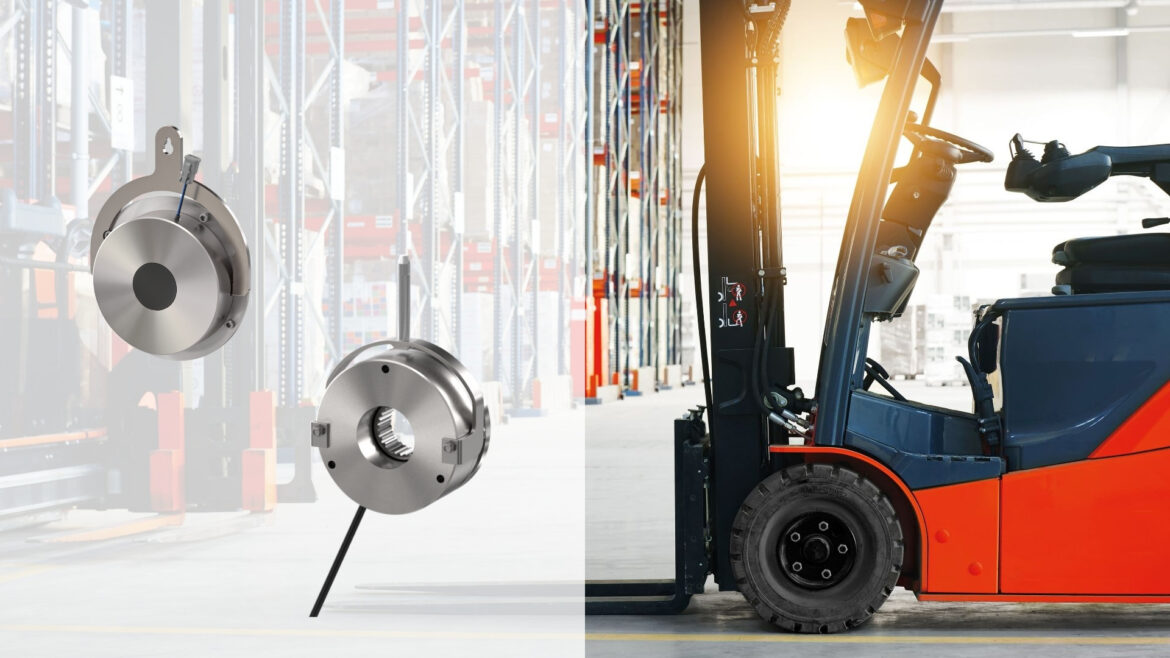
The industrial truck industry is characterized by high safety and performance requirements. With increasing electrification, electric drive systems and their safety components are becoming more important. Compact spring-applied brakes from Kendrion contribute significantly to the operational safety of industrial trucks and impress with their stable braking torque over their service life, robust design for industrial conditions, and high mechanical load capacity during emergency stops.

The holding brake is a key component for the operation of counterbalance forklifts: it secures the vehicle when stationary on ramps, is mechanically designed for a high number of load changes, and closes reliably in the event of a fault. The fail-safe principle has proven itself here – spring-operated, electrically released, and closed when de-energized.

Electrified powertrain

With the BFK552-12 and BFK457-14 spring-applied brakes, Kendrion provides its customers with precision solutions for electric counterbalance forklifts. The brake specialists have been developing components for the industrial truck market for decades and support manufacturers and system partners with application-oriented design and series-production-ready implementation. The portfolio ranges from standard brakes to application-specific variants – tailored to motor/gearbox integration, installation position, and protection type requirements.

Flat, robust, energy-optimized

The BFK552-12 is a flat spring-applied brake with a height of only 43.7 mm and a braking torque of 60 Nm – designed for counterbalance drives, including in back-to-back arrangements. With protection class IP66, the brake is ideal for use in climatically demanding environments. Overexcitation and holding current reduction reduce power loss and heat generation, which in turn has a positive effect on the efficiency and longevity of the forklifts. As a ready-to-install unit, the brake reduces installation and adjustment effort and minimizes typical installation errors. In addition, customers benefit from the global availability of brakes developed and produced in Germany.

Design-in platform for the most demanding requirements

The BFK457-14 is available as a design-in platform for new developments with higher performance requirements: With a braking torque of more than 90 Nm and designed for high emergency stopping energies, the brake has proven itself in practice even at high travel speeds. Compact versions with a particularly space-saving design facilitate integration into dense drive compartments and enable application-specific adaptations.

Application experience meets vertical integration

When developing brakes, Kendrion combines application experience with vertical integration, relying for decades on its German development site, well-coordinated project management, a high level of service, and its in-house rotor production.

Visit Kendrion at LogiMAT in Stuttgart from March 24 to 26, 2026, Hall 1, Booth GA35.


Source link

0 comments
0 FacebookTwitterPinterestEmail
Services

From Express to Integrated Logistics for DX

by
written by


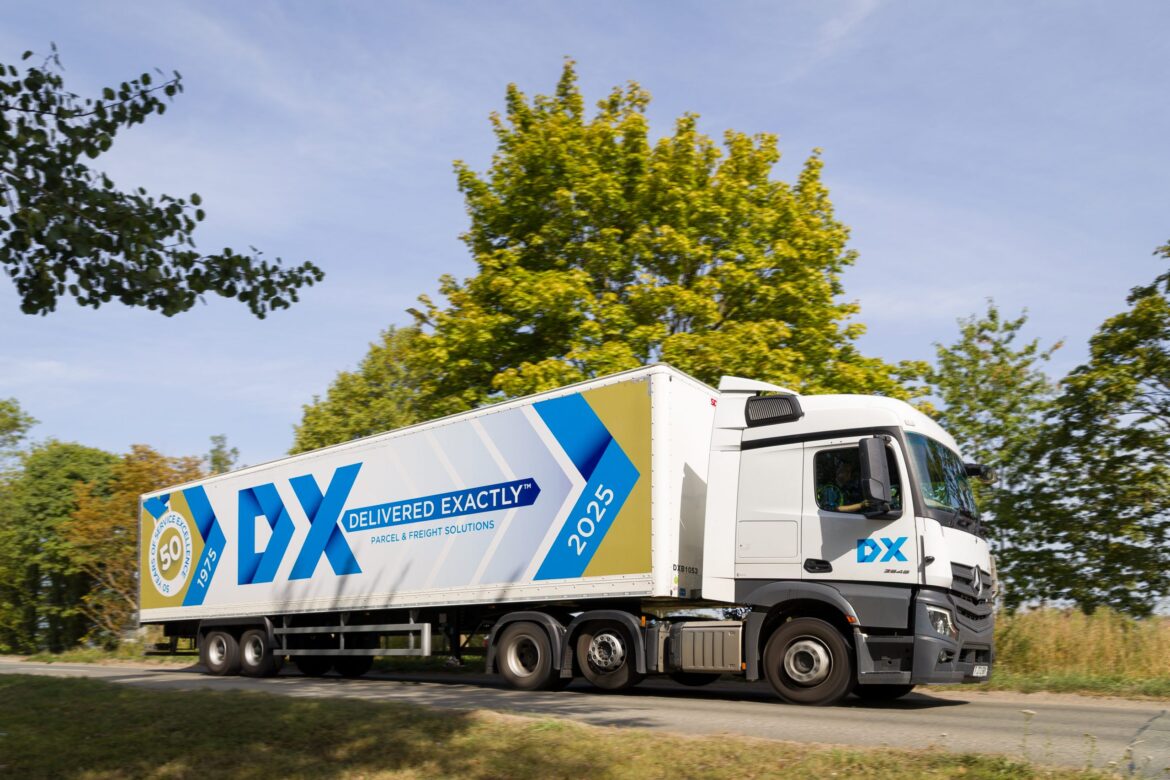
Having honed a reputation and built a physical presence over fifty years as a same day and next day package, parcel and bulky delivery specialist throughout the UK and Ireland, DX is morphing into an integrated pallet freight and third-party logistics operator. CEO Ian Truesdale sat down for an exclusive with Logistics Business’ David Priestman to explain the transformation.

Having been acquired by HIG Capital two years ago, DX Group (formerly listed on the London AIM market) has the resources and new leadership to drive change and growth as it now becomes DX Logistics. Truesdale, who joined last July, forecasts double-digit revenue growth this year to reach the £600m mark. “It’s a good company, with a strong customer base,” he tells me. “We’re profitable, but with the potential to grow – organically, via further acquisitions and by expanding into new vertical markets such as pharmaceuticals, healthcare, defence and temperature-controlled storage and distribution.”

DX has approximately 5300 staff, 2300 vehicles and 105 depots and hubs. Having acquired HDC Logistics in Biggleswade, Bedfordshire, the company has gained pallet freight capacity. Truesdale (pictured, below) expects there to be some consolidation in the British pallet freight networks as there is over-capacity in haulage. His substantial prior experience with Unipart, Kuehne + Nagel, CEVA, Exel and Accenture was what attracted him to HIG to lead this specific challenge.

Physical Presence

The company can now offer integrated logistics services and dedicated solutions. From multi-user DCs to a hybrid of B2C and B2B delivering, direct or via the DX network, a multi-channel approach is being developed. “Many 3PLs don’t have last mile capacity,” Truesdale says. “DX can integrate that into our general suite of services and be a one-stop-shop – end-to-end on the demand side.” This means transporting everything from passports and letters to pallets and bulky items. 93 million items were delivered by the company last year.

Partnerships are another means to broadening the business and its range of expertise. DX has just paired with Rhenus to undertake two-person home delivery of bulky items, white goods and furniture in the UK and Ireland. “There’ll be more of these deals,” Truesdale states. “It was an open conversation with Rhenus, which is a competitor, about what was best for their customers. Instead of withdrawing from this part of the market they chose us.”

Service is key

DX is focused on mid-market SME logistics contract wins, to add to its roster of the likes of B&Q, Viking, H Samuels, Toolstation, Screwfix and Euronics. “We can deliver to both their retail stores, wholesalers and consumers,” Truesdale emphasises.

I asked Truesdale about the company’s ecommerce and fulfilment capabilities. “We’re already 40-50% B2C, so we can call that ecommerce. Some young, independent fulfilment firms have had mixed success. We are identifying which of our customers are already doing ecommerce, or beginning to, or outsourcing it, and we’ll look to win some business there.”

Other challenges have got the CEO’s attention as well, ranging from automation and AI to service performance. I finished by asking Truesdale about the problematic issue of driver recruitment and retention. “Costs have risen,” he tells me. “We’re paying more to retain and to attract (for 7.5t and 18t lorry drivers). We need people in the business that enjoy physical work. We did a staff engagement survey when I arrived as a means of further improving the culture and working environment.” DX is also busy electrifying its commercial vehicle fleet, with HVO already widely used by line-haul trucks.

April will see the launch of an international parcel offering and in May for international freight, especially less-than-truck loads (LTL). These will be time-defined services using international partners – freight forwarders and shippers. Customers will be able to use the DX portal to book and get rates, with DX collecting items from them. Watch this space.


Source link

0 comments
0 FacebookTwitterPinterestEmail
Services

Devices’ Autonomous Bluetooth Tracking Network

by
written by


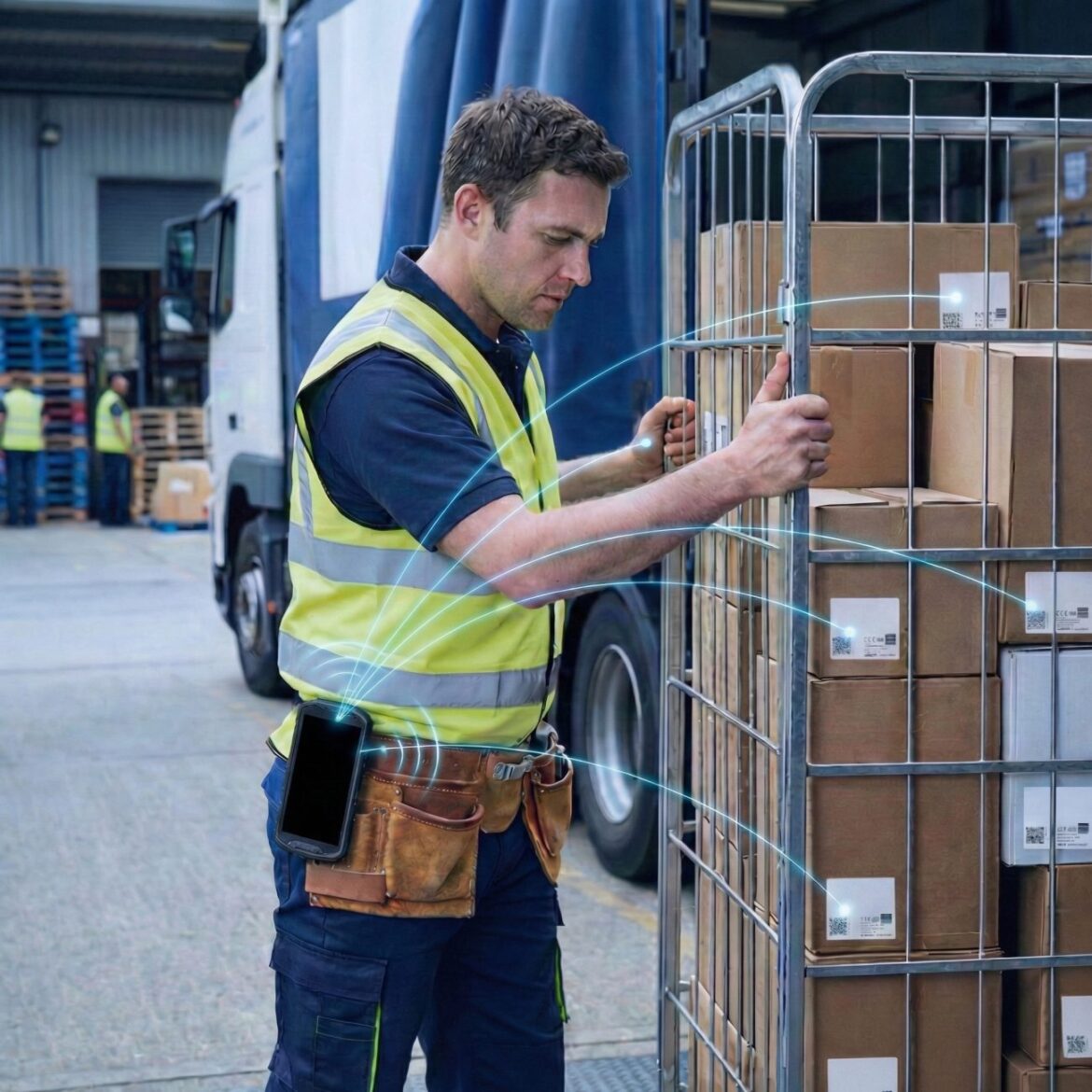
‘Blecon Agent’ is a new software solution aimed to transform Zebra Technologies’ frontline devices into an autonomous Bluetooth tracking network. By deploying the agent across Zebra’s existing device ecosystem, logistics providers can enable continuous asset visibility using the hardware already in the hands of their frontline workforce.

As logistics operations become increasingly digitised, the ability to track assets continuously, without deploying new infrastructure or relying on costly cellular connectivity, has become a commercial imperative.

The Blecon Agent delivers this capability by activating the built-in Bluetooth radios already present in Zebra devices, converting them into mobile hotspots that close long-standing visibility gaps across the supply chain.

By eliminating the need for manual scanning, cellular trackers, or new physical infrastructure, the Blecon Agent enables continuous, cost-effective asset visibility using hardware organizations already have in the field.

Digitising the Gaps in the Supply Chain

Supply chain leaders have historically struggled with gaps in their data where tracking is economically or operationally difficult. Blecon, a Zebra Registered ISV Partner, aims to close this gap by enabling the tracking of a wide spectrum of assets, from reusable roll cages utilising advanced Smart Beacons to one-time pallet shipments using low-cost, disposable Bluetooth Smart labels.

While cellular tracking is often too costly for high-volume assets and fixed readers leave blind spots, Blecon utilises the Bluetooth radio already present in frontline devices from companies like Zebra.
This effectively turns the connected frontline into a massive Bluetooth network that powers asset visibility, ensuring that data flows continuously between workers, assets and backend systems.

“The barrier to total visibility has always been the network,” said Simon Ford, CEO of Blecon. “Operators either pay for expensive cellular connectivity on every asset, or they accept that they can only track items where they have installed additional infrastructure. We offer another way. By activating the Bluetooth radio in the devices they already own, we turn the gaps in their supply chain into data.”

Empowering the Frontline

The solution is designed to support an augmented workforce, where technology handles the heavy lifting of data capture. By running efficiently in the background, the Blecon Agent automates the collection of asset data so workers can focus on high-value tasks.

This approach delivers on the promise of empowering the frontline by removing the friction of manual scanning:
• Autonomous Data Capture: Assets and inventory are detected automatically by the Blecon Agent as they move through the operation.
• Zero Friction: Frontline teams do not need to alter their workflow, creating a truly passive tracking system that enhances operational speed and safety.
• Immediate Scale: Organisations can deploy a global tracking network in days using their existing device estate.


Source link

0 comments
0 FacebookTwitterPinterestEmail
Newer Posts
Older Posts

Recent Posts

  • Milano Linate l’aeroporto ideale per i jet privati
  • Software Migration for Automated Warehouse
  • Yard Management for Smaller Logistics Facilities
  • Order Picking with Intelligent Robotics
  • Pallet Pooler helps Flowers for Mothers Day

Recent Comments

No comments to show.

Social Connect

Whatsapp

Recent Posts

  • Milano Linate l’aeroporto ideale per i jet privati

  • Software Migration for Automated Warehouse

  • Yard Management for Smaller Logistics Facilities

  • Order Picking with Intelligent Robotics

  • Pallet Pooler helps Flowers for Mothers Day

Newsletter

Categories

  • Services (1,085)
  • Uncategorized (41)

@2024 - All Right Reserved. Designed and Developed by Sierraline Cargo services

Manage Consent
To provide the best experiences, we use technologies like cookies to store and/or access device information. Consenting to these technologies will allow us to process data such as browsing behavior or unique IDs on this site. Not consenting or withdrawing consent, may adversely affect certain features and functions.
Functional Always active
The technical storage or access is strictly necessary for the legitimate purpose of enabling the use of a specific service explicitly requested by the subscriber or user, or for the sole purpose of carrying out the transmission of a communication over an electronic communications network.
Preferences
The technical storage or access is necessary for the legitimate purpose of storing preferences that are not requested by the subscriber or user.
Statistics
The technical storage or access that is used exclusively for statistical purposes. The technical storage or access that is used exclusively for anonymous statistical purposes. Without a subpoena, voluntary compliance on the part of your Internet Service Provider, or additional records from a third party, information stored or retrieved for this purpose alone cannot usually be used to identify you.
Marketing
The technical storage or access is required to create user profiles to send advertising, or to track the user on a website or across several websites for similar marketing purposes.
  • Manage options
  • Manage services
  • Manage {vendor_count} vendors
  • Read more about these purposes
View preferences
  • {title}
  • {title}
  • {title}
Sierraline Cargo Services
  • HOME
  • Services
    • Trade With Us
  • About Us
  • Contact Us
  • private jet
    • BOOK YOUR JOURNEY
  • Track Packages
  • Insurance
  • safekeeping

WhatsApp us