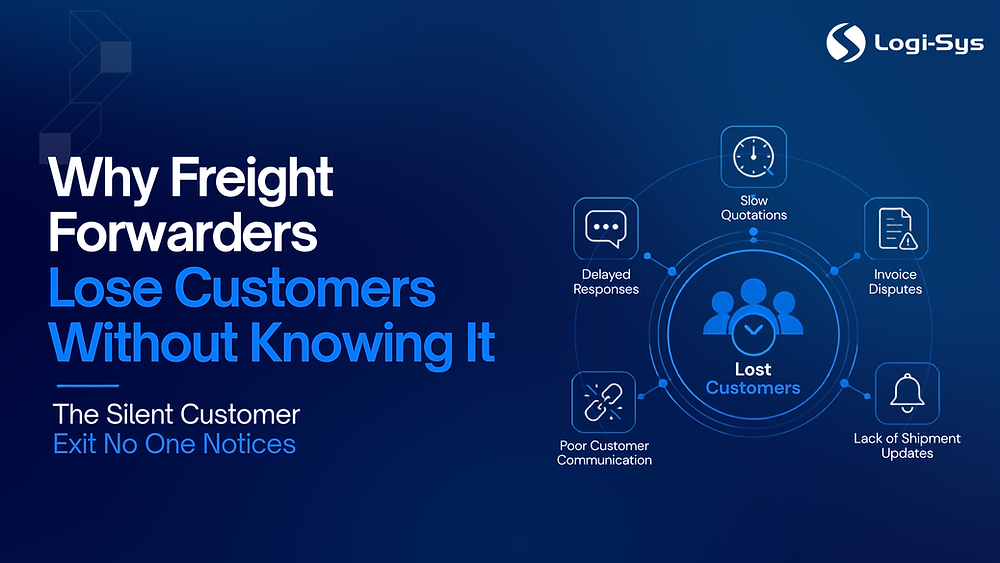

The Silent Customer Exit No One Notices
Most freight forwarders believe they lose customers because of price.
But in many cases, the real reason is far less obvious.
Customers rarely wake up one morning and decide to switch freight partners. Instead, they gradually lose confidence after repeatedly experiencing minor operational issues.
-
A quotation that takes too long. An email that goes unanswered.
-
An invoice that doesn’t match expectations.
-
A shipment update they have to chase.
-
A customer service experience that feels reactive instead of proactive.
None of these incidents may seem serious on their own. All combined, they create doubts, and often these doubts send customers to your competitor.
Most freight forwarders don’t even realize it’s happening.
1. Slow Quotations Signal Slow Operations
Today’s customers expect speed.
When a shipper requests a quote, they are often comparing multiple freight forwarders simultaneously. The company that responds first with an accurate, competitive quotation immediately gains an advantage.
But many forwarding companies still rely on disconnected emails, spreadsheets, and manual approvals.
-
Sales teams wait for rates.
-
Operations searches for information.
-
Managers approve pricing manually.
-
Customers wait.
By the time the quotation reaches the customer, someone else may have already won the shipment.
A slow quotation doesn’t just lose one booking.
It creates the impression that every future shipment will be handled the same way.
2. Delayed Responses Break Customer Confidence
Customers understand that logistics is unpredictable.
What they don’t accept is silence.
When an importer or exporter asks a simple question like:
-
Has the container departed?
-
Has customs cleared the shipment?
-
When will delivery happen?
They expect timely communication.
Unfortunately, many forwarding teams spend more time finding information than sharing it.
-
Operations checks multiple systems.
-
Customer service sends internal emails.
-
Sales follows up with operations.
-
Finance confirms billing.
-
Hours pass.
-
Sometimes days.
The customer begins wondering whether anyone is actually managing their shipment.
Even if everything is moving correctly, poor communication creates the feeling that nothing is under control.
3. Invoice Disputes Damage Trust Faster Than Delays
Nothing frustrates customers more than unexpected charges.
An invoice that differs from the original quotation immediately raises questions.
Why has the freight cost changed?
Where did these additional charges come from?
Why wasn’t this communicated earlier?
Whether the mistake comes from manual data entry, disconnected billing systems, or missing operational updates, the customer sees only one thing:
Resolving disputes consumes valuable time across finance, operations, and customer service.
More importantly, it weakens confidence.
Customers don’t simply want accurate invoices.
They want predictable billing.
4. Lack of Shipment Updates Creates Unnecessary Anxiety
Imagine ordering something valuable online and hearing nothing for two weeks.
You’d probably start asking questions.
Your customers feel exactly the same.
Many freight forwarders still depend on customers calling or emailing for shipment updates.
That approach no longer meets customer expectations.
Modern shippers expect visibility.
If they constantly need to follow up, they begin feeling that managing the shipment has become their responsibility instead of yours.
Visibility isn’t just a convenience anymore.
It’s part of the customer experience.
5. Poor Communication Makes Customers Feel Unimportant
Communication isn’t limited to replying to emails.
It’s about keeping customers informed before they ask.
Small communication gaps accumulate over time.
-
A missed callback.
-
An unanswered WhatsApp message.
-
No proactive notification about a delay.
-
No explanation for revised costs.
Eventually, customers stop believing they’ll receive timely information.
That’s when they quietly start requesting quotations from other freight forwarders.
Many businesses mistake customer silence for satisfaction.
In reality, silence often means they’re already evaluating alternatives.
The Invisible Cost of Customer Churn
Replacing a lost customer is far more expensive than retaining one.
It takes months of prospecting, meetings, proposals, and negotiations to acquire a new account.
Losing one because of avoidable operational inefficiencies is a cost most businesses never calculate.
Beyond lost revenue, customer churn also affects:
-
Referral opportunities
-
Long-term profitability
-
Brand reputation
-
Employee morale
-
Sales productivity
The most dangerous part is that these losses happen gradually, making them difficult to identify until revenue begins to decline.
Why Operational Visibility Matters
Customer experience doesn’t begin with customer service.
It begins with operations.
When sales, operations, finance, documentation, and customer communication work from different systems, delays become inevitable.
The customer experiences the symptoms, even if they never see the internal chaos causing them.
Forwarders that operate with a unified workflow can respond faster, provide accurate information, automate routine updates, and deliver consistent customer experiences.
Instead of reacting to problems, they prevent them.
Turning Customer Experience Into a Competitive Advantage
Price may win a shipment.
Experience wins long-term business.
Freight forwarders that consistently deliver fast quotations, proactive communication, accurate billing, and real-time visibility build something far more valuable than transactions.
They build trust. And trust is what keeps customers returning shipment after shipment.
In an industry where competitors often offer similar services and pricing, customer experience becomes one of the strongest differentiators.
The companies that invest in operational efficiency today won’t just reduce delays and disputes.
They’ll create customers who stay longer, recommend their services, and become long-term partners.
Because customers rarely leave after one mistake.
They leave after dozens of small frustrations that could have been prevented.
