Sierraline Cargo Services
  • HOME
  • Services
    • Trade With Us
  • About Us
  • Contact Us
  • private jet
    • BOOK YOUR JOURNEY
  • Track Packages
  • Insurance
  • safekeeping
Services

Last Mile Platform Automates Delivery Network

by
written by


NGR, one of the most influential gastronomic groups, has deployed LogiNext’s AI-powered delivery automation platform across all six of its national brands – Bembos, Popeyes, Papa John’s, Dunkin’, China Wok, and Don Belisario, marking a significant modernization of the company’s nationwide delivery infrastructure.

With more than 400 locations across 14 provinces, NGR’s scale demands consistency, speed, and reliability, and the move to a unified orchestration engine sets a new baseline for how the group manages last-mile fulfillment across Latin America.

Through a streamlined implementation, LogiNext has helped NGR bring uniformity to delivery operations that were previously managed store by store. The new, consolidated platform enables faster dispatching, end-to-end visibility, and standardized last-mile execution across all brands. It also marks a structural shift: from manual and reactive processes to an AI-led model capable of automated order assignment, intelligent routing, multi-brand consolidation, exception handling, and real-time communication with customers.

This transition has helped NGR scale its delivery operations with consistency while ensuring each brand retains its unique service identity.

“Delivery defines our brands, and LogiNext has helped us scale that promise across Latin America with consistency and precision. Live in minutes, configured in days, and adopted by 1,000+ teams within a month, its AI-led routing and assignments now give us a faster, more reliable nationwide delivery network,” said Nikitza Ivankovich, Director of Operations at NGR.

One of the most consequential outcomes of the rollout is NGR’s ability to operate a unified, multi-brand delivery network. A single driver can now reliably deliver across all six brands within a zone, improving fleet productivity and reducing cost per delivery. Automated batching and optimized route planning have trimmed unnecessary detours and reduced the number of single-order trips, lowering fuel consumption while directly increasing driver earning potential. The added structure, through clearer routing, predictable schedules, and organized workflows, has strengthened motivation and loyalty among delivery partners, creating a healthier, more efficient, and more dependable delivery ecosystem.

“The biggest shift is operational predictability. Drivers now deliver faster and more accurately across all six brands, with lower cost per delivery. Multi-brand consolidation, real-time exception management, and analytics have completely transformed how we plan and execute deliveries,” said Roberto Gonzales, Central Delivery Manager at NGR.

Today, NGR’s delivery network operates on a single AI-orchestrated backbone, allowing the organization to manage high-volume demand with far greater control and predictability. Automated decisioning replaces manual interventions, improving handoffs between stores, controllers, and fleet partners while tightening SLAs across zones. The resulting operational discipline, faster order flow, cleaner exception handling, and more efficient route utilization have contributed to measurable reductions in wasteful mileage, idle time, and overall delivery costs, while strengthening the consistency of service that customers experience nationwide.

“NGR is setting a benchmark for what modern QSR delivery should look like,” said Dhruvil Sanghvi, Founder & CEO of LogiNext. “Their ability to unify six brands under a single AI-powered platform shows how the right orchestration of technology can transform speed, accuracy, and customer experience at scale. At LogiNext, our focus continues to be building intelligent, automation-led systems that help enterprises make smarter decisions in real time and achieve measurable operational efficiency.”



Source link

0 comments
0 FacebookTwitterPinterestEmail
Services

High-capacity AGVs for ULD Transport

by
written by


China Eastern Air Logistics Co., Ltd. (CEAL) has partnered with Lödige Industries to deploy the latest generation of high-capacity automated guided vehicles (AGVs) for the flexible and fully automated transportation of unit load devices (ULDs). Six 10ft AGVs have now been fully implemented in CEAL’s cargo terminal 4 at Shanghai Pudong International Airport. With testing and commissioning successfully completed and the system officially handed over to CEAL, the terminal is set to operate as a true next-generation smart cargo facility.

Each AGV is capable of transporting loads of up to 6.8 tonnes, establishing new benchmarks in automation, safety, stability and reliability for air cargo handling. The AGV system is fully integrated with Lödige’s proprietary Cargo Management System (CMS), the Cargo Professional Suite, an advanced terminal management system that streamlines cargo flow planning, guidance, and tracking. Leveraging real-time data analytics, the system provides visualized insights via mobile devices, enabling precise and efficient cargo management.

“Lödige’s system far exceeded our expectations, completely transforming our operational model. It has made our logistics processes more efficient and adaptable, while fully preparing us for sustained future growth. What impressed us most is how the system seamlessly integrates with existing workflows, delivering a quantum leap in operational capabilities,” says Weddy Pan, Senior Deputy Manager, Operations Quality Management Division, Cargo Terminal Business Development, at China Eastern Air Logistics Co., Ltd.

“Our AGV system is a powerful enabler of efficiency and automation in air cargo terminals,” said Nicholas Tripptree, Managing Director of Asia-Pacific at Lödige Industries. “We’re proud to partner with CEAL to deploy this cutting-edge technology, helping them enhance efficiency, increase flexibility, and set new standards for cargo operations and overall terminal performance.”

The AGVs enhance operational flexibility by reducing reliance on manual transport, optimizing routing, reducing dependence on fixed infrastructure, and enabling scalable, dynamic cargo flows. The data driven intelligence ensures precise control, minimizes the risk of ULD damage, supports 24/7 operations, and allows staff to focus on higher value tasks. All six AGVs were manufactured in Germany and underwent rigorous testing to ensure consistent quality and performance. The AGV fleet harmonizes with China’s first lift-and-run system, also supplied by Lödige Industries, further boosting throughput and operational intelligence at the terminal.

The partnership between the CEAL and Lödige Industries continues to grow, with previous collaborations including an Elevating Transfer Vehicle (ETV) system refurbishment, and a Transfer Vehicle (TV) system, underscoring their shared commitment to innovation in air cargo logistics.


Source link

0 comments
0 FacebookTwitterPinterestEmail
Services

Temperature Compliance Secured via API

by
written by


Microlise, a provider of innovative solutions for the transport sector, has completed an OEM fleet API integration with GAH Transport Refrigeration. The new integration will ensure continuous temperature compliance for the Group’s customers in partnership with the industry supplier.

With this addition, the Group’s product suite will enable mutual customers to adhere to temperature compliance regulations, providing absolute confidence that temperature-sensitive goods will arrive at customer locations in perfect condition.

Should the temperature in any customer assets increase or decrease, transport managers will be alerted, allowing the issue to be rectified quickly and efficiently. A similar alarm network will alert transport managers to the impact of door openings on temperatures.

The integration allows customers to gather real-time data directly from GAH installed products back into the Microlise product, removing the need for specific installations or additional hardware such as temperature probes. It also reduces compliance costs by removing the need to take vehicles out of service to fit standardised solutions and configurations.

Microlise’s Product Director, Stephen Watson, said: “This integration marks the first step in a truly global transformation. No longer do engineers around the world need to install bespoke solutions tied to specific vehicle manufacturers. Instead, we can deliver seamless, manufacturer-agnostic integrations that enable temperature-controlled deliveries to begin immediately, wherever they are and whatever they drive.

“When goods like pharmaceuticals arrive compromised, they’re rendered unusable, which results in significant financial loss. Our solution eliminates that risk by continuously recording temperatures throughout the journey, providing verified compliance with critical standards such as the European EN12830 directive.”

Jon Hill, Applications Manager at GAH, added “This integration with Microlise represents a significant milestone in our mission to simplify temperature compliance for our customers. By delivering real-time refrigeration data seamlessly into the Microlise platform, we’re removing complexity and cost, while giving operators the visibility and confidence they need to protect temperature-sensitive loads every mile of the journey.”


Source link

0 comments
0 FacebookTwitterPinterestEmail
Services

Temperature Compliance Secured via API

by
written by


Microlise, a provider of innovative solutions for the transport sector, has completed an OEM fleet API integration with GAH Transport Refrigeration. The new integration will ensure continuous temperature compliance for the Group’s customers in partnership with the industry supplier.

With this addition, the Group’s product suite will enable mutual customers to adhere to temperature compliance regulations, providing absolute confidence that temperature-sensitive goods will arrive at customer locations in perfect condition.

Should the temperature in any customer assets increase or decrease, transport managers will be alerted, allowing the issue to be rectified quickly and efficiently. A similar alarm network will alert transport managers to the impact of door openings on temperatures.

The integration allows customers to gather real-time data directly from GAH installed products back into the Microlise product, removing the need for specific installations or additional hardware such as temperature probes. It also reduces compliance costs by removing the need to take vehicles out of service to fit standardised solutions and configurations.

Microlise’s Product Director, Stephen Watson, said: “This integration marks the first step in a truly global transformation. No longer do engineers around the world need to install bespoke solutions tied to specific vehicle manufacturers. Instead, we can deliver seamless, manufacturer-agnostic integrations that enable temperature-controlled deliveries to begin immediately, wherever they are and whatever they drive.

“When goods like pharmaceuticals arrive compromised, they’re rendered unusable, which results in significant financial loss. Our solution eliminates that risk by continuously recording temperatures throughout the journey, providing verified compliance with critical standards such as the European EN12830 directive.”

Jon Hill, Applications Manager at GAH, added “This integration with Microlise represents a significant milestone in our mission to simplify temperature compliance for our customers. By delivering real-time refrigeration data seamlessly into the Microlise platform, we’re removing complexity and cost, while giving operators the visibility and confidence they need to protect temperature-sensitive loads every mile of the journey.”


Source link

0 comments
0 FacebookTwitterPinterestEmail
Services

Fleet expansion supports men’s mental health charity

by
written by


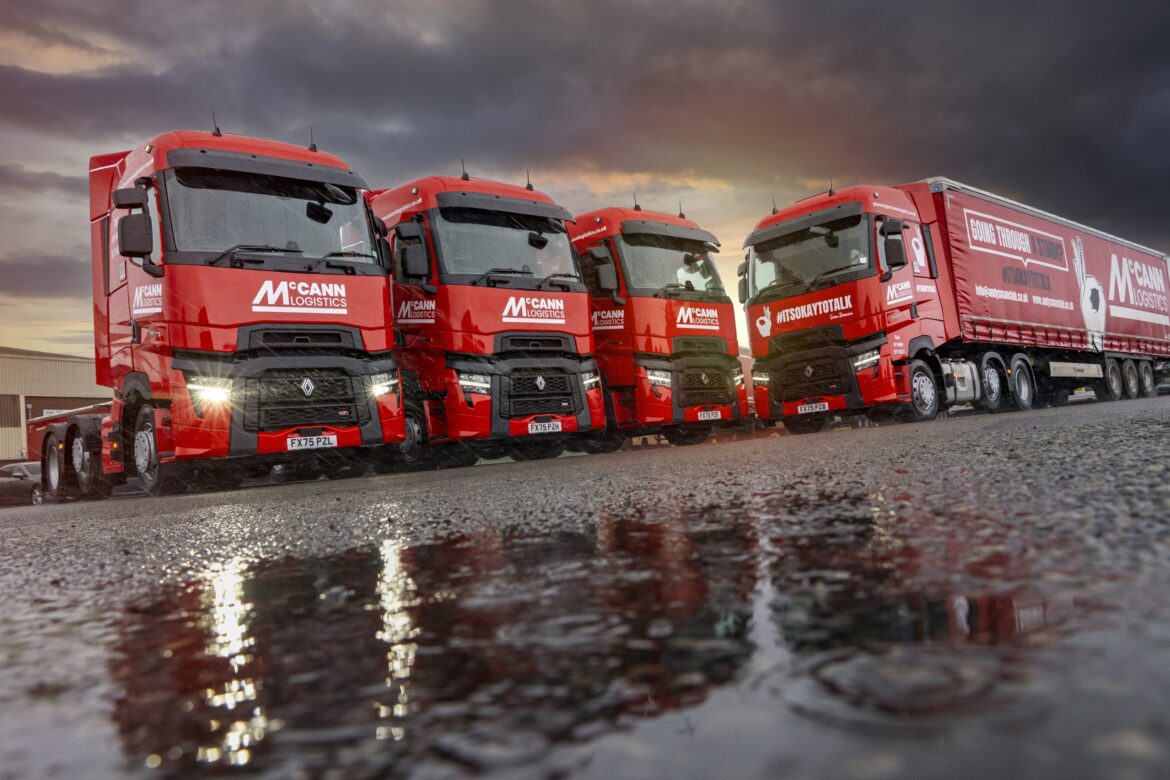
McCann Logistics has strengthened its UK fleet with 12 new Renault Trucks T High 480 6×2 TML Turbo Compound tractor units, marking the company’s first-ever move to the Renault Trucks brand. Two of the vehicles will feature ANDYSMANCLUB’s “It’s okay to talk” message, reinforcing McCann’s support for the men’s mental health charity.

The Immingham-based operator chose the T High after a competitive tender process, praising Renault Trucks and local dealer Thompson Commercials for their driver-focused approach, responsive service, and strong whole-life cost proposition. “From day one, Thompson Commercials listened,” said Mark Brighton, General Manager at McCann Logistics. “They delivered everything we asked for – from driver comfort to a maintenance programme we could trust.”

Powered by Renault Trucks’ DE13 Turbo Compound 480hp engine, the new trucks are designed for long-distance haulage and feature fuel-saving technologies such as Optivision map-based gear shifting and Smart Torque Control. The high-cab units have been customised with rear lockers, microwaves, and inverters for driver comfort, following trials and feedback from McCann’s drivers.

McCann, part of the Brickability Group, operates more than 180 trailers and a 12-vehicle UK truck fleet, serving construction and industrial customers nationwide. The new Renaults will each cover around 1,400 miles per week, supporting both group and third-party deliveries.

The partnership with ANDYSMANCLUB began at a local Armed Forces Day event. Two of the new trucks will carry the charity’s branding, including a personal tribute to a McCann driver’s late son, Sean Dawson. Brighton added: “Supporting AMC is incredibly important to us. If even one man decides to attend a support group because they saw one of our vehicles, then it’s worth everything.”

Sean Gill, Regional Lead at ANDYSMANCLUB, said: “Every journey they make takes our message into towns, villages, and workplaces we may never physically reach. McCann Logistics aren’t just supporting a charity; they’re helping carry hope, connection, and support to men who might be one moment away from needing it.”

Thompson Commercials will maintain the fleet and provide ongoing driver support. Keith Ottley, Sales Projects Manager, commented: “We are delighted McCann has chosen Renault Trucks and proud to support the vital work of ANDYSMANCLUB through this fleet.”


Source link

0 comments
0 FacebookTwitterPinterestEmail
Services

Report calls for radical UK supply chain reforms

by
written by


The UK government must adopt a bold, coherent supply chain strategy to address urgent economic and geopolitical vulnerabilities, according to a new briefing paper published by Ti Insight and the Foundation for Future Supply Chain.

The paper, titled Changing Course: a new direction for the UK in a ‘post-global’ world, warns that the UK’s reliance on globalised supply chains has left it exposed to shocks from pandemics, geopolitical tensions, and international transport disruptions. It calls for a policy of “Strategic Autonomy” that would not only strengthen the country’s resilience but also stimulate economic growth.

Professor John Manners-Bell, the report’s author, stresses that supply chains are no longer obscure business processes – they underpin modern life, influence public policy, and enable the delivery of essential services. He highlights that past government policies have created dependencies on “strategic adversaries,” particularly for critical products and materials sourced from countries such as China, and left the UK ill-prepared to respond to crises.

The paper sets out ten broad recommendations, including diversifying critical supply sources, forging trade deals with friendly nations, and strengthening protection of trade lanes through enhanced naval capabilities. It also calls for urgent re-industrialisation of the UK economy to boost domestic manufacturing and reduce dependence on foreign markets, alongside smarter investment in transport infrastructure and development of the circular economy to recycle critical materials. Other priorities include digital security, workforce training for an AI- and automation-driven future, reforming government policy-making to address fragmented approaches, and encouraging environmentally friendly domestic production through “green-shoring.”

Professor Manners-Bell warns that supply chains are increasingly “weaponised,” with countries using raw materials, energy, and manufacturing capabilities as political leverage.

Without shrewd and careful planning, there is a significant risk that the UK becomes a virtual client-state, accepting the role of rule-taker in a hostile world. Radical action by politicians is required if this outcome is to be avoided,

Professor Manners-Bell said.

The report concludes that growth and resilience are not mutually exclusive. By addressing vulnerabilities, the UK can create new economic opportunities while safeguarding its supply chains against future shocks.


Source link

0 comments
0 FacebookTwitterPinterestEmail
Services

Logistics in 2026: Technology Trials to Execution

by
written by


A Year Focused on Delivery, Not Experimentation

As the logistics sector moves into 2026, the emphasis is shifting decisively from experimentation to execution. After several years of pilot projects and reactive investment, operators are now focused on deploying technology in ways that deliver measurable, long-term operational value. Labour availability, customer service expectations and sustainability targets are all shaping priorities this year – with integration and scalability emerging as defining themes.

Automation Moves from Pilots to Core Operations

A key trend for 2026 is the move away from isolated automation projects towards connected, enterprise-level systems. Warehouses that once trialled individual robots or conveyor lines are now scaling these technologies across entire operations. Yusen Logistics’ Northampton distribution centre, where more than 165 Geek+ shelf-to-person robots are in operation, demonstrates how automation is becoming business-critical rather than experimental. A similar approach can be seen at THG Fulfil’s Warrington facility, where goods-to-person robotics are supporting growing e-commerce volumes while maintaining service levels and accuracy.

AI and Data Drive Faster, Smarter Decisions

Alongside physical automation, 2026 is shaping up to be a year in which AI-driven decision-making becomes standard practice. Traditional WMS platforms are no longer sufficient on their own. Logistics leaders are increasingly turning to AI and advanced analytics to predict bottlenecks, optimise resources and respond faster to disruption. Insights shared on our podcast by CargoON highlight how AI is being used to connect data across the supply chain – turning information into actionable intelligence rather than retrospective reporting. In parallel, Dexory’s warehouse intelligence platform is helping operators move from reactive problem-solving to real-time operational control.

Integrated Automation Architectures Take Shape

Another defining trend this year is the growing focus on fully integrated automation architectures. Rather than deploying technology in silos, logistics operators are combining robotics, AS/RS, conveyors and execution software into cohesive systems. Portwest’s automated storage and retrieval installation with Daifuku at its Barnsley distribution centre is a strong example, delivering significant capacity and throughput gains. In the healthcare sector, Phoenix Healthcare Distribution’s Pack2Patient solution from KNAPP shows how tailored automation can meet the demands of high-volume, highly regulated logistics environments.

Automation as Workforce Support, Not Replacement

Automation in 2026 is increasingly viewed as a way to support people, not replace them. Many projects featured on LogisticsBusiness.com show technology being used to reduce physical strain, improve safety and allow staff to focus on higher-value tasks. This human-centric approach is becoming a critical factor in tackling long-standing labour challenges across warehousing and fulfilment.

Sustainability Moves into Everyday Operations

Sustainability is also moving from ambition to action. With pressure mounting from customers and regulators, logistics companies are embedding sustainability into day-to-day operations. Energy-efficient warehouses, smarter use of existing space and optimised workflows are all playing a role. Discussions on our podcast with MiTek, in the episode Building the Future: The Role of Mezzanines in Automated Warehouse Design, underline how infrastructure decisions can support both automation and sustainability goals by maximising capacity within existing buildings rather than relying on new construction.

Outlook for 2026

Looking ahead, 2026 is likely to reward logistics organisations that prioritise integration over isolated technologies, data-driven decision-making over instinct, and long-term partnerships over short-term fixes. The examples already emerging across the sector suggest the year ahead will be less about adopting new tools – and more about deploying the right ones, in the right way, to build resilient, efficient and future-ready supply chains.


Source link

0 comments
0 FacebookTwitterPinterestEmail
Services

Pallet Shuttle System Adds Capacity

by
written by


Goya, a leading distributor of Latin American food products in Europe, has expanded its warehouse in Casarrubios del Monte, Toledo province, with Mecalux’s semi-automated Pallet Shuttle. The storage system has boosted the company’s logistics performance, ensuring fast replenishment to 4,000 points of sale throughout Spain.

“Mecalux’s semi-automated Pallet Shuttle gives us the flexibility we need to manage over 2,200 items and run a more efficient operation,” says a Goya representative.

Goya Foods

The project features five racking blocks measuring 8 m high, with a capacity of around 3,000 pallets containing Goya tinned goods, beans, sweets, beverages and snacks. Storage lanes with depths of up to 33 pallets maximise density and optimise available space. Inside the lanes, a motorised shuttle moves autonomously to accelerate inbound and outbound flows, cut handling times and minimise operational errors.

With this new infrastructure, the Goya Foods subsidiary has reinforced its growth strategy in the European market. The upgrade ensures quick, reliable service across the company’s retail network.

Goya Europa, a subsidiary of the multinational Goya Foods Inc., is the main distributor of Latin American food in Europe and the sales leader for these products in Spain. The company’s more than 500 SKUs range from beans, flours, seasoning and tinned goods to beverages and snacks. Goya Foods operates 26 production plants and multiple warehouses in Puerto Rico, the Dominican Republic, the US and Spain. It also supports cultural and sports initiatives that promote Latin American cuisine and healthy lifestyles, consolidating its position as a trusted source for these products in the European market.


Source link

0 comments
0 FacebookTwitterPinterestEmail
Services

plug-and-play warehousing and fulfilment – Logistics News

by
written by


Bleckmann, a supply chain management partner for fashion and lifestyle brands, has announced the expansion of its Bscale solution to the UK and the Netherlands. Bscale is Bleckmann’s modular, plug-and-play warehousing and fulfilment offering, designed to support brands of all sizes by streamlining access to enterprise-grade logistics services. This geographical expansion marks the next stage of Bscale’s growth journey, enabling more brands to benefit from this innovative solution.

Simplified access to expert logistics support

Brands using Bscale benefit from near-immediate access to end-to-end logistics support without the typical barriers to entry often faced by emerging fashion and lifestyle companies, such as for example high upfront costs. Instead, they can start shipping in a matter of weeks. A unique ‘pay-as-you-grow’ model ensures that brands are only charged for the services they use, limiting the initial investment burden.

During the initial pilot based at Bleckmann’s distribution centre in Belgium, Bscale grew from a single client to more than 20. Now, with the two new geographies added, brands looking to expand in the UK, the Netherlands and across Europe can get access to the logistics support they need quicker than ever. The entire process is designed to be as intuitive as possible, with quotes requested online, and all service information accessed through a centralised digital portal.

“Bscale is unique in that it’s designed from the point of view of fashion founders,” explains Maxim Sion, Business Development Manager at Bleckmann and fashion entrepreneur. “We’ve looked closely at how we can best unburden start-up and scale-up brands that might otherwise be managing their logistics themselves or working with a generalist provider. By offering access to the same Bleckmann expertise, infrastructure and technology enjoyed by brands like Karl Lagerfeld, COS and Gymshark, we’re helping companies to stay focused on building their brands while we take care of the logistics.”

Advanced automation drives major efficiency improvements

One of the key advantages of Bscale is access to over 160 years of fashion logistics expertise of Bleckmann, combined with high end logistics processes and automation. Brands like luxury handbag maker Sepi Agari and high-end menswear label Wolk Antwerp are seeing consistent reductions in fulfilment times thanks to the highly efficient and scalable solution. Increased speed does not mean compromising on customer experience in other areas. Additionally, Bscale clients have access to Bleckmann’s portfolio of value-added services. This ensures pristine presentation even as brands’ reach expands.

Scaling up an award-winning logistics solution

With demand for its plug-and-play logistics offering continuing to grow, Bleckmann is excited to support the go-live for its first clients in the UK and the Netherlands. This expanded footprint is also designed to support brands looking to test new markets without the usual associated costs and risks. For example, a brand currently operating from Belgium or the Netherlands, can now move a portion of its inventory to Bleckmann’s new UK Bscale hub in Swindon. This additional capacity will also be operated on a ‘pay-as-you-grow’ basis, allowing the brand to scale in line with demand.

Allowing both more efficient fulfilment and streamlined international growth, Bscale has been recognised within the year of its launch as a leading solution in the industry. At the recent 2025 SupplyTech Breakthrough Awards, it won the ‘3PL Solution of the Year’ category, cementing its position as a tech-enabled logistics toolkit for growing brands. “Bscale was designed as a modular solution, allowing brands to take the next steps on their growth journey in line with their expansion,” adds Sion. “Now, we are applying that same modular approach to the offering itself, and we look forward to supporting even more brands across more geographies to meet their growth ambitions.”


Source link

0 comments
0 FacebookTwitterPinterestEmail
Services

Four Trends Reshaping Returns – Logistics News

by
written by


The growing importance of marketplaces, sustainability and recommerce will drive four key trends in customer returns in 2026, according to new data from logistics and returns experts.

Advanced Supply Chain and ReBound by Reconomy surveyed 900 retail supply chain decision makers* to find out what will influence customer returns processing and management next year. The research identified four trends:

1) Making returns customer centric. Supply chain professionals (22%) ranked improvements in customer service as their top returns priority for 2026. Goals include making returns faster (19%), reducing the costs of returns for shoppers (17%) and shortening lead times for customer refunds (16%).

2) Streamlining salvaging. Retailers and brands want to increase the salvage rates (19%) of goods being sent back. A third of businesses (33%) plan to outsource returns processing to help optimise repair and restoration process in 2026, as they aim to boost sustainability and compliance, and develop recommerce models. 18% referenced Extended Producer Responsibility (EPR) schemes as a key driver for optimising returns processing and strengthening salvage rates, while 27% are prioritising recommerce as part of their 2026 returns strategies. 32% are focusing on improving the rerouting of ‘beyond-repair’ returns to recycling.

3) Localising returns. The growing success of marketplace retail models is making international growth accessible and affordable for a wide range of brands. Attention is now switching to localising returns management to manage costs and reduce supply chain mileage. 35% of supply chain professionals have made local returns consolidation a top-ranking priority for next year. 18% are actively focusing on improving the returns management of goods sent back via marketplaces, with 16% keen to enhance the visibility of customer returns.

4) Monetising returns. 2026 will see the continued trend of retailers and brands prioritising the productivity and profitability of returns processing and management. 18% are adapting strategies to generate more revenue from returns, with emphasis on duty drawback from cross-border returns (20%), decreasing back-to-stock time (16%) and reducing losses caused by returns fraud (14%).

Alexandra Romantseva (pictured, above), Head of Marketing at ReBound and Advanced Supply Chain, said: “Growing consumer preferences for marketplaces, recommerce and sustainability can increase the complexities of goods being sent back by shoppers. There’s a risk of reverse logistics processes becoming longer and more fragmented, and this occurring at a time when legislation and consumers increasingly require supply chains to be more resourceful. Businesses are embracing this as an opportunity to rethink returns strategies.

“Emphasis is being placed on treating returns as a strategic driver for supporting sales, customer satisfaction, sustainable practices and cost management. Sophisticated tech is enabling this and it’s why, for example, we see around a third of professionals (31%) prioritising portals for e-commerce returns, and technical capabilities ranking highly during the outsourcing of returns.”

Stuart Greenfield (below), UK and European Sales Director at Advanced Supply Chain, added: “Forward-thinking businesses view returns as a supply chain hot spot for advancing circularity. Clearly defined salvage rates and robust quality inspections, backed up by returns management software and systems that enable connectivity and enrich supply chain data, can minimise waste and errors. This is why there’s such a strong focus on salvaging and localising returns – trends that are likely to grow alongside the popularity of marketplaces and recommerce.”

*About the research: Censuswide carried out online surveys of 901 senior supply chain decisions makers working throughout the e-commerce sectors in the UK, USA, Italy, France, Germany and Spain. Research was completed in October 2025.


Source link

0 comments
0 FacebookTwitterPinterestEmail
Newer Posts
Older Posts

Recent Posts

  • Driving Efficiency and Innovation in Conveying
  • Milano Linate l’aeroporto ideale per i jet privati
  • Software Migration for Automated Warehouse
  • Yard Management for Smaller Logistics Facilities
  • Order Picking with Intelligent Robotics

Recent Comments

No comments to show.

Social Connect

Whatsapp

Recent Posts

  • Driving Efficiency and Innovation in Conveying

  • Milano Linate l’aeroporto ideale per i jet privati

  • Software Migration for Automated Warehouse

  • Yard Management for Smaller Logistics Facilities

  • Order Picking with Intelligent Robotics

Newsletter

Categories

  • Services (1,086)
  • Uncategorized (41)

@2024 - All Right Reserved. Designed and Developed by Sierraline Cargo services

Manage Consent
To provide the best experiences, we use technologies like cookies to store and/or access device information. Consenting to these technologies will allow us to process data such as browsing behavior or unique IDs on this site. Not consenting or withdrawing consent, may adversely affect certain features and functions.
Functional Always active
The technical storage or access is strictly necessary for the legitimate purpose of enabling the use of a specific service explicitly requested by the subscriber or user, or for the sole purpose of carrying out the transmission of a communication over an electronic communications network.
Preferences
The technical storage or access is necessary for the legitimate purpose of storing preferences that are not requested by the subscriber or user.
Statistics
The technical storage or access that is used exclusively for statistical purposes. The technical storage or access that is used exclusively for anonymous statistical purposes. Without a subpoena, voluntary compliance on the part of your Internet Service Provider, or additional records from a third party, information stored or retrieved for this purpose alone cannot usually be used to identify you.
Marketing
The technical storage or access is required to create user profiles to send advertising, or to track the user on a website or across several websites for similar marketing purposes.
  • Manage options
  • Manage services
  • Manage {vendor_count} vendors
  • Read more about these purposes
View preferences
  • {title}
  • {title}
  • {title}
Sierraline Cargo Services
  • HOME
  • Services
    • Trade With Us
  • About Us
  • Contact Us
  • private jet
    • BOOK YOUR JOURNEY
  • Track Packages
  • Insurance
  • safekeeping

WhatsApp us